

TL;DR:
- Maintaining a solar energy system in the Pacific Northwest requires regular checks for moss, debris, and shading due to unique climate challenges. Consistent monitoring and professional inspections help protect warranties, ensure safety, and optimize performance over the system’s lifespan. Combining homeowner routine maintenance with professional service is essential for long-term system reliability and efficiency.
Maintaining a solar energy system in Washington or Oregon is not the same as caring for one in Arizona or California. The Pacific Northwest throws unique challenges at your panels: extended rainy seasons, significant tree coverage, moss-friendly moisture, occasional heavy snowfall, and weeks of low-angle winter sun. These conditions can quietly erode your system’s performance if you’re not watching closely. This checklist gives you a structured, regionally adapted approach to protecting your investment, maintaining your warranty, and keeping your system producing at its best year after year.
Table of Contents
- Understanding the importance of solar maintenance
- Monthly solar maintenance checklist: homeowner’s routine
- When to call in a professional: critical cases and troubleshooting
- Organizing your O&M plan and key records
- What most solar owners in the Northwest overlook
- Need expert solar service or a custom maintenance plan?
- Frequently asked questions
Key Takeaways
| Point | Details |
|---|---|
| Monthly checks matter | Regular inspections and system data reviews help spot problems early and keep your solar panels productive. |
| Know when to call pros | Leave electrical and persistent system errors to certified professionals to protect your warranty and safety. |
| Good records simplify service | Organizing system documentation and maintenance logs speeds repairs and saves future headaches. |
| Cleaning isn’t optional | Rain alone won’t clear away moss or debris, especially in the Northwest—occasional cleaning is required. |
Understanding the importance of solar maintenance
To understand where to begin, let’s first clarify why ongoing attention is so important to your system’s long-term value.
A solar energy system is a long-term asset. Most residential installations are designed to last 25 to 30 years, but that lifespan depends heavily on how well the system is maintained. It’s not a “set it and forget it” piece of equipment. Panels accumulate soiling, inverters develop errors, and connections can degrade over time.
Regular monitoring and inspections ensure optimal production, reduce system downtime, and catch issues before they become costly repairs. That’s not a minor benefit. A degraded or malfunctioning system may still produce some power, making it easy to overlook problems until a significant loss has already occurred.
Here are the most important reasons consistent maintenance matters for Northwest homeowners:
- Warranty protection: Many panel and inverter manufacturers require documented maintenance records to honor warranty claims. A single missed inspection can complicate your coverage.
- Safety: Electrical faults, wiring corrosion, and inverter failures can pose real safety risks if left undetected.
- Performance preservation: Even a small layer of organic growth or debris can reduce panel output by 5 to 25 percent depending on severity.
- Early detection: Catching a failing component early costs far less than replacing a system that has been quietly underperforming for months.
Northwest-specific threats make maintenance even more pressing. Moss thrives in damp, shaded conditions, which describes many rooftops in Western Washington and the Willamette Valley. Pollen from conifers and alders coats panels in spring. Debris from nearby trees builds up after windstorms, and branches can shift in a way that creates new shading problems.
“The biggest mistake Northwest solar owners make is assuming the rain handles everything. Moss, lichen, and pollen don’t wash away cleanly, and even partial soiling affects output in ways that aren’t immediately obvious.”
For most homeowners, good maintenance is a combination of your own regular checks and periodic professional service visits. Knowing solar best practices for your region gives you a baseline to measure against and act on with confidence.
Pro Tip: Even if your system looks fine from the ground, production data is your most reliable early warning tool. A drop of 10 percent or more compared to the same period last year warrants a closer look.
Monthly solar maintenance checklist: homeowner’s routine
With the big picture in mind, let’s focus on what you should do every month to keep your system on track.
Monthly monitoring and visual checks from the ground are genuinely practical for homeowners in Washington and Oregon. You don’t need to climb on your roof every month. What you do need is a consistent routine that takes 15 to 30 minutes and covers the most important indicators of system health.
Follow these steps each month:
Review your production data. Log into your monitoring app or inverter portal and compare this month’s production to the same month last year. If you notice a drop of more than 10 to 15 percent and the weather patterns are comparable, investigate further. Understanding how solar monitoring works will help you read these numbers accurately.
Compare against seasonal expectations. Northwest production varies significantly by season. January in Seattle averages far fewer sun hours than July. Use your monitoring history to build a sense of what’s normal for each month so you can spot true anomalies.
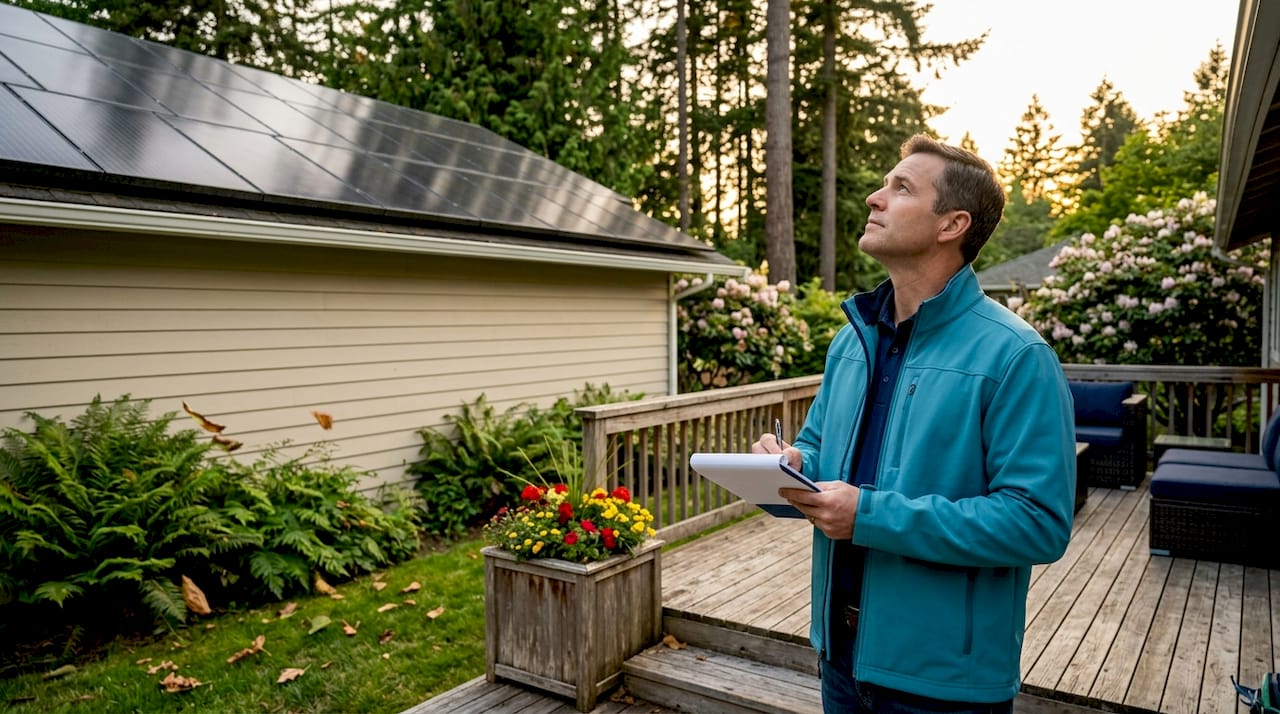
Perform a ground-level visual inspection. From a safe vantage point on the ground or from an upper-floor window, look at your panels. Note any visible soiling, moss patches, leaves, bird droppings, or debris buildup. Look for shading caused by tree branches that may have grown since installation.
Check your inverter for warning lights or error codes. Most modern inverters display a green light when operating normally. Any amber or red indicator, or an error code on the display, should be noted immediately. Your monitoring app may also push error alerts.
Review app notifications. Many monitoring systems send alerts for communication failures, production drops, or component errors. Check your app’s notification log, not just the dashboard summary. Checking system production data through the app gives you a more detailed view than the top-line numbers.
Inspect for physical obstructions. After windstorms or heavy rain, walk the perimeter of your home and look for branches, debris, or anything that might have landed on or near the panels. In winter, note any snow accumulation and whether it’s blocking the full array.
Record what you observe. Keep a simple log, even just a note in your phone or a spreadsheet. Date, observations, any app alerts, and what action you took. This log becomes invaluable if you ever need to make a warranty claim or troubleshoot a recurring issue.
Pro Tip: Set a recurring calendar reminder on the first weekend of every month so this check becomes a habit rather than something you do only when you notice a problem.
When to call in a professional: critical cases and troubleshooting
Even with diligent routine care, some problems call for expert tools and know-how. Here’s how to spot those situations.
Not every issue is something you can or should address on your own. Some situations require a licensed solar technician with proper diagnostic equipment, electrical training, and safety gear. Knowing when to make that call protects both your safety and your investment.
Homeowners should seek professional help for electrical inspections when inverters trip repeatedly or persistent system errors appear. Simply resetting the system without identifying the root cause risks further damage and can void coverage under certain warranty terms.
Here’s a breakdown of common issues and the right response:
| Issue | Homeowner action | Professional needed? |
|---|---|---|
| Minor soiling or dust on panels | Ground-level monitoring; schedule cleaning | No, for accessible single-story arrays |
| Moss or lichen growth on panels | Document and schedule professional cleaning | Yes, for steep or high rooflines |
| Inverter shows single brief error | Note the code, monitor for recurrence | If it repeats within 48 hours |
| Inverter trips repeatedly | Do not reset repeatedly; note all codes | Yes, immediately |
| Unexplained production drop over 15% | Review monitoring data; check for shading | Yes, if not explained by weather or soiling |
| Physical damage to panels or racking | Do not touch wiring; document with photos | Yes, without exception |
| Rodent or pest activity near wiring | Note and report | Yes, electrical inspection required |
| Branch or debris on array | Remove only if safely reachable from ground | Call a pro for anything requiring roof access |
When in doubt, consult the solar troubleshooting guide for step-by-step guidance on what each inverter error code means and how to respond. And if you live in a storm-prone area of Washington or Oregon, it’s worth knowing how to prepare for winter storms before the season arrives.
Key situations that always require professional intervention:
- Any electrical fault or unusual heat near your inverter, disconnect, or conduit runs
- Cracked or discolored panel glass, which can be a fire hazard and must be inspected before the system operates again
- Roof-level cleaning on steep pitches, multi-story homes, or arrays near skylights or vents
- Wiring repairs or connector replacements of any kind
Using a certified technician for these tasks also preserves your manufacturer warranties, which often include explicit language about who is permitted to perform repairs.
Organizing your O&M plan and key records
To complete your checklist, organization is everything. Let’s make your records and plans as reliable as your panels.
A solar system generates data constantly, but that data is only useful if you can access and understand it. Many homeowners discover, only when something goes wrong, that they’ve lost track of their monitoring login, can’t locate their installer’s contact information, or have no idea where their warranty documents are stored. That situation slows down troubleshooting and can delay repairs by days or even weeks.
Maintenance planning should include a clear operations and maintenance budget along with organized records of passwords, monitoring platform details, and system specifications.
Here’s what your O&M records folder, digital and physical, should contain:
- System documentation: Installation permits, inspection sign-offs, system design diagrams, and panel/inverter model numbers
- Warranty documents: Panel product warranty, performance warranty, inverter warranty, and workmanship warranty from your installer
- Monitoring access: Platform name, login URL, username, and password stored in a secure password manager or a sealed physical envelope
- Installer contact information: Company name, lead technician, phone number, and email address for both routine service and emergency calls
- Utility interconnection agreement: The document from your utility confirming your system is approved for net metering
- Maintenance log: A running record of every cleaning, inspection, error event, reset, and repair with dates and outcomes
- Financial records: Incentive application confirmations, tax credit documentation, and utility rebate correspondence
For solar monitoring setup details specifically, write down which communication method your system uses, whether that’s Wi-Fi, cellular, or a dedicated gateway device. If your router changes or your internet service is interrupted, you’ll need those specifics to reconnect the monitoring system quickly. Good production monitoring tips also recommend downloading quarterly production reports as backups in case your monitoring platform changes providers or discontinues a feature.
Budget-wise, plan for one to two professional cleanings per year depending on your roof’s tree exposure, plus one full inspection every two to three years. Systems with battery backup components may need more frequent professional reviews due to the additional complexity of the storage system.
Pro Tip: Keep a physical copy of your monitoring login and installer contact in a clearly labeled folder with your other home documents. Digital access is convenient, but a paper backup has saved many homeowners hours of frustration during outages or device failures.
What most solar owners in the Northwest overlook
Having explored all the structured steps, it’s time to share some hard-earned lessons from years of working with solar systems in our unique climate.
The single most persistent misconception we encounter is that Northwest rain keeps panels clean enough. It simply isn’t true for most properties. Rain does remove loose dust, but moss spores land and establish roots quickly in our damp, partly shaded environment. Pollen from Douglas fir, alder, and cedar creates a sticky film that water alone won’t remove. Organic buildup of this kind can reduce output steadily over months without triggering an obvious alert in your monitoring data.
The second issue is over-reliance on app dashboards. Monitoring platforms are genuinely useful, but they report what the system tells them. A panel with a degraded cell or a micro-crack may still produce enough power to appear “normal” in aggregate data while losing 8 to 12 percent of its potential output. A visual inspection from a professional, combined with thermal imaging in some cases, catches what the app cannot.
The third and perhaps most underestimated risk is information mismanagement. We regularly work with homeowners who cannot access their monitoring portal because the login was tied to an old email account, or who don’t know their installer’s current phone number because the company has changed its name or been acquired. When a repair is urgent, these gaps cost real time and money.
Finally, there’s the question of DIY confidence. A ground-level check is absolutely appropriate for homeowners. But some owners go further than they should, attempting to clean steep arrays themselves, resetting inverters multiple times without recording the error codes, or bypassing disconnect switches to check wiring. These actions create safety hazards and can complicate diagnostics later. Following expert maintenance insights from certified professionals gives you clear boundaries and keeps your system in safe hands when the situation calls for it.
Smart Northwest solar owners combine their own monthly checks with scheduled professional evaluations. That combination catches problems early, keeps warranties intact, and gives you real confidence in your system’s performance year over year.
Need expert solar service or a custom maintenance plan?
If you want peace of mind and expert guidance, here’s how to take the next step.
If your system is due for a checkup, showing unfamiliar error codes, or you simply want a certified technician to verify everything is performing as it should, A&R Solar is ready to help. We bring two decades of regional experience and a team of certified technicians who understand the specific demands of Washington and Oregon climates.
Whether you’re in Western Washington or across the Willamette Valley, our solar service in Washington and professional solar repair in Oregon teams are equipped to handle everything from routine inspections to complex troubleshooting and component repairs. Our real-life project case studies show the range of systems we’ve serviced and the outcomes we’ve delivered for homeowners just like you. Reach out today to schedule your system evaluation or build a custom maintenance plan that fits your home and budget.
Frequently asked questions
How often should I clean my solar panels in the Pacific Northwest?
Most homeowners should plan for one to two cleanings per year, with extra attention after spring pollen season or major storms. Regular soiling checks are essential in areas with debris or organic growth, and the Northwest qualifies on both counts.
Can rain keep my solar panels clean enough?
Rain helps with loose surface dust, but it won’t remove moss, pollen, or tree sap effectively. Moss and debris can persist despite regular precipitation in the Northwest, making manual cleaning necessary to maintain optimal output.
What’s the first step if my solar inverter shows an error?
Write down the exact error code and the date it appeared, then monitor to see if it repeats. Resetting may not address root issues, and scheduling a professional electrical inspection is the recommended response for any persistent or recurring inverter fault.
Why should I keep records of my solar system’s maintenance?
Organized records speed up troubleshooting, strengthen warranty claims, and prevent the common problem of lost monitoring access. Documenting maintenance actions and storing system information is a core part of any effective long-term operations plan.