

TL;DR:
Homeowners often assume solar panels require little attention, but active monitoring reveals potential failures and output issues. It is essential for maximizing system efficiency, protecting financial returns, and qualifying for incentives in Northwest regions with challenging weather. Advanced monitoring tools with real-time alerts and AI diagnostics help ensure long-term performance and investment security.
Most homeowners who go solar expect their panels to quietly do their job year after year without much attention. That assumption can cost you real money. Solar panels do generate power on their own, but without active monitoring, you may never know when a single panel fails, when debris cuts your output by 15%, or when a billing error shortchanges your net metering credits. For homeowners in Washington and Oregon, where incentives, net metering, and Northwest weather all play a role, knowing how to track your system’s performance is just as important as the installation itself.
Table of Contents
- What is solar system monitoring and why does it matter?
- Key features and tools in modern solar system monitoring
- How solar monitoring impacts financial returns and incentives
- Maintenance and troubleshooting: What to do if your system underperforms
- Our take: Most solar owners underestimate the value of active monitoring
- Connect with experts to protect your solar investment
- Frequently asked questions
Key Takeaways
| Point | Details |
|---|---|
| Ongoing monitoring pays off | Staying engaged with your solar system’s monitoring app ensures long-term performance and savings. |
| Incentives require tracking | Net metering and incentive programs rely on accurate, up-to-date monitoring data to maximize your benefits. |
| Maintenance keeps returns high | Combining regular monitoring with prompt maintenance preserves your system’s value and reliability. |
| Advanced features add value | AI-powered analytics can identify subtle issues for homeowners seeking maximum system optimization. |
What is solar system monitoring and why does it matter?
Solar system monitoring is the real-time tracking and analysis of your system’s energy production and overall health. It means continuously recording how much electricity your panels generate, how your inverter is performing, whether any components are signaling faults, and how your output compares to expected levels based on weather and season.
Understanding how solar monitoring works is the foundation for protecting your investment. A properly monitored system gives you the data you need to catch problems before they shrink your savings. Without it, a failed microinverter or a shading issue could quietly drag down your production for months.
Here is why monitoring matters in practical terms:
- Maximize uptime: Faults caught early are fixed before they compound, keeping your system producing at full capacity.
- Protect your financial payback: Every kilowatt-hour your system fails to produce is money that goes back to the utility instead of staying in your pocket.
- Qualify for net metering credits: Oregon and Washington utilities require accurate production data to process credits for surplus energy you send to the grid.
- Meet incentive program requirements: Some state and utility incentive programs require performance documentation as part of participation.
- Track system aging: Panels degrade over time, but monitoring lets you identify abnormal drops early.
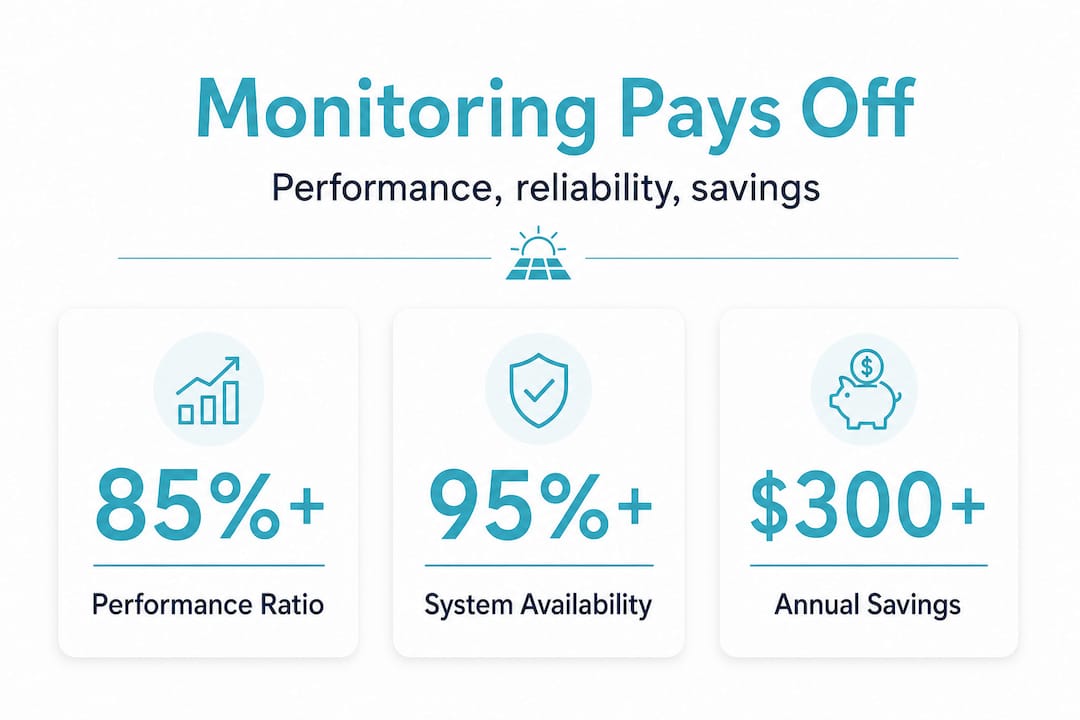
Weather and extreme events accelerate system aging across the U.S. photovoltaic fleet. NREL data confirms that regular operation and maintenance keeps performance ratios above 85% and system availability above 95%. Skipping that maintenance in a region with heavy rain, snow, and wind like the Pacific Northwest puts your system’s long-term output at real risk.
The Northwest climate makes monitoring especially relevant. Washington and Oregon both experience extended cloudy seasons, wind events, and occasional snowfall that affect output. Active monitoring lets you distinguish between expected weather-related dips and actual system problems, so you are not guessing when something is wrong.
Key features and tools in modern solar system monitoring
Not all monitoring systems are built the same. Basic systems report overall production totals through a simple app. Advanced platforms offer panel-level diagnostics, fault alerts, historical trend analysis, and integration with your utility’s billing system. Knowing what to look for helps you choose the right setup.
When evaluating a monitoring platform, you should expect to see these core features:
- Real-time energy output: How many kilowatt-hours your system is producing right now and over the past hours, days, or months.
- Panel-level or string-level status: Which panels or groups of panels are underperforming or offline.
- Fault and alert notifications: Automatic messages sent to your phone or email when the system detects a problem.
- Weather-adjusted performance data: Comparisons of actual output versus expected output given current conditions.
- Export and net metering tracking: How much energy you are sending back to the grid and how that translates into credits on your bill.
Checking your system’s production regularly through your monitoring app keeps you informed without requiring technical expertise. Most platforms are designed for homeowners, not engineers.
Pro Tip: Choose a monitoring system that integrates directly with utility reporting for Washington and Oregon net metering. This makes it far easier to verify your credits, dispute billing discrepancies, and document production for incentive program compliance.
The most significant advancement in recent years is AI-based diagnostics. AI inspection data is increasingly used for predictive maintenance, catching subtle degradation patterns that standard alerts might miss. NREL continues to emphasize data quality as central to reliable PV performance assessment. AI-driven tools can identify a panel that is losing efficiency gradually, weeks before a standard threshold alert would fire.
Here is a comparison of what basic and advanced monitoring platforms typically offer:
| Feature | Basic monitoring | Advanced monitoring |
|---|---|---|
| Total system output | Yes | Yes |
| Panel-level diagnostics | No | Yes |
| Fault alerts | Limited | Real-time, customizable |
| AI-based predictive analysis | No | Yes |
| Utility/net metering integration | Sometimes | Yes |
| Historical performance trends | Basic | Detailed |
| Mobile app access | Yes | Yes, with richer data |
For most residential systems in the Northwest, a mid-range platform with panel-level visibility and utility integration gives you the best balance of usability and protection. Basic systems are fine for simple setups, but if your home has shading variables, a more complex roof layout, or a battery backup component, advanced monitoring is worth the additional investment.

How solar monitoring impacts financial returns and incentives
Here is where monitoring moves from technical convenience to direct financial impact. Your solar system is an investment with a payback period, typically between seven and twelve years for most Northwest homeowners. Active monitoring protects that payback by ensuring you capture every dollar of production and every credit you are owed.
Oregon’s residential solar incentives, including programs through the Energy Trust of Oregon, require documentation of system production to qualify and maintain eligibility. Confirming that your installer is approved for WA or OR incentives is the first step, but you also need your monitoring system to generate the records that prove compliance over time.
Residential solar incentives through the Energy Trust of Oregon cover solar and storage systems, and net metering credits apply to excess production sent to the grid. Both programs depend on accurate, documented production data, which only active monitoring can reliably provide.
Let’s look at what undetected underperformance actually costs:
| Scenario | Monthly production loss | Annual lost credit value (estimated) |
|---|---|---|
| One failed microinverter (undetected 3 months) | 45 to 60 kWh/month | $60 to $90 |
| 20% shading from tree growth | 80 to 120 kWh/month | $130 to $200 |
| Inverter running at 80% efficiency | 100 to 150 kWh/month | $160 to $240 |
| System offline 10 days (undetected) | 100 to 200 kWh total | $16 to $32 per event |
These numbers add up. A homeowner who does not monitor closely might lose $300 to $500 or more in annual savings without realizing it, particularly when failures go undetected for several months.
Here is how monitoring connects directly to financial outcomes, step by step:
- Continuous production tracking confirms you are generating expected output daily.
- Net metering data integration verifies that every kilowatt-hour exported to the grid is being credited by your utility.
- Alert-triggered responses mean issues are caught and resolved quickly, minimizing production loss.
- Incentive program documentation gives you a ready-made record for Oregon and Washington rebate programs.
- Performance ratio reporting keeps you above the 85% threshold that NREL identifies as the marker for a well-maintained system.
Key stat: Systems that maintain a performance ratio above 85% through regular monitoring and maintenance consistently outperform neglected systems by 10% to 20% over a 20-year lifespan. That difference in total output translates directly into thousands of dollars in savings and incentive earnings.
Maintenance and troubleshooting: What to do if your system underperforms
Understanding your monitoring data is only as valuable as your ability to act on it. So what should you do when the numbers change?
The first step is knowing what underperformance actually looks like in your monitoring dashboard. Common warning signs include:
- Output that drops more than 15 to 20% compared to the same period last month or last year.
- A panel showing zero production while its neighbors are functioning normally.
- Inverter fault codes appearing in your app.
- Net metering credits on your utility bill that are lower than your monitoring data would predict.
When you see one of these signals, follow these troubleshooting steps before calling in a professional:
- Check your inverter’s status light. Green means normal, yellow or red usually indicates a fault code that your monitoring app can explain.
- Inspect your panels visually from the ground. Look for debris, bird droppings, snow accumulation, or shading from trees that may have grown since installation.
- Review recent weather. An extended cloudy period is normal. A sunny stretch with low output is not.
- Check your circuit breaker panel. Occasionally a breaker trip will interrupt the system.
- Compare your output against your monitoring app’s historical baseline. A clear, consistent drop over multiple sunny days points to a hardware issue.
If the drop persists for more than one full day of good weather after you have ruled out the obvious causes, contact your solar service provider. Following solar maintenance best practices regularly also reduces the frequency of these events in the first place.
Regular O&M keeps performance ratios above 85% and system availability above 95%, according to NREL research. In the Pacific Northwest, where moss, leaf accumulation, and seasonal weather affect panels more than in drier climates, scheduled maintenance is not optional. It is how you protect the return on a $15,000 to $30,000 investment.
Pro Tip: Keep a simple log of any monitoring alerts, unusual readings, and actions you took in response. This documentation is invaluable when filing warranty claims, applying for incentive payments, or disputing billing discrepancies with your utility. A short note with a date takes two minutes and can save significant time later.
Our take: Most solar owners underestimate the value of active monitoring
Conventional wisdom in the solar industry leans toward a simple message: install the system and let it work. That message is not wrong, but it is incomplete. And in Washington and Oregon, where incentive windows close, net metering policies evolve, and Northwest weather accelerates wear, incomplete information is expensive.
We have worked with homeowners across the region who discovered, months after the fact, that a single equipment failure had quietly eroded thousands of dollars in expected savings. The system was still producing electricity. It just was not producing as much as it should have been, and no one noticed because no one was checking.
The homeowners who get the best long-term results from solar treat their monitoring app the way they treat their bank account: they check it regularly, they notice when something looks off, and they act on it quickly. That habit does not require technical expertise. It just requires attention.
There is also a financial incentive most guides skip. Oregon and Washington incentive programs do not automatically maximize your benefit. They respond to documented performance data. Homeowners who actively monitor are better positioned to capture every credit, file accurate claims, and maintain program eligibility. Those who do not may leave real money on the table simply because they could not prove their system’s output when it mattered.
If you are thinking about why investing in solar energy makes long-term sense, monitoring is a central part of that argument. The investment pays off most reliably when it is actively managed, not passively assumed to be working.
Connect with experts to protect your solar investment
Your solar system is one of the largest investments you will make in your home. Active monitoring is how you protect it. But sometimes the data reveals issues that go beyond a simple reset or a quick cleanup, and that is when local expertise makes a real difference.
At A&R Solar, we work with Washington and Oregon homeowners at every stage, from initial installation to long-term system care. You can explore real residential solar projects to see how other Northwest homeowners have protected their investments. If your system needs attention, our team provides professional solar repair in Washington and Oregon solar repair services tailored for regional conditions and incentive programs. Whether you need a one-time repair, a monitoring upgrade, or a full maintenance plan, we bring two decades of regional experience to every visit.
Frequently asked questions
How often should I check my solar monitoring dashboard?
Checking your dashboard weekly gives you enough frequency to catch developing issues before they become costly, while not requiring daily attention. During the Northwest’s rainy season, quick weekly checks help you separate normal weather dips from actual system problems.
What if my solar system’s output suddenly drops?
Check your monitoring alerts first, then inspect your panels for shading, debris, or snow. If the drop continues through a full sunny day, contact your installer, because weather and system aging can cause sudden efficiency losses that require professional diagnosis.
Is advanced AI monitoring necessary for residential solar?
Most homeowners get strong results from mid-range monitoring systems with real-time alerts and panel-level data. That said, AI-driven predictive tools can identify subtle degradation earlier than standard threshold-based alerts, which is a real advantage for larger or more complex systems.
How does monitoring connect to local solar incentives in Oregon and Washington?
Residential incentive programs, including Energy Trust of Oregon cash incentives and net metering credits, require accurate production records that your monitoring system generates. Without that data, verifying eligibility or disputing credit discrepancies becomes significantly harder.