

TL;DR:
- Electricity rates are rising in Washington and Oregon, with increasing storm-related outages affecting regional homeowners. Proper system sizing, site assessment, and understanding of hardware warranties are essential for reliable and cost-effective solar investments. A local expert like A&R Solar provides tailored evaluations, quality hardware, and ongoing support to optimize long-term energy resilience and savings.
Electricity rates in Washington and Oregon have climbed steadily, and storm-related outages are becoming more frequent across the region. For homeowners weighing solar, the core question is not just whether it saves money but whether the right system will hold up through a cloudy Pacific Northwest winter, keep critical appliances running during an outage, and actually deliver the return on investment the quotes promise. This guide walks through every major evaluation step, from roof assessment to battery selection to quote comparison, so you can make a confident, evidence-backed decision.
Table of Contents
- What to know before you start: Home and goals assessment
- Step 1: Calculating your solar needs and potential
- Step 2: Comparing solar panels, inverters, and warranties
- Step 3: Evaluating backup batteries for NW resilience
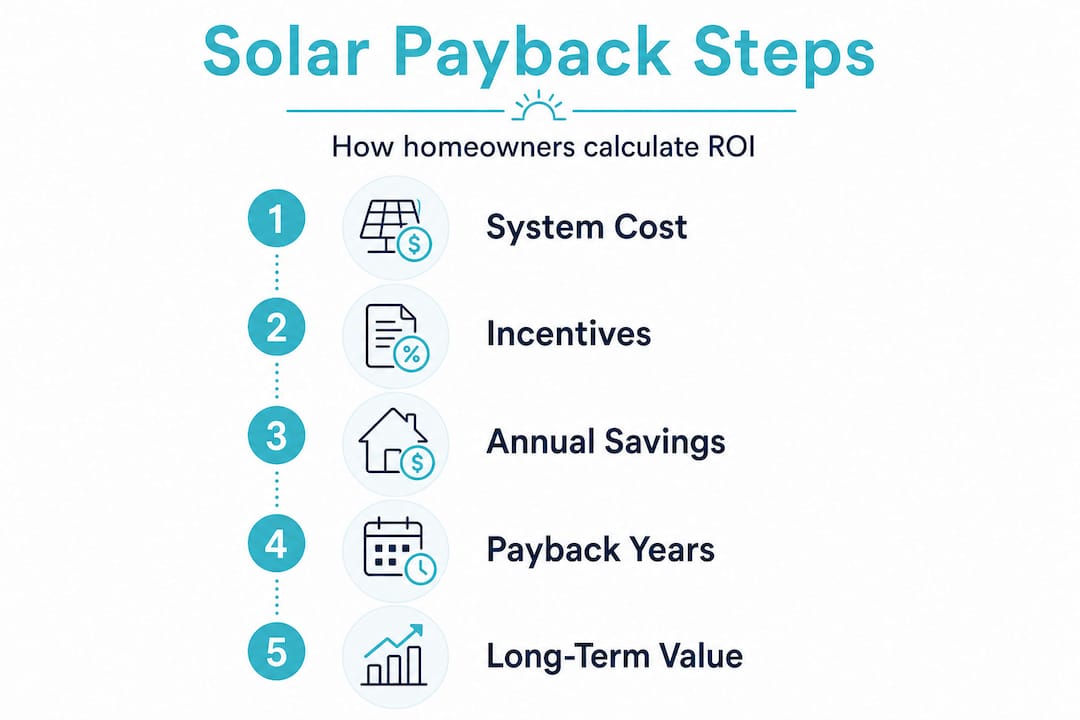
- Step 4: Quoting, incentives, payback, and maintenance realities
- What most overlook when evaluating solar in the Pacific Northwest
- How A&R Solar can help you evaluate and install the right system
- Frequently asked questions
Key Takeaways
| Point | Details |
|---|---|
| Start with a home audit | Assess your roof, annual energy use, and personal backup needs before requesting any solar quotes. |
| Right-size your system | Use annual utility data and local sun hours to determine optimal panel number and system size. |
| Prioritize local site assessments | In-person evaluations and multiple quotes are crucial for NW accuracy, especially with shading and battery backup. |
| Understand gear and warranties | Choose efficient panels, reliable inverters, and strong warranties to maximize savings and peace of mind. |
| Leverage net metering and plan for maintenance | Net metering and regular upkeep keep your system financially sound even with PNW’s cloudy winters. |
What to know before you start: Home and goals assessment
Before requesting a single quote, you need to complete some basic homework. Skipping this step is one of the most common reasons homeowners end up with systems that underperform or cost more than expected.
Start with your roof. A solar-ready home prep checklist should cover four areas:
- Age: Roofs under 20 years old are ideal. If your roof needs replacement in the next five years, do it before installing panels to avoid costly removal and reinstallation fees later.
- Material: Composition shingles and metal roofs are the most compatible with standard solar mounting systems. Tile and flat roofs require specialized hardware and raise costs.
- Orientation: South-facing roofs produce the most energy annually. West-facing roofs are a close second and often capture peak afternoon sun, which can be valuable if your utility uses time-of-use rates.
- Shading: Trees, chimneys, and neighboring buildings can cut output significantly. A professional shading analysis matters more than most homeowners realize.
According to the U.S. Department of Energy, a proper roof assessment covering condition, age, orientation, and shading is the recommended first step before any solar evaluation proceeds.
Next, be clear about your goals. Are you primarily trying to lower monthly bills? Maximize long-term return on investment? Have reliable backup power when the grid goes down? Reduce your carbon footprint? Or all of the above? Your answers will shape every technical decision that follows, from system size to whether you need a battery.
Pro Tip: Pull 12 full months of utility bills before any installer visit. Annual usage, not just a single month’s bill, gives installers the data they need to size your system accurately. Summer and winter usage patterns in the Northwest can vary dramatically.
Step 1: Calculating your solar needs and potential
After clarifying your goals and confirming basic roof readiness, the next step is translating your energy use into concrete system requirements.
Here is a simplified four-step process:
- Add up 12 months of utility bills to find your total annual kilowatt-hour (kWh) usage. The average Washington or Oregon household uses roughly 10,000 to 12,000 kWh per year, though this varies widely by home size and heating type.
- Identify your region’s peak sun hours. Washington and Oregon average approximately 4 to 4.5 peak sun hours per day. This is not total daylight hours but the equivalent hours of full-strength sunlight a panel captures.
- Apply the sizing formula. Divide your annual kWh by a production ratio of 1.1 to 1.5 (reflecting local efficiency losses), then divide by your panel’s wattage. A typical 430W panel in the Northwest will produce roughly 1,500 to 1,700 kWh per year.
- Check roof space. Standard 430W panels measure about 22 square feet each. A 20-panel system requires roughly 440 square feet of unshaded, usable roof area.
| Home annual usage (kWh) | Estimated panels needed (430W) | Approximate system size |
|---|---|---|
| 8,000 | 13 to 16 | 5.5 to 7 kW |
| 10,000 | 16 to 19 | 7 to 8 kW |
| 12,000 | 19 to 23 | 8 to 10 kW |
Regional benchmarks confirm that Oregon and Washington systems yield a production ratio of 1.1 to 1.5, with panels expected to last 25 years and experience 12 to 15 percent total degradation over that period.
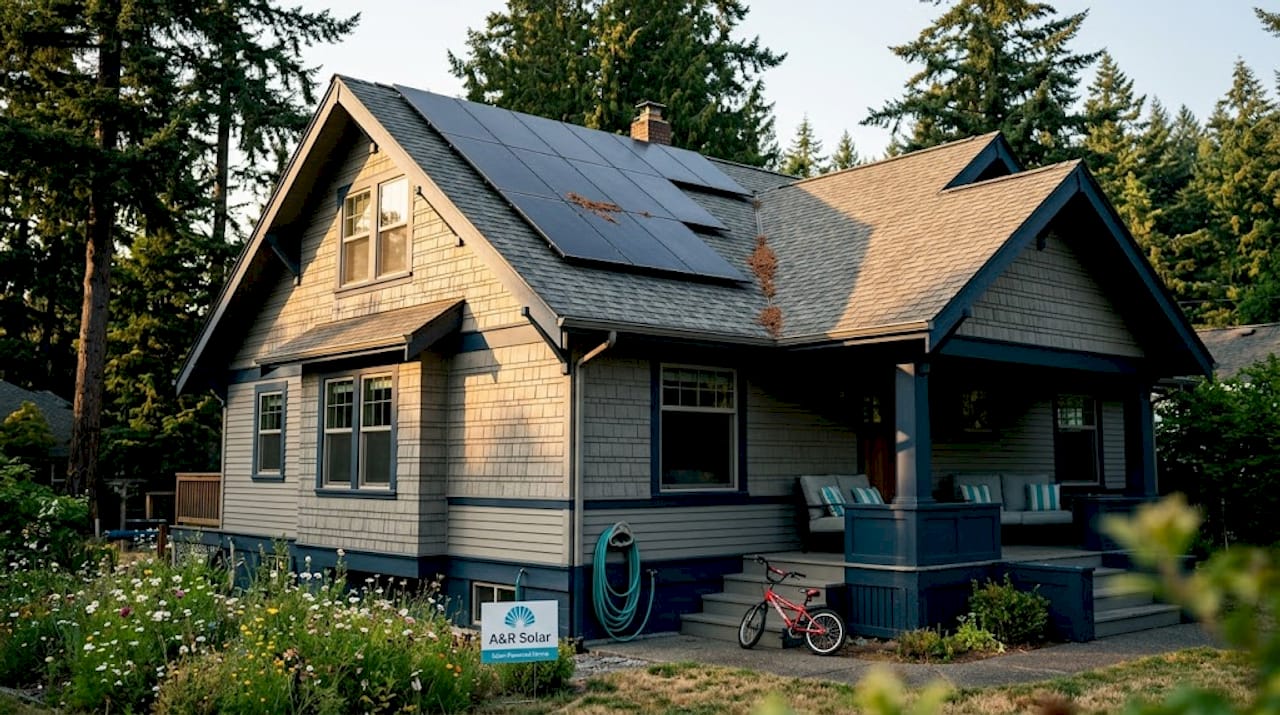
Understanding solar costs in the Northwest and how your specific usage maps to system size will put you in a much stronger position when reviewing installer quotes. It also helps to understand solar viability in cloudy weather, since many homeowners underestimate how well panels perform even on overcast days.
Pro Tip: If you are planning to add an electric vehicle, heat pump, or electric dryer in the next few years, factor that added load into your sizing now. Upsizing a system at installation is far cheaper than adding capacity later.
Step 2: Comparing solar panels, inverters, and warranties
Once your sizing estimate is in hand, the focus shifts to hardware quality and contract protections.
Panel types and efficiency
Monocrystalline panels (including mono-PERC technology) are the most efficient option available for residential use, typically converting 19 to 22 percent of sunlight into electricity. They are the best choice when roof space is limited or when you need maximum output per square foot. Polycrystalline panels cost slightly less but require more roof area for the same output. For most Northwest rooftops, monocrystalline is the practical standard.
Degradation and long-term output
All solar panels lose efficiency over time. The industry benchmark for quality panels is 0.5 to 0.8 percent annual degradation. A panel rated at 430W today should still produce at least 80 to 90 percent of that output after 25 years. Look for panels with a production guarantee that explicitly commits to an output floor, not just a product warranty covering defects.
What to look for in warranties
- 25-year power performance warranty (minimum 80 percent output retention)
- 10 to 12-year product warranty covering manufacturing defects
- Tier-1 manufacturer classification, which reflects a company’s financial strength and warranty claim history
Inverter selection
Inverters convert DC power from panels into the AC electricity your home uses. String inverters are lower cost and work well on rooftops with no shading. Microinverters attach to each panel individually and are the better option when any shading is present because they prevent one shaded panel from dragging down the whole system’s output.
“Prefer tier-1 manufacturers with a strong claim history. For shaded roofs, microinverters outperform string inverters by optimizing each panel independently.” — Solar Planet guide on choosing solar systems
Knowing the right questions to ask solar companies about hardware brands and warranty terms is just as important as the panel specs themselves. You can also review solar panel warranties explained for a deeper breakdown of what the fine print actually means.
Pro Tip: Ask every installer for the panel manufacturer’s contact information and check whether the warranty is backed by the manufacturer directly or only by the installer. If the installer goes out of business, a manufacturer-backed warranty still protects you.
Step 3: Evaluating backup batteries for NW resilience
With panels and inverters selected, the next decision is whether to add battery storage, and if so, how much.
In the Pacific Northwest, this is not a theoretical question. Ice storms, wind events, and equipment failures cause real outages that can last days. A solar system without battery storage cannot power your home during a grid outage, even on a sunny day, because of safety disconnection requirements.
Deciding how much storage you need
- Essential backup (roughly 10 kWh): Covers a refrigerator, lights, phone charging, and a few outlets for 24 hours. One standard battery unit typically covers this.
- Whole-home backup (30 kWh or more): Covers HVAC, water heating, and most appliances. Requires multiple stacked battery units.
Key specs to evaluate
| Spec | What to look for |
|---|---|
| Usable capacity | 90 to 95% of total rated capacity |
| Continuous power output | 3 to 11 kW per unit |
| Round-trip efficiency | Greater than 90% |
| Battery chemistry | LFP (lithium iron phosphate) is safer and longer-lived than NMC |
| Warranty | 10 to 15 years, minimum 70% capacity retention |
Two of the most common options for Northwest homes are the Tesla Powerwall 3 (13.5 kWh usable, 11.5 kW continuous output, stackable to 54 kWh) and the Enphase IQ5P (5 kWh per unit, 3.84 kW continuous, stackable to 80 kWh). Both are proven home storage solutions with strong track records, but the right choice depends on your existing setup and load priorities.
If you already have solar panels and want to add storage, look for AC-coupled batteries, which connect to your existing system without replacing your inverter.
Read more about PNW solar batteries explained and the battery backup basics for a deeper look at your options.
Pro Tip: Size your battery to cover your critical loads for at least 24 hours, not just a few hours. Most Northwest outages resolve within a day, but multi-day events do happen, especially in rural areas.
Step 4: Quoting, incentives, payback, and maintenance realities
With technical choices made, it is time to get quotes and pressure-test the economics.
Getting and comparing quotes
- Request at least three detailed, line-item quotes. Each quote should list panel brand and model, inverter type, battery (if included), labor, permits, and monitoring separately.
- Ask for a site-specific production estimate in kWh per year, not just a generic estimate based on zip code. Installers who conduct detailed site assessments rather than relying on online tools tend to produce more accurate projections.
- Compare warranty terms across all three quotes, not just price.
- Ask each installer to explain how they handle production shortfalls if your system underperforms against their estimate.
Incentives that matter most in WA/OR
Net metering is the single most important financial tool for Northwest homeowners. When your panels produce more than you use (which happens regularly in summer), the excess flows back to the grid and credits your account to offset winter bills.
“In WA/OR, net metering outweighs tax credits as the primary driver of ROI. Batteries are essential for outage protection given the region’s weather risks.” — EnergySage Oregon solar data
Maintenance in the Northwest
Annual cleaning is especially relevant here. Pollen in spring and leaf debris in fall can reduce output noticeably. Most quality systems include remote monitoring, so you can track daily output and catch underperformance early. Budget roughly $150 to $300 per year for professional cleaning and an occasional inspection.
Learning how to analyze solar quotes side by side is one of the most practical skills you can develop before signing anything, and reviewing solar warranty tips will help you read the fine print without getting lost.
Pro Tip: Ask each installer for references from homes in your county that had similar roof types and energy usage. Real-world production data from nearby customers is far more reliable than any online calculator estimate.
What most overlook when evaluating solar in the Pacific Northwest
Most evaluation guides focus on the basics: roof angle, panel count, payback period. Those fundamentals matter. But in Washington and Oregon specifically, a few less-discussed factors can significantly affect whether your system actually delivers.
Online solar calculators almost never account for real Northwest conditions. They rarely factor in site-specific shading from tall Douglas firs or neighboring structures, and they typically model average sun hours rather than your actual roof plane. Research shows that shading from trees can reduce individual panel output by 15 to 20 percent, an effect that compounds across a string-wired system. If your roof has any shading at all, a professional shading analysis is not optional.
The seasonal storage value of net metering is also widely underestimated. Northwest homes generate surplus power in May through August. That surplus, banked as credits, offsets the weaker production of November through February. Homeowners who evaluate solar only on winter output numbers consistently underestimate annual savings.
Battery value deserves more weight than it typically receives in financial models. The grid in many parts of Washington and Oregon is vulnerable to outage events, and a solar system without storage cannot provide backup power by code. The upfront cost of a battery feels significant, but the alternative is having a solar system that goes dark the moment the grid fails.
On the contract side, we consistently see homeowners focus on price and miss the production guarantee clause. A guaranteed annual output number in your contract, with a compensation clause if the system falls short, is worth more than a marginally lower sticker price.
Finally, avoid power purchase agreements (PPAs) and lease structures if full ownership is possible for your situation. Leases and PPAs transfer most of the financial incentives to the third-party owner. Ownership keeps those benefits with you and builds equity in your home. Look at solar performance in cloudy weather to understand what your owned system can realistically deliver across all seasons.
How A&R Solar can help you evaluate and install the right system
Applying everything covered in this guide is straightforward when you have a knowledgeable local partner walking through it with you.
A&R Solar has spent two decades installing residential systems across Washington and Oregon. Every project starts with a detailed site assessment, not an online estimate, covering roof condition, shading analysis, local utility rate structures, and your actual energy data. From there, we build a line-item quote that includes panel specs, inverter selection, battery options, and projected annual output backed by a production guarantee. As a certified B Corporation and employee-owned company, our team has a direct stake in the quality and longevity of every system we install. Post-installation, we provide ongoing monitoring, maintenance support, and warranty service so your system performs for the full 25-year life of the panels.
Frequently asked questions
How many solar panels does an average WA or OR home need?
Most homes require 16 to 23 solar panels of about 430W, depending on annual energy use and available sunlight. Homes with higher usage or significant shading may need panels toward the upper end of that range.
How do I know if my roof is suitable for solar?
Your roof should be newer than 20 years, in good structural condition, ideally face south or west, and have minimal shading from trees or structures during peak sun hours.
Are batteries worth it for backup in WA/OR homes?
Batteries are genuinely valuable in the Northwest because solar panels cannot power your home during a grid outage without storage. Given regional weather outage risks, battery backup adds real resilience that most homeowners eventually appreciate.
What’s the typical payback period for solar in the PNW?
Payback typically falls in the 8 to 12-year range, depending on net system cost and annual savings, which are shaped by net metering credits, available incentives, and local utility rates.
Do cloudy Northwest winters make solar a bad investment?
No. Summer net metering banking allows excess credits from sunny months to carry forward and offset weaker winter production, keeping annual savings on track even in the cloudiest parts of the region.