

TL;DR:
- Choosing an employee-owned solar company ensures higher wages, better workmanship, and greater long-term stability for homeowners. These companies prioritize community investment and align worker incentives with quality service, resulting in more reliable and lasting solar installations. Supporting employee ownership promotes economic equity and sustainable business practices in the renewable energy industry.
When you’re comparing solar installers, the temptation is to focus entirely on price per watt and panel brand. But the ownership structure of the company you hire shapes every aspect of your experience, from the quality of the installation to what happens when you need service five years later. The case for why choose employee-owned solar goes well beyond feel-good ethics. It connects directly to workmanship, business stability, community investment, and long-term accountability. This article lays out the specific, data-backed reasons that employee ownership changes the equation for homeowners in Washington and Oregon.
Table of Contents
- Key Takeaways
- What is an employee-owned solar company?
- Financial and ethical benefits of employee-owned solar
- Community and customer service advantages
- Employee-owned vs. traditional solar providers
- How to identify a trustworthy employee-owned solar company
- My perspective on employee-owned solar
- A-rsolar: employee-owned solar for the Pacific Northwest
- FAQ
Key Takeaways
| Point | Details |
|---|---|
| Higher wages, stronger teams | Wages at employee-owned companies run 20% to 30% higher, attracting and retaining skilled installers who deliver better work. |
| Greater business stability | Employee-owned firms experience 50% fewer layoffs during economic downturns, meaning your installer will still be around for warranty service. |
| Owner accountability on every job | Workers with a financial stake treat each installation as if it reflects directly on them, because it does. |
| Local community reinvestment | Employee owners live and spend money in the same communities where they work, creating a direct accountability loop. |
| Ethical alignment for eco-conscious buyers | Choosing an employee-owned solar company supports worker prosperity and reduces wealth gaps alongside your clean energy goals. |
What is an employee-owned solar company?
An employee-owned company is one where workers hold a meaningful financial stake in the business, not just a paycheck. The most common structure in the U.S. is an Employee Stock Ownership Plan, commonly called an ESOP. In an ESOP, the company sets up a trust that holds shares on behalf of employees. As workers stay longer, their share allocation grows. When they retire or leave, those shares are bought out, giving them a real financial return.
Other models include worker cooperatives, where employees vote on major decisions and share profits directly, and hybrid structures that combine profit-sharing with partial employee ownership. Solar companies like A-rsolar operate as employee-owned businesses, which means the people who show up to install panels on your roof have a direct financial interest in the company’s reputation and long-term success.
Here is what distinguishes employee-owned solar companies from traditional privately held or investor-backed firms:
- Shared financial incentive. Employees benefit when the company profits and are harmed when it loses clients or reputation.
- Long-term thinking. Because employees are also owners, decisions favor long-term stability over short-term cost-cutting.
- Reduced hierarchy. Workers often have more input into operations, which surfaces practical improvements faster.
- Succession planning built in. The employee ownership model is designed to outlast founding individuals, providing continuity for customers.
Pro Tip: When evaluating solar companies, ask directly whether they have an ESOP or employee ownership structure. A company that is genuinely employee-owned will be proud to explain it in detail.
Financial and ethical benefits of employee-owned solar
The financial case for why you should support employee-owned companies starts with what these structures do for workers. Wages run 20% to 30% higher at employee-owned firms compared to traditional companies. For the solar industry, that matters practically. Higher wages attract more experienced technicians and certified installers. The crew on your roof is not the lowest bidder.
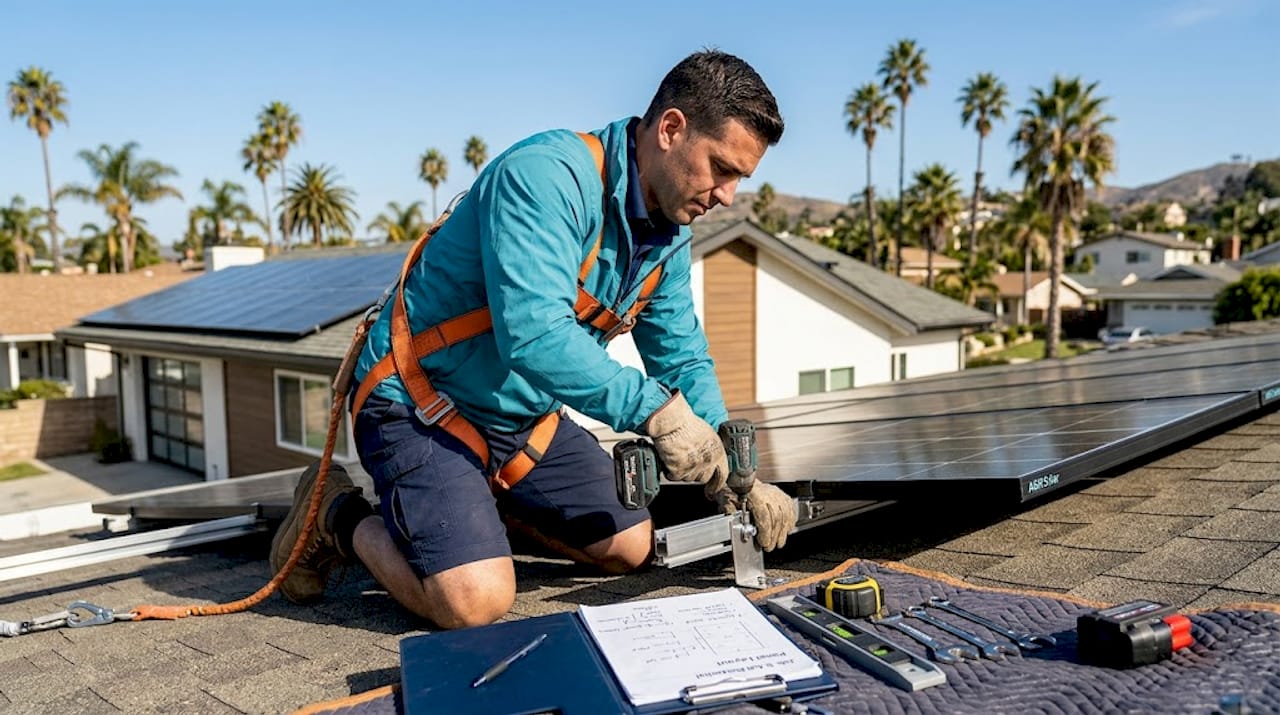
The stability data is even more striking. Employee-owned companies experienced 50% fewer layoffs during economic downturns between 1999 and 2020 compared to traditional firms. For homeowners, this is not an abstract statistic. It means the company that installed your system is likely to still be operating when you need a warranty repair, a panel replacement, or a system expansion years from now.
The broader economic equity argument is also worth understanding. Research from Harvard Business School found that if all U.S. private companies were just 10% employee-owned, Black household wealth could more than double. Employee ownership is one of the most direct tools for closing the wealth gap, making it an ethical priority alongside environmental goals.
There are several specific financial and ethical advantages worth calling out:
- Employee owners hold median tenure of 5.2 years compared to 3.4 years for non-owners in the same age group, meaning less turnover and more experienced teams on your job.
- Profit-sharing creates direct incentives to solve problems efficiently and avoid the costly callbacks that erode margins.
- A global meta-analysis of 102 studies covering 56,984 companies confirmed that broad employee ownership correlates with better performance, more innovation, and greater longevity.
Pro Tip: Ask your solar installer for their average employee tenure. A company with low turnover has experienced crews and a culture people want to stay in. That directly affects installation quality.
The ethical business practices of employee-owned firms are not incidental. They are structural. When the people doing the work share in the outcome, the incentives align with quality, honesty, and care in ways that traditional employment structures simply do not produce.
Community and customer service advantages
Employee-owned solar companies operate differently at the community level, not just the business level. When your installer owns a stake in the company, they live locally, spend locally, and have a reputation to protect in the same community where you live. That creates an accountability loop that investor-backed national firms cannot replicate.
“The shift to employee ownership changes how workers approach every job. There is a sense of pride and responsibility that comes from knowing your financial future is tied to the company’s reputation.” (Shaw Solar, Durango Herald)
This “owner’s eye” mentality is well-documented. Employees who hold ownership stakes treat client installations as if they are personally responsible for every detail, because they are. A misaligned panel or a loose conduit run reflects on their company’s value and their own financial stake. That accountability produces measurably better workmanship.
The community benefits extend beyond individual installations:
- Local economic circulation. Workers embedded in local communities spend their income at local businesses, compounding the economic benefit of your purchase.
- Long-term customer relationships. Employee-owned companies are built for longevity, so the person who installs your system may be around for your service call a decade later.
- Consistent quality standards. Low turnover means institutional knowledge stays inside the company, so each crew member knows the local code requirements, utility interconnection rules, and regional weather considerations specific to the Pacific Northwest.
- Accountability without escalation. With employee-owned firms, you rarely need to escalate a complaint through a national call center. The person answering has a direct stake in your satisfaction.
For homeowners in Washington and Oregon, understanding why local solar installers matter is part of getting solar right. Regional factors like net metering policies, utility interconnection timelines, and roof load requirements for rain and snow vary significantly, and local employee-owners have professional and financial reasons to get those details right.
Employee-owned vs. traditional solar providers
It helps to see the differences laid out directly. The table below compares the two models across the factors that matter most to homeowners.
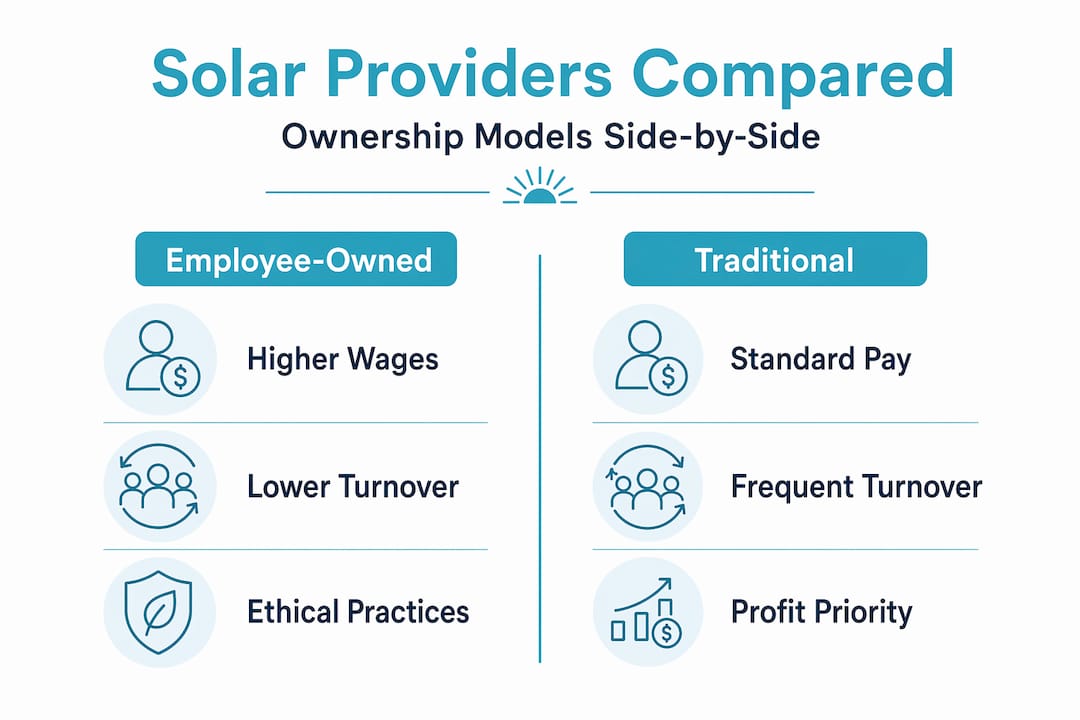
| Factor | Employee-owned solar | Traditional solar provider |
|---|---|---|
| Worker compensation | 20% to 30% higher wages on average | Market-rate or lower wages typical |
| Employee tenure | Median 5.2 years | Median 3.4 years |
| Layoff risk during downturns | 50% fewer layoffs | Higher volatility; layoffs more common |
| Installation quality incentive | Personal financial stake in outcome | Job performance metrics only |
| Long-term business continuity | Built-in succession; designed to outlast founders | Dependent on owner exit strategy or investor decisions |
| Community investment | Workers live and spend locally | Revenue often flows to outside investors |
| Ethical alignment | Worker prosperity built into the model | Profit typically flows to shareholders |
The contrast in business continuity deserves extra attention. When a traditional solar company is sold, acquired, or goes out of business, warranty obligations often become difficult to enforce. An employee-owned firm with a functioning ESOP has a structural reason to stay in operation and maintain its reputation. Employee ownership as a long-term strategy is designed specifically to provide the continuity that protects customers over time.
How to identify a trustworthy employee-owned solar company
Not every company that uses the words “team” or “family” in its marketing is actually employee-owned. Here is how to verify and evaluate the claim before you sign a contract.
- Ask for specifics on the ownership structure. A genuine ESOP company can explain how shares are allocated, what the vesting schedule looks like, and approximately what percentage of the company employees own.
- Request employee ownership documentation. Certified employee-owned companies often have third-party verification or filings with the Department of Labor. Ask if they have this on file.
- Look for B Corporation certification. Certified B Corps meet rigorous standards for social and environmental performance. Not all employee-owned companies are B Corps, but the certification adds an independent layer of accountability.
- Read long-form customer reviews. Look for patterns in reviews that reflect the owner mentality: crews who take time to answer questions, follow-up calls after installation, and service that exceeds the minimum requirement.
- Ask about average employee tenure. If most crew members have been with the company for three or more years, that is a reliable signal of both culture and employee ownership in practice.
Pro Tip: Check whether the company has a stated community mission or gives back locally. Employee-owned firms often sponsor community events, hire locally, and participate in regional clean energy initiatives. These behaviors are consistent markers of genuine employee ownership culture.
A-rsolar’s partnership approach to solar reflects exactly this kind of embedded, community-focused model. Two decades in the Pacific Northwest means local knowledge, stable teams, and a track record you can actually verify.
My perspective on employee-owned solar
I’ve spent years paying close attention to how different solar companies operate, and the difference between employee-owned firms and traditional providers shows up most clearly not in the sales conversation, but in what happens after installation. The callbacks, the warranty claims, the “we’ll get someone out there” responses. Employee-owned teams simply behave differently when something needs to be fixed.
What I’ve found is that the ownership stake changes how people think about their work at a fundamental level. It is not about motivation posters or company culture slogans. It is about the fact that when your financial future is tied to how well the company performs, you pay attention to details that a standard hourly employee might not. I’ve seen this produce measurably better outcomes, and the data on sustained enterprise value backs up what I’ve observed firsthand.
There is also a social dimension that I think gets underemphasized. Choosing an employee-owned solar company is one of the few purchasing decisions where your commitment to clean energy and your commitment to economic equity reinforce each other directly. You are not making a trade-off. You are getting cleaner energy and supporting a business model that builds worker wealth and community stability at the same time.
My honest take: if you care about where your energy comes from, you should also care about how the company that installs it treats its workers. Employee ownership is the clearest signal available that those incentives are properly aligned.
— Shyerome
A-rsolar: employee-owned solar for the Pacific Northwest
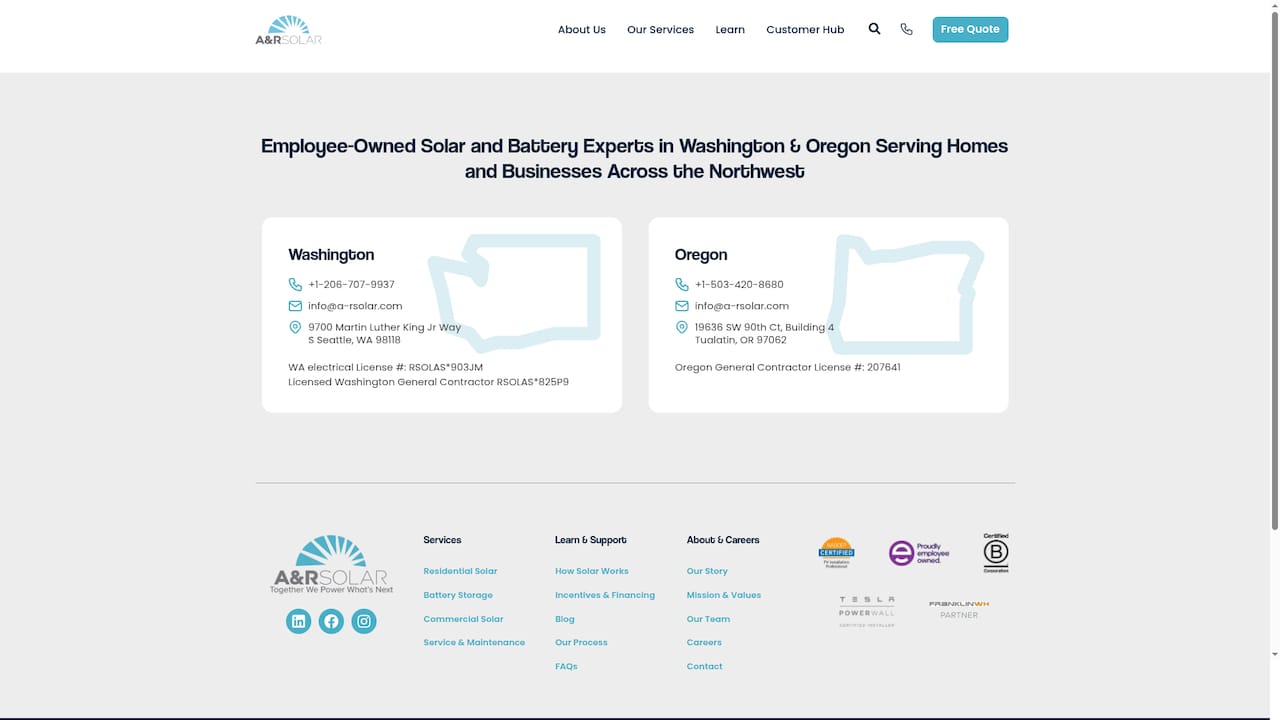
A-rsolar has operated as an employee-owned, certified B Corporation in Washington and Oregon for two decades. That is not a marketing claim. It is a structural fact that shapes how every installation is planned, executed, and supported after the job is done. The teams that install your panels have a direct financial stake in the company’s reputation. They live in the same communities, know the regional permitting requirements, and are built for the long term.
If you want to see what employee-owned solar looks like in practice, A-rsolar’s residential case studies show real Pacific Northwest installations with real outcomes. For homeowners interested in pairing solar with resilience, A-rsolar’s home battery backup solutions are installed and serviced by the same committed, locally embedded teams. Contact A-rsolar to talk with a team that has a genuine stake in getting your project right.
FAQ
What is an employee-owned solar company?
An employee-owned solar company is one where workers hold a financial stake in the business through structures like an ESOP, worker cooperative, or profit-sharing plan. This ownership aligns workers’ financial interests with customer satisfaction and long-term company performance.
Why choose employee-owned solar over a traditional installer?
Employee-owned firms pay 20% to 30% higher wages, experience 50% fewer layoffs during downturns, and produce workers who treat each job as a direct reflection of their own financial stake. That combination delivers better workmanship and longer-lasting customer support.
How do I know if a solar company is genuinely employee-owned?
Ask the company to explain their ownership structure, including how shares are allocated and what vesting looks like. Certified B Corporations and companies with Department of Labor ESOP filings offer additional verification.
Does employee ownership affect the quality of a solar installation?
Yes, directly. Workers with an ownership stake are more likely to take care on details and follow through on service issues, because their financial future is tied to the company’s reputation. This translates into higher-quality installations and more responsive after-sales support.
Are employee-owned solar companies more stable long-term?
Research shows employee-owned companies experience significantly fewer layoffs during economic downturns and are designed with succession planning built in. That stability matters for homeowners who need warranty service and ongoing system maintenance years after installation.