

TL;DR:
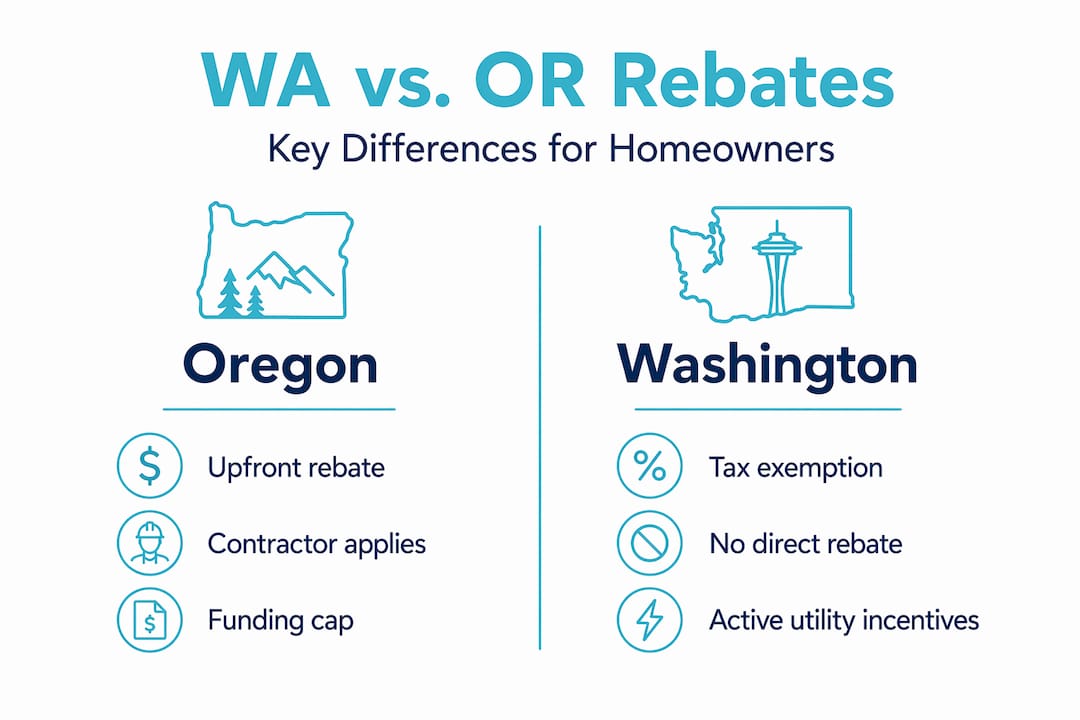
- Solar rebates lower upfront costs by reducing the purchase price of systems, not through tax credits or utility payments. In Oregon, homeowners can receive up to $5,000 for solar and $2,500 for storage through approved contractors, while Washington offers a 9% sales tax exemption on qualifying systems until 2029, saving homeowners money at the point of sale. Proper documentation, contractor approval, and understanding incentive stacking are essential to maximize savings and avoid delays or program disqualifications.
If you’ve started researching solar and found yourself confused about how solar rebates work, you’re not alone. The term gets used loosely to describe everything from instant price cuts at installation to annual utility payments, and the programs available in Washington and Oregon operate differently than what many homeowners expect. This article breaks down exactly what solar rebates are, which programs are currently available in your state, and how to make sure you’re capturing every dollar of savings available to you in 2026.
Table of Contents
- Key takeaways
- How solar rebates work to reduce your installation costs
- Oregon solar rebate programs in 2026
- Washington solar incentives and tax exemptions
- Stacking rebates and incentives without miscalculating savings
- How to apply for solar rebates and maximize your savings
- My take on the mistakes homeowners keep making
- Get expert guidance on solar rebates from A&R Solar
- FAQ
Key takeaways
| Point | Details |
|---|---|
| Rebates reduce upfront costs | Most solar rebates in WA and OR lower what you pay at installation, not after. |
| Oregon offers up to $7,500 | Eligible homeowners can receive up to $5,000 for solar and $2,500 for storage through approved contractors. |
| Washington’s tax exemption saves roughly 9% | The statewide sales and use tax exemption acts as an automatic price reduction on qualifying systems. |
| Contractor selection is critical | Only approved contractors can administer Oregon rebates and apply Washington’s tax exemption correctly. |
| Programs update annually | Rebate amounts and eligibility rules change each year, so confirm current details before committing. |
How solar rebates work to reduce your installation costs
Understanding solar rebates starts with separating them from other types of solar incentives. A solar rebate is a direct reduction in the purchase price of your solar system. It is not a credit you claim on your tax return, and it is not a monthly check from your utility. It comes off the top of what you owe, either applied by your installer at the point of sale or paid directly to your contractor, who then reduces your invoice accordingly.
This distinction matters because it changes how you budget. With a rebate, the savings show up before you write a check or sign a financing agreement. That reduces your loan principal if you’re financing, and it reduces the total system cost used as the basis for any other state incentives you might stack on top.
Here’s how the main types of solar financial incentives differ:
- Upfront rebates: A direct price reduction applied at installation. The most common form in Oregon and Washington programs.
- Performance-based incentives: Payments tied to how much energy your system produces over time. Less common now than they were a decade ago.
- Tax exemptions: Reductions in what you owe on sales, property, or other taxes related to your solar purchase. Washington’s primary solar incentive falls into this category.
- Net metering credits: Utility bill credits for excess electricity your system sends back to the grid. Valuable over time, but not a rebate.
Pro Tip: When a solar installer quotes you a “rebate,” ask directly whether it reduces your contract price before signing or arrives as a separate payment later. The answer changes how you should approach financing.
The state and utility programs in Washington and Oregon are structured to put savings in your hands at the time of purchase, which is one of the clearest benefits of solar rebates for homeowners who want to minimize what they borrow.

Oregon solar rebate programs in 2026
Oregon currently offers two primary pathways for upfront solar savings, and both operate through a contractor-based model that removes much of the administrative burden from homeowners.
The Oregon Solar + Storage Rebate Program
This is Oregon’s most significant rebate program for residential solar. The program offers up to $5,000 for solar and an additional $2,500 for paired energy storage systems. The rebate is issued directly to approved contractors, who then reduce the project price for the homeowner. You don’t receive a check. You simply pay less at signing.
Here’s how the process typically unfolds:
- Find an ODOE-approved contractor. Only contractors approved by the Oregon Department of Energy can reserve and administer these rebates. Starting with an unapproved installer means you are not eligible, regardless of your system size or income.
- Confirm your eligibility. The program has income-tiered provisions, and enhanced rebate amounts may apply for lower-income households. Ask your contractor to walk you through current eligibility criteria.
- Reserve the rebate before installation. Your contractor handles rebate reservation with the state. Timing matters because funding is limited. The program reopened June 15, 2026, with $1.1 million in funding, and reservations filled quickly.
- Review your invoice. The rebate amount should appear as a line-item reduction on your final project cost. Verify this before signing off.
- Proceed with installation. Once the rebate is reserved and applied, the project moves forward at the reduced price.
Energy Trust of Oregon
Energy Trust of Oregon administers separate direct cash incentives for solar customers of Pacific Power and Portland General Electric. These incentives are paid to contractors, who reduce the homeowner’s invoice accordingly. The program mechanics are similar to the state rebate program in that you benefit from the savings upfront without waiting for reimbursement.
One critical detail: Energy Trust updates incentive amounts annually on January 1. The dollar figures you saw quoted in 2025 may not reflect what’s available now. Check Energy Trust’s website or ask your installer to confirm current amounts before moving forward. You can find a current overview of Oregon solar incentives and program requirements to orient yourself before your first contractor conversation.
Pro Tip: Oregon’s rebate funding is capped and replenishes periodically. If you’re planning a solar project, don’t wait until fall. Spring and early summer typically offer the best window for securing rebate reservations before funds are exhausted.
Washington solar incentives and tax exemptions
Washington takes a different approach than Oregon. The state’s primary solar savings mechanism is a sales and use tax exemption for solar energy systems under 100 kW. For a residential system, that threshold is easily met. What this means practically is that your installer does not charge you sales tax on the qualifying solar components.
That exemption is currently in place through 2029 and translates to roughly 9% savings on the cost of your system. On a $30,000 installation, that’s approximately $2,700 kept in your pocket at the point of purchase with no application required on your part.
Here’s what you should know about how Washington’s exemption works in practice:
- It applies at point of sale. The tax reduction happens on your invoice automatically when your installer handles it correctly. You don’t file paperwork to claim it.
- Proper documentation is required. Improperly documented systems may not receive the exemption, which can result in unexpected costs. Your installer needs to apply the correct system classification and sizing on the invoice.
- System sizing must qualify. The exemption applies to systems under 100 kW. All standard residential systems qualify, but confirm this with your installer if you’re considering a larger property.
- It’s not the only Washington incentive. Washington also offers a property tax exemption on the added home value from solar. Your home’s assessed value does not increase due to the solar installation, which means your property taxes stay flat.
| Incentive | Applies to | How you receive it | Expiration |
|---|---|---|---|
| Sales/use tax exemption | Solar systems under 100 kW | Automatic at point of sale | 2029 |
| Property tax exemption | Increased home value from solar | Applied during property assessment | Ongoing |
| Net metering credits | Excess energy production | Utility bill credit monthly | Varies by utility |
For a full breakdown of current programs, the Washington solar incentives page from A&R Solar covers eligibility and documentation requirements in detail.
Stacking rebates and incentives without miscalculating savings
One of the areas where homeowners most often make errors is in combining multiple programs and then projecting their total savings incorrectly. The math isn’t complicated, but the order of operations matters.
When you receive an upfront rebate, it reduces your system’s net purchase price. That lower price becomes the basis for calculating any other incentive tied to your total project cost. This is what the IRS refers to as a purchase-price adjustment, and it applies when rebates reduce the eligible project cost used in other calculations. Getting this wrong means your savings projections may be overstated.
A few practical notes on stacking incentives:
- Confirm program compatibility. Not all programs allow stacking. Ask each program administrator directly whether their incentive can be combined with others you’re pursuing.
- Work from a verified net cost. After all rebates and exemptions are applied, calculate your true net system cost before projecting savings from other sources.
- Use approved contractors throughout. In Oregon, only ODOE-approved contractors can reserve and process rebates. Using an unapproved installer disqualifies you from the program entirely.
- Check annual updates before signing. Both Oregon and Washington programs update their terms on a regular cycle. Locking in quotes from last year’s program details can lead to disappointment.
Pro Tip: Ask your installer to provide a written breakdown showing each incentive applied separately, the net cost after each reduction, and the basis used for any remaining calculations. This protects you from surprises and gives you a clear picture of actual savings.
How to apply for solar rebates and maximize your savings
The application process varies by program, but the steps below apply broadly to homeowners in both Washington and Oregon.
- Start with approved contractors. In Oregon, this means ODOE-approved installers. In Washington, it means contractors experienced with the sales tax exemption documentation process. This single step determines your eligibility for most available programs.
- Confirm current program details. Rebate amounts and rules update annually, so verify specifics directly with your contractor or the administering agency before you plan your budget.
- Review your project quote carefully. Your invoice should itemize each rebate or exemption separately. Never assume a discount is included. Ask your contractor to confirm it in writing.
- Time your project with funding cycles. Oregon’s rebate program releases funds periodically and reservations fill fast. Homeowners who start conversations in late winter or early spring have a better chance of securing funding.
- Explore local utility programs. Some utilities in Oregon and Washington offer additional rebates on top of state programs. Ask your installer and your utility provider what’s currently available in your service area.
- Consider pairing solar with battery storage. Oregon’s rebate program includes a separate $2,500 incentive for storage. If energy resilience matters to you, this makes the economics of adding a battery significantly more attractive.
My take on the mistakes homeowners keep making
I’ve seen homeowners lose rebate funding not because of bad luck, but because of avoidable timing and documentation errors. The most common mistake I see is starting with an unapproved contractor and then trying to switch mid-project after realizing the rebate isn’t accessible. By that point, the funding window may have closed.
The second most common issue is treating advertised rebate amounts as guaranteed. Oregon’s programs are funded, and once the allocation is gone, it’s gone. I’ve spoken with homeowners who planned their entire project budget around a rebate amount they read about online, only to find that the program had paused for the season by the time they were ready to move forward.
My honest advice: start with the contractor, not the calculator. Before you run any savings numbers, confirm that the installer you’re talking to is approved for the programs you’re counting on. Everything else, the pricing, the timeline, the financing, flows from that one decision. I’ve also seen homeowners underestimate Washington’s sales tax exemption because it doesn’t feel like a rebate in the traditional sense. There’s no certificate, no payment, no paperwork on your end. But 9% off a $30,000 system is real money, and it’s available to every qualifying homeowner in the state right now.
The Washington sales tax exemption is one of the cleanest, most accessible incentives available to residential solar buyers. Don’t overlook it just because it’s quiet.
— Shyerome
Get expert guidance on solar rebates from A&R Solar
Navigating rebate programs in two states, each with their own rules, funding cycles, and contractor requirements, is exactly where having an experienced local partner pays off. A&R Solar has worked with Oregon and Washington homeowners for two decades, and their team knows which programs are currently funded, which contractors are approved, and how to structure your project so you capture every available incentive.
Whether you’re just beginning to explore residential solar options or you’re ready to move forward and want to confirm your rebate eligibility before signing, A&R Solar offers personalized consultations to help you plan with accurate numbers. Their services cover everything from initial permitting to installation, battery backup integration, and ongoing system care. Reach out to the A&R Solar team at a-rsolar.com/contact to get started with a plan built around what’s actually available in your area today.
FAQ
What are solar rebates and how do they differ from tax credits?
Solar rebates are direct reductions applied to the purchase price of your solar system at the time of installation. Unlike tax credits, which reduce what you owe on your tax return, rebates lower your upfront cost before you pay.
How much can Oregon homeowners receive through the Solar + Storage Rebate Program?
Eligible Oregon homeowners can receive up to $5,000 for solar and an additional $2,500 for paired battery storage through ODOE-approved contractors.
Does Washington have a solar rebate program?
Washington’s primary upfront incentive is a statewide sales tax exemption on solar systems under 100 kW, which saves homeowners roughly 9% on system costs automatically at the point of sale through 2029.
Can you stack multiple solar rebates and incentives in Oregon or Washington?
Yes, most programs can be combined, but each rebate reduces your net system cost, which affects calculations for other incentives. Work with an approved contractor to model the correct stacking order before finalizing your budget.
How often do solar rebate programs update their amounts and rules?
Programs like Energy Trust of Oregon update incentive amounts annually, effective January 1. Always confirm current figures directly with your contractor or the program administrator before committing to a project budget.