



TL;DR:
- Although the federal Residential Clean Energy Credit expired in 2025, state incentives, net metering, and rising utility rates still make going solar financially appealing in 2026. Homeowners can expect system costs of $18,000 to $27,000 before incentives, with long-term savings driven by increased home value, higher utility rates, and environmental benefits. Proper planning, equipment quality, and understanding local policies are essential for maximizing solar investment returns this year.
The 30% federal Residential Clean Energy Credit expired at the end of 2025, and a lot of homeowners are wondering whether the numbers still make sense. That confusion is understandable, but it’s leading many people to dismiss solar prematurely. The reasons to go solar in 2026 remain compelling: electricity rates are rising, state-level solar incentives in 2026 are still substantial in many regions, panel technology keeps improving, and your utility bill is not getting any cheaper. This article cuts through the noise and gives you a clear-eyed look at what solar actually costs, what you can save, and whether the investment makes sense for your household right now.
Table of Contents
- Key takeaways
- Why go solar in 2026: what the numbers actually show
- Solar incentives in 2026: what’s still available
- Financial benefits: savings, payback, and home value
- Environmental benefits of going solar
- Practical considerations before you sign
- My perspective: solar still makes financial sense, but the homework matters more now
- How A-rsolar helps you get it right
- FAQ
Key takeaways
| Point | Details |
|---|---|
| Federal credit expired, state incentives remain | The 30% federal credit ended in 2025, but property tax exemptions, rebates, and net metering still reduce net costs significantly. |
| System costs are stable and competitive | Typical 6–8 kW systems run $18,000–$27,000 before incentives, with soft costs as the biggest price variable between quotes. |
| Solar adds real home value | Owned solar systems add roughly $4 per watt in resale value, which translates to $15,000–$25,000 for a typical home. |
| Battery storage changes the ROI equation | Pairing solar with a battery is now the smarter path under updated net metering rules in many states. |
| Environmental impact is substantial | A residential system offsets approximately 3.9 tons of CO2e per year and pays back its carbon footprint within a few years. |
Why go solar in 2026: what the numbers actually show
The first thing to understand is what residential solar actually costs today. The national average installed cost sits around $2.95 per watt before incentives. For a standard 6 to 8 kW system, that puts your total between $18,000 and $27,000 depending on equipment choices, roof conditions, and where you live.
That’s a wide range, and the reason comes down to soft costs. Soft costs account for 60–65% of total installed prices. These include permitting fees, installer overhead, sales commissions, and labor. The panels and inverters themselves are nearly commoditized at this point. What varies wildly between quotes is everything else.
What drives price differences
A steep or complex roof adds labor hours. Microinverters cost more upfront than string inverters but perform better on partially shaded rooftops. Regional labor markets in places like Seattle or Portland carry different wage rates than rural areas. Equipment brands also vary in quality and warranty terms.
| System size | Estimated cost before incentives | Estimated cost after state incentives (varies) |
|---|---|---|
| 6 kW | $17,700–$19,800 | $14,000–$17,000 |
| 7 kW | $20,650–$23,100 | $16,500–$20,000 |
| 8 kW | $23,600–$26,400 | $19,000–$23,000 |
Note: State incentive estimates reflect average rebates and exemptions and will vary by location.
Pro Tip: Get at least three itemized quotes and ask each installer to break out hardware costs from soft costs separately. Permits and overhead are where you’re most likely to be overcharged, and most homeowners never think to ask.
Solar incentives in 2026: what’s still available
The federal Residential Clean Energy Credit expired December 31, 2025, which means homeowners who purchase their own systems in 2026 cannot claim it. That’s a real change. For a $22,000 system, you’re no longer getting a $6,600 credit back. But that doesn’t mean incentives disappeared entirely.
To understand the credit’s history and what changed, A-rsolar’s overview of the federal solar tax credit is worth reading before you start collecting quotes.
State and local programs vary widely, but many states still offer meaningful financial support:
- Property tax exemptions: Most states with strong solar markets exempt the added home value from solar from your property tax assessment. In New Jersey, Massachusetts, and Oregon, this exemption can save hundreds of dollars annually.
- Sales tax exemptions: Several states waive sales tax on solar equipment purchases. Washington State, for example, exempts solar equipment from state sales tax.
- Direct rebates: Some utilities and state programs offer upfront cash rebates. Hawaii and New York have active rebate programs that reduce out-of-pocket costs directly.
- Solar Renewable Energy Credits (SRECs): In states like New Jersey and Massachusetts, homeowners earn tradeable certificates for every megawatt-hour their system produces. These certificates have real market value.
- Net metering programs: Most utilities still allow you to send excess electricity back to the grid for a credit on your bill. State-specific incentives like net metering, property tax exemptions, and SRECs significantly affect your final payback period.
Pro Tip: Don’t assume your installer knows every available local rebate. Check your state energy office website directly and call your utility’s customer service line before signing any contract. Utility-specific solar rebates often go unclaimed simply because homeowners didn’t ask.
One more note on leasing: if you go the lease or power purchase agreement route, the third-party owner can still access commercial solar credits under Section 48E. That credit is passed along through lower lease rates. It’s not the same as owning the credit yourself, but it does mean leased systems carry some indirect benefit.
Financial benefits: savings, payback, and home value
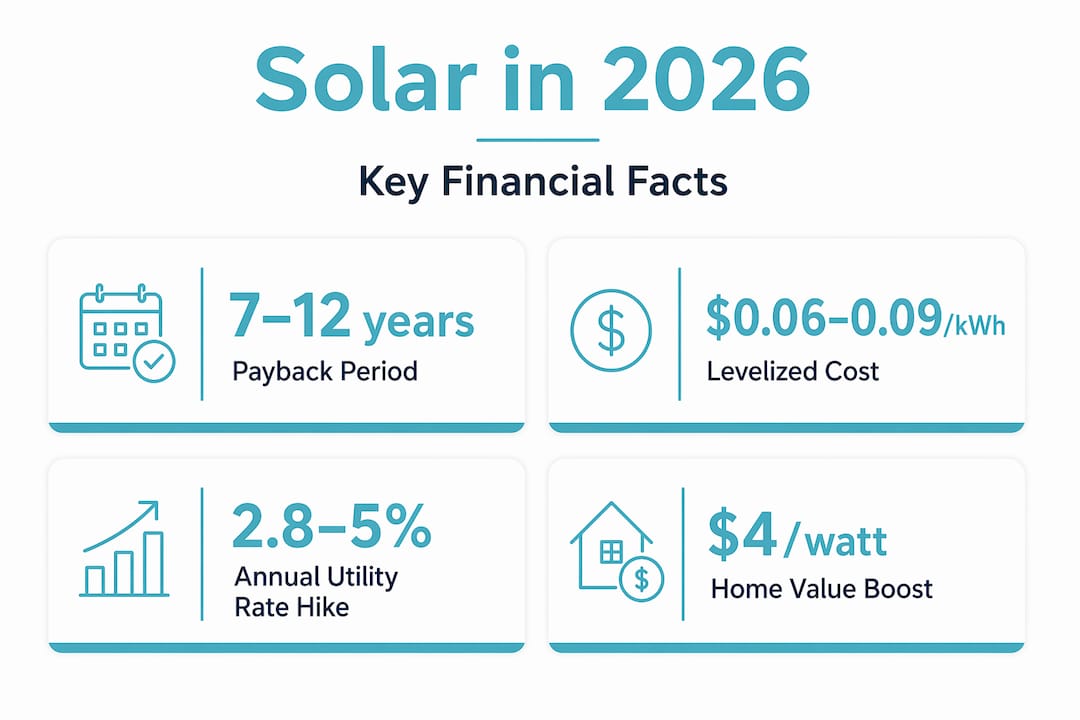
Here’s the core financial case for solar in 2026. The levelized cost of solar energy averages $0.06 to $0.09 per kWh over a system’s life. Grid electricity, depending on your region and rate tier, costs anywhere from $0.18 to $0.45 per kWh. That gap is large and it grows over time.

Utility rates have historically risen between 2.8% and 5% annually. In some states facing clean energy mandates and grid infrastructure upgrades, those increases have been running closer to 6% to 8% in recent years. Solar locks in a large portion of your energy costs at today’s prices, which gets more valuable every year your rates climb.
Payback periods and long-term returns
Without the federal credit, payback periods are longer. Realistically, most homeowners in 2026 should plan for a 7 to 12 year payback depending on their state incentives, local electricity rates, and system size. After payback, every kilowatt-hour your panels produce is essentially free electricity for the remaining 15-plus years of your system’s life.
Pro Tip: When calculating your ROI, use a conservative 4% utility inflation rate rather than the 6–8% figure many installers plug into their proposals. It gives you a more honest projection of savings.
There’s also the home value angle. Studies show owned solar systems add roughly $4 per watt in resale value. For a 6 kW system, that’s approximately $24,000 added to your home’s market price. Importantly, this applies only to systems you own outright, not leased systems, which can actually complicate a home sale.
Battery storage is also changing the financial math. Under updated net metering rules in California (NEM 3.0) and similar policy shifts in other states, the credit you receive for exporting power to the grid has dropped. Battery storage paired with solar improves your ROI by letting you use more of what you generate rather than selling it back at reduced rates. This is a significant shift from how solar was evaluated even two years ago.
Environmental benefits of going solar
The environmental case for residential solar is straightforward and well-documented. A typical home solar system offsets about 3.9 tons of CO2e annually based on the national average grid emissions factor. Over a 25-year system life, that adds up to nearly 100 tons of avoided carbon emissions from a single home.
The “carbon debt” question comes up often: doesn’t manufacturing the panels emit carbon too? Yes, but advances in panel manufacturing efficiency have reduced that footprint considerably, and most systems pay back their carbon debt within 1 to 4 years. After that, every year of clean generation is a genuine net positive.
A few additional ways solar compounds its environmental impact:
- Electric vehicles: Charging an EV with solar power eliminates transportation emissions at nearly zero marginal cost per mile.
- Heat pumps: Running a heat pump on solar-generated electricity cuts home heating and cooling emissions substantially compared to gas systems.
- Grid support: During peak demand hours, solar homes can push clean electricity back to the grid, reducing the need for utilities to fire up carbon-intensive peaker plants.
3.9 tons of CO2e avoided per year. That’s the equivalent of not driving a gas-powered car for approximately 9,800 miles annually.
Choosing solar in 2026 also connects your household to broader clean energy goals. As more homes generate their own power, the grid as a whole gets cleaner and more resilient.
Practical considerations before you sign
Going solar in 2026 requires more homework than it did when the federal credit made nearly any deal look attractive. Here’s a practical checklist of what to think through before committing:
- Evaluate your net metering policy. Find out what credit rate your utility pays for exported electricity. If it’s been reduced recently, factor battery storage into your quote from the start.
- Size your system to your actual usage. Oversized systems waste money upfront and may produce more than you can use or sell. Pull 12 months of utility bills before any consultation.
- Compare ownership options honestly. Purchasing outright yields better ROI than leasing in most scenarios now that homeowners can’t claim the federal credit themselves. Financing through a low-interest solar loan is the middle path worth exploring.
- Verify equipment and warranties. Look for panels with at least a 25-year performance warranty and inverters from established manufacturers. Cheap equipment erodes long-term savings.
- Think about your energy load profile. If most of your electricity use happens in the evening, a battery backup system improves your return significantly. Evening-biased household loads benefit the most from pairing storage with solar.
Pairing solar with other renewable energy upgrades for your home can accelerate your overall return and reduce total energy costs further.
Pro Tip: Ask your installer for a shading analysis report, not just a verbal estimate. Trees grow, neighbors build additions, and a system that performs well on day one may underperform five years from now if shading wasn’t properly accounted for.
My perspective: solar still makes financial sense, but the homework matters more now
I’ve watched homeowners react to the federal credit expiration with a lot of uncertainty, and honestly, that reaction makes sense. Losing a $6,600 credit on a $22,000 purchase is not trivial. But I think some of that anxiety is pushing people toward the wrong conclusion.
What I’ve found is that the credit was never the whole story. The homeowners who got the best long-term outcomes were the ones who sized their systems correctly, understood their utility’s net metering rules, and paid attention to equipment quality. The credit was a bonus. The fundamentals were the real value driver.
In my view, 2026 is actually a better time than many people realize to think about solar as part of a larger home energy strategy. Battery storage technology has matured. Costs have come down. And the gap between what you pay for grid power and what solar costs over its lifetime is wider than ever.
What I’d caution against is leaning too hard on leasing without reading the full contract. A 20-year PPA locks in your costs in a way that can complicate refinancing, selling your home, or upgrading your system later. The indirect credit benefit through a third-party owner is real, but I’d run the full 25-year cost comparison before deciding it’s the better path for your household.
Do the detailed ROI math yourself using conservative inputs. Shop at least three installers. And treat solar not as a standalone purchase but as the anchor of your home’s long-term energy plan.
— Shyerome
How A-rsolar helps you get it right
A-rsolar has spent two decades working with homeowners across Washington and Oregon to design, install, and maintain residential solar systems. The team handles every step, from permits and system design to installation, ongoing maintenance, and system monitoring.
If you’re evaluating solar in 2026, the best starting point is seeing what real installations have delivered for real homeowners. A-rsolar’s residential case studies show actual system sizes, costs, and savings across a range of Pacific Northwest homes. For homeowners weighing battery storage given the current net metering environment, A-rsolar’s Powerwall battery solutions are worth a close look. Contact A-rsolar to get a personalized consultation and an itemized quote tailored to your home’s energy profile.
FAQ
Does solar still make financial sense without the federal credit?
Yes. State incentives, net metering credits, rising utility rates, and strong home resale value still make solar a viable long-term investment for most homeowners, though payback periods now typically run 7 to 12 years depending on location.
What solar incentives are available in 2026?
State-level programs including property tax exemptions, sales tax exemptions, direct rebates, SRECs, and net metering remain active in many states. Strong incentive states include New Jersey, Massachusetts, New York, California, and Hawaii.
How much does a residential solar system cost in 2026?
The national average is around $2.95 per watt, putting most 6 to 8 kW systems between $18,000 and $27,000 before any state rebates or incentives are applied.
Is leasing or buying solar better in 2026?
Buying outright or financing through a solar loan generally delivers better long-term ROI than leasing, since homeowners can no longer claim the federal credit directly. Leasing does carry some indirect credit benefit through third-party owners, but the long-term contract terms require careful review.
Should I add battery storage to my solar system in 2026?
For most homeowners, especially those on utilities that have reduced net metering export rates, adding battery storage significantly improves your return on investment and provides energy resilience during outages.