

TL;DR:
- B Corporation certification is a rigorous, third-party verified standard that assesses a company’s social, environmental, and governance impact through audits aligned with international standards. Certified B Corps in solar reduce buyer risk, enhance supply chain transparency, and demonstrate measurable environmental results, such as billions in energy savings and millions of metric tons of avoided emissions. Choosing a B Corp solar partner ensures accountability, long-term stability, and compliance with ESG frameworks, making it a vital factor in sustainable energy decisions.
B Corp certification is not a marketing badge. It is a verified standard, and the role of B corporations in solar is growing more significant as consumers and businesses demand proof behind sustainability claims. In a sector where greenwashing is a real concern, certified B Corporations bring independently audited accountability to every project they touch. This article explains what that certification actually requires, why it matters for solar companies specifically, and what it means for you when choosing a solar partner or evaluating a supplier’s sustainability credentials.
Table of Contents
- Key Takeaways
- The role of B corporations in solar starts with real certification standards
- How B corporations contribute uniquely to the solar sector
- Measurable outcomes from B Corp solar companies
- Practical advantages of choosing a B Corp solar partner
- My perspective on B Corp certification in solar
- Why A&R Solar’s B Corp certification sets it apart
- FAQ
Key Takeaways
| Point | Details |
|---|---|
| B Corp is third-party verified | Certification involves audits and evidence collection aligned with international standards, not self-declaration. |
| Solar B Corps reduce buyer risk | Verified ethics and governance help procurement teams and homeowners avoid supply chain surprises. |
| Measurable impact is documented | Companies like Sunrun show billions in energy savings and millions of metric tons of avoided carbon emissions. |
| ESG alignment is built in | B Corp certification maps directly to ESG and CSRD reporting frameworks, simplifying compliance for buyers. |
| Long-term reliability matters | B Corps commit legally to stakeholder governance, not just shareholder returns, creating more durable partnerships. |
The role of B corporations in solar starts with real certification standards
Most people assume a company calling itself a B Corporation has simply filled out a form or paid a fee. That assumption is wrong, and understanding why matters if you want to make informed decisions about solar.
B Corp certification is a rigorous, third-party verified process that assesses a company’s social, environmental, and governance impact using B Lab Standards aligned with ISO 17021-1. That last detail is worth pausing on. ISO 17021-1 is the same international framework used to accredit management systems certifications like ISO 9001. Applying it to business ethics and impact measurement is a serious undertaking.
The process works in stages:
- Self-assessment: Companies complete the B Impact Assessment, scoring themselves across governance, workers, community, and environment categories.
- Evidence upload: Every claim requires documentation. A solar company saying it pays fair wages needs payroll records and HR policies to back it up.
- Third-party audit: B Lab or an accredited assessor reviews the evidence and scores, often requesting additional documentation or interviews.
- Ongoing accountability: Certification is ongoing, requiring iterative evidence collection and corrective action within six months when auditors flag nonconformities.
For solar companies, this process covers far more than whether their panels produce clean electricity. It evaluates how they treat workers, how transparent their governance is, what their supply chain practices look like, and how their business decisions affect the communities they serve.
Certified B Corporations commit legally to stakeholder governance, balancing profit with benefits to employees, communities, and the environment. In practical terms, that means a B Corp solar installer cannot legally prioritize short-term financial returns if doing so harms employees or customers. This legal commitment separates B Corps from companies that simply publish a sustainability report.
Pro Tip: When evaluating any solar company’s sustainability claims, ask directly whether they hold active B Corp certification and when their last audit was completed. A certified company will be able to provide that information without hesitation.
How B corporations contribute uniquely to the solar sector
The solar industry has a transparency problem. Panels may be manufactured with labor practices that buyers never see. Installers may overstate system performance projections. Supply chains can span multiple continents with limited oversight. B Corp certification directly addresses all of these issues, which is why the impact of B corporations in solar goes well beyond the certificate on the wall.

Luxra, a Swiss solar module and energy storage manufacturer, achieved B Corp certification specifically because it helps reduce customer risk and supports ESG and CSRD reporting requirements. Their reasoning reflects a growing reality: large buyers, particularly commercial and institutional purchasers, are under regulatory pressure to demonstrate the sustainability credentials of their supply chains. A B Corp supplier simplifies that process considerably.
Consider what this means in practice:
- Procurement alignment: A buyer with ESG or CSRD reporting obligations can point directly to their solar supplier’s B Corp certification as verified evidence of responsible sourcing.
- Supply chain transparency: B Corp audits examine governance and worker practices throughout the business, not just the end product.
- Reduced risk of disruption: Procurement continuity improves when suppliers have verified, stable governance practices rather than opaque ownership structures.
- Greenwashing protection: Because certification is independently audited and not self-declared, it carries real weight when a buyer needs to defend their sourcing choices to regulators or stakeholders.
Solaris Energy takes a different but complementary approach. They apply a triple-bottom-line model that ties business success directly to accelerating solar deployment and reducing environmental impact. Their B Corp status underpins financing decisions, community program choices, and the types of projects they pursue.
“We believe doing right by people and planet is not in conflict with building a strong business. B Corp certification is how we demonstrate that belief with evidence, not just words.” — Solaris Energy on maintaining values through changing political climates.
This framing is useful for organizations evaluating potential solar partners. A company whose values are embedded in its legal structure and verified by auditors is a more reliable long-term partner than one whose sustainability commitments exist only in a marketing brochure.
Measurable outcomes from B Corp solar companies
The benefits of B corporations in solar are not abstract. They show up in quantifiable results, and some of the numbers are striking.
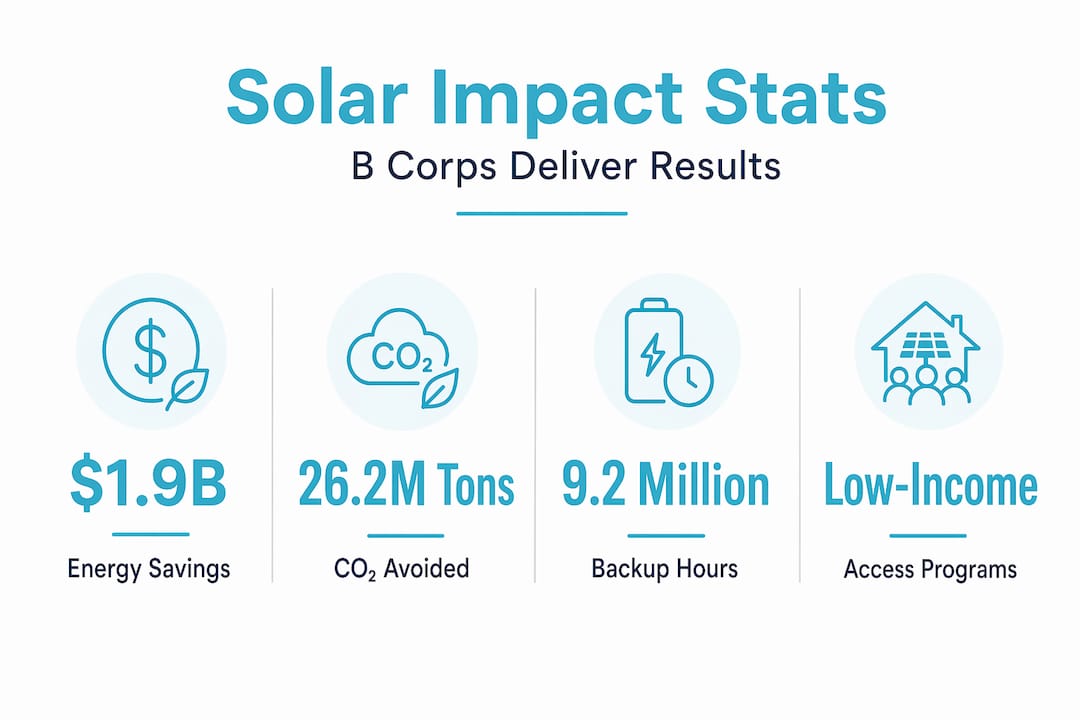
Sunrun, one of the largest residential solar providers in the United States, ranked No. 5 on TIME’s World’s Most Impactful Companies list in 2026. The reason is data-driven. Since 2007, Sunrun has delivered $1.9 billion in energy savings, provided 9.2 million hours of backup power, and helped avoid 26.2 million metric tons of carbon emissions.
| Metric | Result |
|---|---|
| Customer energy savings | $1.9 billion since 2007 |
| Backup power provided | 9.2 million hours |
| Carbon emissions avoided | 26.2 million metric tons |
| TIME ranking (2026) | No. 5, World’s Most Impactful Companies |
Those numbers matter for more than bragging rights. They demonstrate that the B Corp model of linking business practices to social and environmental outcomes actually produces results at scale. The company’s verified commitments to community benefit and low-income household access are part of what earned that recognition.
Community solar programs serve as another clear example. B Corp solar companies tend to prioritize access for low-income households because their legal structure and certification standards push them toward that outcome. Standard solar businesses are not incentivized in the same way.
Pro Tip: If you are comparing solar providers, look for data-driven impact reports, not just mission statements. A B Corp company should be able to provide documented outcomes, not estimates.
B Corp evaluation also covers holistic company performance across governance, community, environment, and workers. That means a solar company with excellent panel specifications but poor worker treatment or weak governance cannot pass certification. The standard demands consistency across all dimensions, which is what makes the certification credible.
Practical advantages of choosing a B Corp solar partner
Understanding how B corporations support solar is one thing. Knowing how to use that understanding when making decisions is what creates real value.
For homeowners in Washington and Oregon, choosing a B Corp solar installer means working with a company that has been verified to operate with transparency and accountability. That reduces the risk of cost overruns, misleading projections, or disappearing after installation. The certification is not a guarantee of zero problems, but it is documented evidence that the company operates under a higher standard of governance.
For organizations with procurement policies, the advantages are more specific:
- ESG and CSRD reporting: B Corp certification maps directly to ESG frameworks, so sourcing from a B Corp solar supplier simplifies compliance documentation.
- Supplier due diligence: The certification replaces multiple layers of supplier questionnaires and audits, reducing procurement friction significantly.
- Lower long-term costs: B Corp solar companies demonstrate financial stability and ethical governance, meaning fewer surprise service interruptions, billing disputes, or contract violations over time.
- Financing advantages: Companies like Solaris Energy use their B Corp values to pursue low-cost solar financing models that expand access for households and communities that standard financing excludes.
NABCEP-certified installers already demonstrate technical competence, but pairing that with B Corp standards gives you verified ethical and governance performance alongside verified technical skill. That combination is rare and worth seeking out.
The distinction between B Corp solar providers and conventional ones is not primarily about product quality. It is about accountability structures. When a company’s legal charter requires balancing stakeholder interests, and when that charter is audited by a third party, your interests as a customer carry more weight than they would otherwise.
My perspective on B Corp certification in solar
I have followed B Corp certification in the solar sector long enough to have a clear opinion: most people underestimate what the certification actually involves, and that underestimation leads them to either dismiss it as a label or to accept cheaper imitations without scrutiny.
What I have seen repeatedly is that the solar companies most likely to deliver on their long-term promises are the ones that have had to document and defend their practices to an outside auditor. Not because certification makes them perfect, but because the process of pursuing it forces them to build systems, not just intentions.
The ongoing accountability requirement is what separates meaningful certification from a one-time exercise. Solar operators must anticipate audit nonconformities and address corrective actions within six months to maintain certification timelines. That is not a paperwork burden. It is a structural commitment to continuous improvement.
My honest take: if you are choosing a solar company for your home or evaluating a solar supplier for your organization, B Corp certification should be a serious factor in that decision. Not the only factor, but a meaningful one. The companies that invest in verified accountability are the ones building for the long term. That is who you want installing panels on your roof or supplying your supply chain.
The role of benefit corporations in clean energy will grow as ESG reporting requirements expand and as consumers become more skeptical of unverified claims. Getting ahead of that curve by working with certified companies is not just good ethics. It is smart planning.
— Shyerome
Why A&R Solar’s B Corp certification sets it apart
A&R Solar is a Certified B Corporation and employee-owned solar installer serving residential customers throughout Washington and Oregon. That certification is not a marketing tagline. It reflects two decades of verified commitment to workers, communities, and environmental outcomes, audited by a third party and renewed on an ongoing basis.
For homeowners considering solar, that means you are working with a company whose governance structure legally prioritizes your interests alongside business performance. A&R Solar’s residential solar projects reflect the kind of long-term thinking that B Corp certification demands: full-service installations that include permits, maintenance, and system care, not just a panel drop and departure.
If whole-home energy independence is your goal, their home battery backup solutions pair with solar installations to keep your household running when the grid does not. For more on what drives A&R Solar’s B Corp commitment, their certification story is worth reading before your next solar conversation.
FAQ
What does B Corp certification require from solar companies?
B Corp certification requires solar companies to complete a third-party audited assessment of their governance, worker practices, community impact, and environmental performance using B Lab Standards aligned with ISO 17021-1. It is not self-declared and must be renewed through ongoing evidence collection and audits.
How do B corporations reduce risk for solar buyers?
B Corp solar companies provide verified evidence of ethical governance and supply chain practices, reducing procurement risk and simplifying ESG and CSRD reporting compliance for organizations that source from them.
What is the real-world impact of B Corp solar companies?
Companies like Sunrun have documented $1.9 billion in customer energy savings and 26.2 million metric tons of avoided carbon emissions since 2007, demonstrating that B Corp principles translate into measurable community and environmental results.
Is B Corp certification the same as being a benefit corporation?
No. A benefit corporation is a legal business structure available in many U.S. states. B Corp certification is an independent third-party verification issued by B Lab. Some companies hold both, but they are distinct designations with different requirements and processes.
How can homeowners verify a solar company’s B Corp status?
You can search the B Lab directory at bcorporation.net to confirm active certification status, the most recent certification date, and the company’s overall impact score across governance, community, environment, and workers.