

TL;DR:
- Community solar allows renters and homeowners with shaded or unsuitable roofs to access solar energy through off-site shared arrays. Subscribers receive bill credits that often lower their utility costs and can benefit from income-qualified discounts and long-term transferability. With growing nationwide programs, community solar expands access to clean energy, providing cost savings, local economic benefits, and enhanced grid resilience for diverse households.
Most people assume that benefiting from solar energy means mounting panels on your roof. If you rent, have a shaded roof, or live in a condo, that assumption leaves you out of the picture entirely. Community solar explained simply: it is a model where you subscribe to a share of a solar array built off your property and receive bill credits based on what that array produces. No installation. No roof required. This article covers how community solar works, what it costs, what the real benefits of community solar are, and how to find a program near you.
Table of Contents
- Key takeaways
- Community solar explained: how it actually works
- Benefits of community solar for homeowners and renters
- Community solar costs and common misconceptions
- How to find and join a community solar program
- Community solar, energy equity, and what’s ahead
- My take on community solar’s real potential
- Ready to explore your solar options with A-rsolar?
- FAQ
Key takeaways
| Point | Details |
|---|---|
| No roof required | Renters and homeowners with shaded or unsuitable roofs can still access solar energy through a shared off-site array. |
| Bill credits reduce costs | Subscribers receive electricity bill credits that can translate into significant long-term savings on their utility costs. |
| Income-qualified discounts available | Some programs offer up to 50% bill reductions for income-qualified households through combined assistance programs. |
| Programs exist nationwide | 44 states and DC have some level of community solar participation today. |
| Flexibility is built in | Subscriptions can often be transferred within a utility territory if you move, which reduces long-term commitment risk. |
Community solar explained: how it actually works
Community solar is a shared solar model where a developer builds a large solar array, typically on open land or a commercial rooftop, and multiple subscribers buy or lease a portion of that array’s output. You do not own the panels yourself. Instead, you sign up for a share of the electricity they produce, and your utility applies bill credits to your account each month reflecting the energy your share generated.
There are two main participation structures. The first is a subscription model, where you pay a monthly fee for your share and receive credits that offset that cost. The second is an ownership model, where you purchase a portion of the project outright. Most residential programs use the subscription model because it requires no upfront capital and carries far less financial risk.
Here is a simplified breakdown of how the process typically works:
- A developer builds a community solar farm in your utility service area.
- You sign up and select a subscription size, usually measured in kilowatts or as a percentage of your monthly energy usage.
- The array generates electricity and feeds it into the local grid.
- Your utility tracks the energy your share produced and applies a corresponding credit to your monthly bill.
- You pay the subscription fee and your reduced utility bill, and the credits cover the difference or more.
Over 40% of households cannot host rooftop solar due to structural issues, renting arrangements, or financial barriers. Community solar programs exist specifically to remove those barriers. Geographic availability has expanded rapidly, with 24 states passing community solar enabling legislation. The typical signup process takes minutes online and resembles signing up for a utility account rather than a construction project.
Benefits of community solar for homeowners and renters
The benefits of community solar extend well beyond electricity savings, though the savings alone are worth paying attention to. Here is what participation actually delivers:
- No installation or maintenance costs. You are subscribing to energy output, not buying equipment. There are no permits, no installers on your roof, and no maintenance bills over the life of the array.
- Access regardless of your housing situation. Whether you rent an apartment, own a home with a north-facing roof, or live under a tree canopy, you qualify. This makes community solar one of the few renewable energy options fully available to renters.
- Real electricity bill savings. Community solar energy costs can run as low as $0.06 per kWh, compared to standard utility supply rates above $0.12 per kWh in many states. That gap translates directly into lower bills.
- Stronger discounts for income-qualified households. In California, income-qualified customers receive a 20% discount that, combined with existing assistance programs, can slash electricity bills by up to 50%.
- Local economic benefits. Solar projects support local employment during both construction and ongoing operations, keeping energy dollars circulating in the community rather than flowing to distant fuel suppliers.
- Grid resilience and environmental benefits. Distributed generation through community solar improves grid resilience by reducing dependence on centralized power plants and diversifying energy sources during peak demand periods. Some projects also incorporate wildlife-friendly land management like pollinator habitats and native plantings alongside the arrays.
Pro Tip: When evaluating a community solar program, compare the subscription rate per kWh against your current utility supply rate. If the subscription rate is lower, you will save money from day one without any additional action on your part.
For renters specifically, A-rsolar has documented how shared solar arrangements have worked for affordable housing communities. You can read one example in their affordable senior housing case study to see what real-world savings look like for residents with limited fixed incomes.

Community solar costs and common misconceptions
The biggest misconception people carry about community solar is that it must be expensive or filled with hidden fees. The reality is different, and worth unpacking directly.
Most programs are structured so that the bill credit you receive exceeds the subscription fee you pay. The net result is a monthly savings, not an added expense. Connecticut subscribers receive credits of approximately 2.5 cents per kWh above the subscription cost over 20 years, projected to generate more than $200 million in total savings statewide. That is not a trivial number.
Here is what the typical cost structure looks like:
- Subscription fee: You pay the community solar provider a rate per kWh for your share of production. This rate is usually set below your utility’s standard supply rate.
- Utility bill credit: Your utility credits your account for the energy your share produced, often at the full retail rate or a defined credit rate.
- Net impact: If the credit rate exceeds your subscription fee, your total energy cost drops. Most well-structured programs guarantee this outcome.
“Concerns about community solar cost often overlook broader system benefits such as cost-effective clean energy and grid improvements.” — CT Mirror analysis of shared solar economics
Programs designed for low-income participants go further. These programs require a minimum 20% savings guarantee, no termination fees, and plain-language contracts. That means consumers are protected from the predatory terms that occasionally appear in competitive energy markets. Before signing any contract, you should verify that those protections are present or that your state mandates equivalent standards.
One more myth worth addressing: community solar does not require you to stay in your home for the life of the project. Subscribers can transfer subscriptions within the utility service territory if they move, which removes the long-term lock-in concern that deters some potential participants.
How to find and join a community solar program
Finding a program is simpler than most people expect. The challenge is knowing where to look and what questions to ask before committing.
- Start with your utility. Many utilities in states with enabling legislation have active community solar programs or approved rosters of participating developers. Your utility’s website or customer service line is the fastest starting point.
- Check your state energy office. State energy offices maintain lists of approved programs and may offer consumer guides that compare options. This is especially valuable in states with multiple competing providers.
- Use the Department of Energy’s community solar resources. The DOE provides program directories and educational materials that can help you identify what is available in your area.
- Read the contract before signing. Look specifically for the subscription rate per kWh, the credit rate applied to your utility bill, contract length, exit terms, and whether savings are guaranteed.
- Ask about income-qualified options. Even if you do not believe you qualify, it is worth asking. Eligibility thresholds vary by program and state, and some discounts apply to moderate-income households as well.
Pro Tip: Request a sample bill comparison from the provider before enrolling. A reputable program should be able to show you a side-by-side estimate of your current bill versus your projected bill after subscribing, with and without the credit applied.
The enrollment process itself is typically straightforward. Most programs accept online applications and require only your utility account number and address. Some programs have waitlists due to high demand, so signing up early in your area matters. For context on how community solar participation has played out at the neighborhood level, A-rsolar’s piece on community solar in Capitol Hill offers a useful local perspective.
Community solar, energy equity, and what’s ahead
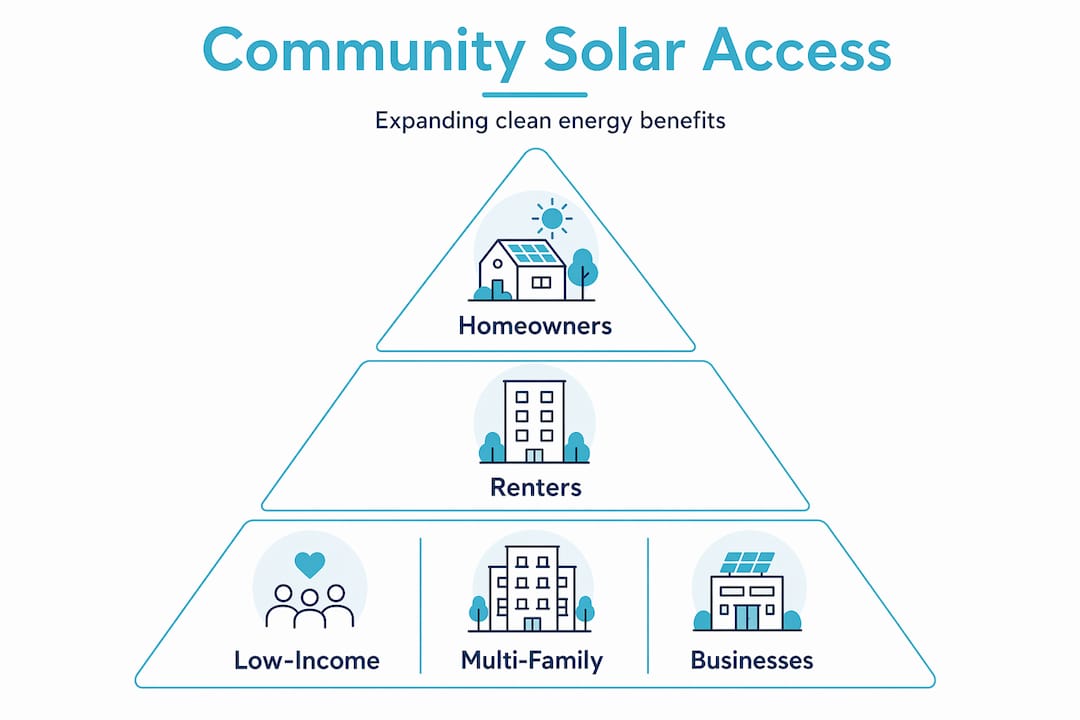
Community solar is not just an energy product. It is a meaningful tool for expanding access to clean power among households that standard solar cannot reach. The table below captures the key equity dimensions and outlook for programs across the country.
| Group served | Current barrier removed | Example program benefit | Growth outlook |
|---|---|---|---|
| Renters | No roof ownership required | Full subscription access with no installation | Strong; more state mandates expected |
| Low-income households | No upfront cost; guaranteed savings | Up to 50% bill reduction in California | Expanding with equity-focused legislation |
| Homes with shaded roofs | No need for direct sun exposure | Same subscription model as any participant | Growing in urban and forested areas |
| Affordable housing residents | Developer leads project, no tenant action | Automatic credits applied to unit bills | Increasing under federal and state housing programs |
States like California, New York, and Illinois have passed legislation specifically requiring that a portion of community solar capacity serve low-income customers. These mandates are producing measurable results. The broader trend points toward more states following suit as clean energy mandates push utilities to demonstrate equitable access.
There are challenges ahead. Program waitlists can be long. Contract terms vary enough across providers that consumer confusion is a genuine risk. And in some states, utility credit rates are set in ways that reduce the financial benefit to subscribers. Advocates and regulators are working to address these gaps, but the responsibility of reading your agreement carefully still sits with you as a consumer.
The overall trajectory is positive. With 44 states already showing some level of participation, the infrastructure for broader access is in place. Policy momentum, falling project costs, and growing consumer demand are pushing community solar toward mainstream adoption.
My take on community solar’s real potential
I have spent years watching the renewable energy conversation focus almost entirely on homeowners with new roofs and good credit scores. Community solar is the first model I have seen that genuinely includes everyone else, and I think it is underutilized as a result.
What I see consistently is that consumers discount community solar because they do not understand how bill credits work. They assume a subscription is an added bill rather than a replacement for part of their existing utility cost. That framing shift, from “added expense” to “lower-cost energy source,” changes everything for most people I talk to.
My concern is that the market’s growth has outpaced consumer education. Not every community solar provider operates with transparent terms, and I have seen contracts that bury the credit rate in fine print. The programs with strong consumer protections, guaranteed savings, and plain-language disclosures are the ones worth recommending. The others require scrutiny.
If you are a renter or a homeowner who has been told solar is not for you, community solar is worth reconsidering. The financial math is straightforward when you compare subscription rates against your current utility rate. The programs that cannot show you that comparison clearly are the ones to walk away from.
— Shyerome
Ready to explore your solar options with A-rsolar?
A-rsolar has worked with residential customers across Washington and Oregon for two decades, helping homeowners and renters understand their solar options and make decisions grounded in real numbers. Whether you are weighing community solar against a rooftop installation or simply want to know what makes sense for your household, their team provides straightforward guidance without the sales pressure.
You can browse A-rsolar’s residential solar projects to see real examples of how solar solutions have worked for customers in the Pacific Northwest. For a deeper look at case studies including community-oriented projects, the residential case studies portfolio is a practical starting point. If you are ready to talk through your specific situation, reach out directly to schedule a consultation with an A-rsolar advisor.
FAQ
What is community solar and who can join?
Community solar is a shared solar program where subscribers receive electricity bill credits from an off-site solar array without needing to install any equipment. Renters, condo owners, and homeowners with unsuitable roofs can all participate.
How does the billing work for community solar subscribers?
Your utility applies a credit to your monthly bill based on the energy your subscription share produced. You pay the subscription fee to the solar provider and a reduced amount to your utility, with the credit covering the difference.
Is community solar worth it financially?
For most subscribers, yes. Community solar energy costs can be as low as $0.06 per kWh compared to standard utility rates above $0.12 per kWh, and income-qualified programs can reduce total electricity bills by up to 50%.
What happens if I move after subscribing to a community solar program?
Most programs allow you to transfer your subscription to a new address within the same utility service territory. If you move outside the service area, you can typically cancel without a termination fee, especially in programs with strong consumer protections.
Are there community solar programs in Washington and Oregon?
Both states have active renewable energy programs and ongoing legislative support for distributed solar. Checking with your utility or contacting a local solar advisor like A-rsolar is the most direct way to identify current options in your service area.