

TL;DR:
- Getting solar permits in Washington can take over eight weeks due to inconsistent requirements and slow reviews, while Oregon’s process is faster at four to eight weeks through its prescriptive path. Most delays stem from incomplete submissions, incorrect documents, or poor communication, not government inefficiency, emphasizing the importance of thorough preparation and local experience. Proactive coordination with authorities and filing complete applications simultaneously can significantly reduce project timelines and costs.
Getting solar panels installed sounds straightforward until you hit the permitting process. Washington state earned an F grade for solar permitting ease, meaning homeowners there routinely wait more than eight weeks before a single panel goes up. Oregon moves faster, but even the prescriptive path takes four to eight weeks. For homeowners ready to start saving on energy costs, that gap between decision and activation adds up, in both time and money.
Table of Contents
- Understanding the solar permitting process
- Washington vs. Oregon: Permitting timelines and requirements
- How to prepare a complete permit submission
- After approval: What to expect and next steps
- Why most permitting delays are avoidable—and what homeowners should really focus on
- Get expert help for your solar project
- Frequently asked questions
Key Takeaways
| Point | Details |
|---|---|
| WA vs. OR permitting speed | Washington permits are slower and more prone to delays, while Oregon’s process is faster when the prescriptive path is followed. |
| Complete submission is crucial | Filling out all documents at the beginning minimizes project delays and costly repeat visits. |
| Avoiding costly delays | Every permitting delay can add hundreds of dollars to your final bill due to extra inspections and truck rolls. |
| Prepare for inspections | After permit approval, timely inspections and utility hookups are essential for solar activation. |
| Expert help available | Working with experienced installers or consultants streamlines the process and helps you avoid common pitfalls. |
Understanding the solar permitting process
Now that you know why delays matter, let’s break down the solar permitting steps so you can avoid the most common pitfalls.
Solar permitting is a legally required step before any installation work begins on your home. It is not optional, and skipping it can result in fines, forced removal of your system, or problems when you sell your home. The permit process involves multiple parties: your local building department, your utility company, and sometimes your homeowners association (HOA). Each party has its own timeline and documentation requirements, which is why coordination matters so much.
Here is what a typical solar permitting process looks like from start to finish:
- Site plan: A drawing of your property showing where panels will be placed, roof orientation, and setback distances from edges and obstructions
- Engineering letter or structural report: Confirms your roof can support the weight of the solar array
- Electrical diagrams: Show how the system connects to your home’s existing wiring and the utility grid
- Utility interconnection application: Filed with your utility company to allow two-way power flow through net metering
- Equipment specifications: Datasheets for panels, inverters, and racking systems
- Signatures and notarization: Some jurisdictions require signed consent from all property owners listed on the deed
Understanding solar panels for your home starts with knowing that all of these documents must be assembled together before submission. Sending an incomplete package is one of the most common reasons permits get delayed.
Each incomplete permit submission that requires a follow-up site visit costs an additional $475 per truck roll nationwide, a preventable expense that falls on either you or your installer.
Pro Tip: Before submitting any permit application, run through your jurisdiction’s official checklist at least twice. One missing signature or one outdated datasheet can push your project back by weeks. Following solar best practices from the start significantly reduces the chance of a resubmission.
The interconnection application deserves special attention. This is the form you file with your utility provider to connect your solar system to the grid and qualify for net metering (a billing arrangement where the utility credits you for excess electricity your system sends back to the grid). Depending on your utility, interconnection approval alone can take two to six weeks on top of your building permit timeline.
Washington vs. Oregon: Permitting timelines and requirements
With a basic understanding of permitting, let’s see how requirements differ between Washington and Oregon so you can plan accordingly.
The gap between these two states is significant. Washington’s permitting process earned an F grade in solar ease assessments, reflecting inconsistent requirements across its many jurisdictions, slow review times, and a lack of standardized online submission portals. Oregon, by contrast, benefits from a prescriptive path that simplifies approval for standard residential systems, though it still requires four to eight weeks from submission to final sign-off.
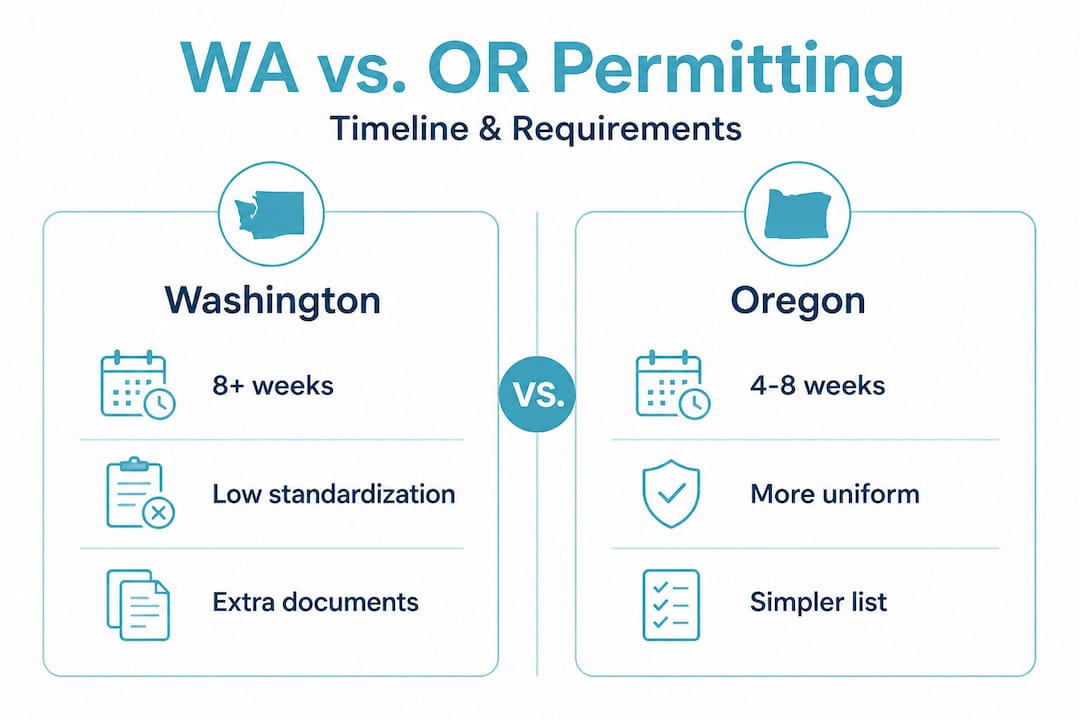
Here is a side-by-side comparison of key differences:
| Factor | Washington | Oregon |
|---|---|---|
| Typical timeline | 8+ weeks | 4 to 8 weeks |
| Standardization | Low, varies by city/county | Moderate, prescriptive path available |
| Online submission | Limited availability | More widely adopted |
| Interconnection timeline | 2 to 6 weeks | 2 to 4 weeks |
| HOA requirements | Must comply, no override law | Limited HOA restrictions on solar |
| State incentives | Sales tax exemption, net metering | Oregon solar incentives include tax credits and rebates |
Oregon’s prescriptive path is worth understanding if you live there. This pathway allows systems that meet pre-approved size and equipment standards to bypass custom engineering review, which removes several weeks from the review timeline. Not every system qualifies, but most standard residential rooftop installations do.
For the fastest possible approval in either state, follow these steps in order:
- Confirm jurisdiction requirements early. Contact your local building department before you finalize your system design. Requirements vary significantly between cities, counties, and utility districts.
- Use pre-approved equipment lists. Some utilities and jurisdictions maintain lists of pre-approved inverters and panels that speed up review.
- Submit everything at once. A complete package reviewed once moves faster than a partial package reviewed multiple times.
- File your interconnection application in parallel. You do not have to wait for your building permit to submit the utility interconnection application. Filing both simultaneously saves weeks.
- Respond to requests immediately. If the building department asks for additional information, treating that response as urgent keeps your place in the review queue.
“In Oregon, homeowners who qualify for the prescriptive path and submit complete documentation consistently see faster approvals. The system rewards preparation.” This reflects what experienced solar project coordinators report when working across both states.
If you are still deciding on financing, reviewing options like leasing solar in Washington can also affect which documentation your installer needs to prepare, so factor that in early.
How to prepare a complete permit submission
Knowing the difference in state requirements, the next step is making sure your submission is complete. Here is how to do that reliably.
The single biggest source of permitting delays is an incomplete first submission. Prioritizing a complete application on the first try eliminates the most expensive and time-consuming delays, including additional $475 truck roll fees. This is not a minor convenience, it is a core project management decision that affects your total cost and installation date.
Here are the most common documentation mistakes homeowners and installers make:
- Outdated equipment datasheets: Manufacturers update their spec sheets frequently. Always include the version current at the time of submission.
- Missing property owner signatures: If the home is owned jointly, every person on the deed may need to sign. Check your jurisdiction’s specific rule.
- Incomplete electrical diagrams: A diagram that shows the panel layout but omits the load calculation or AC disconnect location will be returned for revision.
- Wrong setback measurements: Roof setbacks (the required clear space around panel arrays) vary by jurisdiction and fire code version. Confirm the current local standard before drawing your site plan.
- Interconnection application filed too late: Some homeowners wait until the building permit is approved to file with the utility. Filing both simultaneously saves four to six weeks.
The following table shows the typical documents required for each state:
| Document | Required in Washington | Required in Oregon |
|---|---|---|
| Scaled site plan | Yes | Yes |
| Structural/engineering letter | Yes (most jurisdictions) | Yes, unless prescriptive path qualifies |
| Single-line electrical diagram | Yes | Yes |
| Equipment datasheets | Yes | Yes |
| Interconnection application | Yes (filed with utility) | Yes (filed with utility) |
| Load calculation | Yes | Sometimes required |
| HOA approval letter | Yes (if applicable) | Rarely required |
| Contractor license number | Yes | Yes |
Following thorough solar documentation tips before you submit means reviewing every item on this list and confirming it is current, signed, and formatted to your jurisdiction’s standards.
Pro Tip: Ask your installer directly whether they have a permit submission checklist specific to your city or county. An installer who works regularly in your jurisdiction will know quirks like specific form versions, local plan check fees, or whether your utility requires wet signatures versus e-signatures. Verifying that your installer is approved for WA or OR incentives is equally important, because unapproved contractors can disqualify you from state and utility rebates.
After approval: What to expect and next steps
Once your permit is approved, here is what happens next and what you need to watch for so your solar system gets online smoothly.
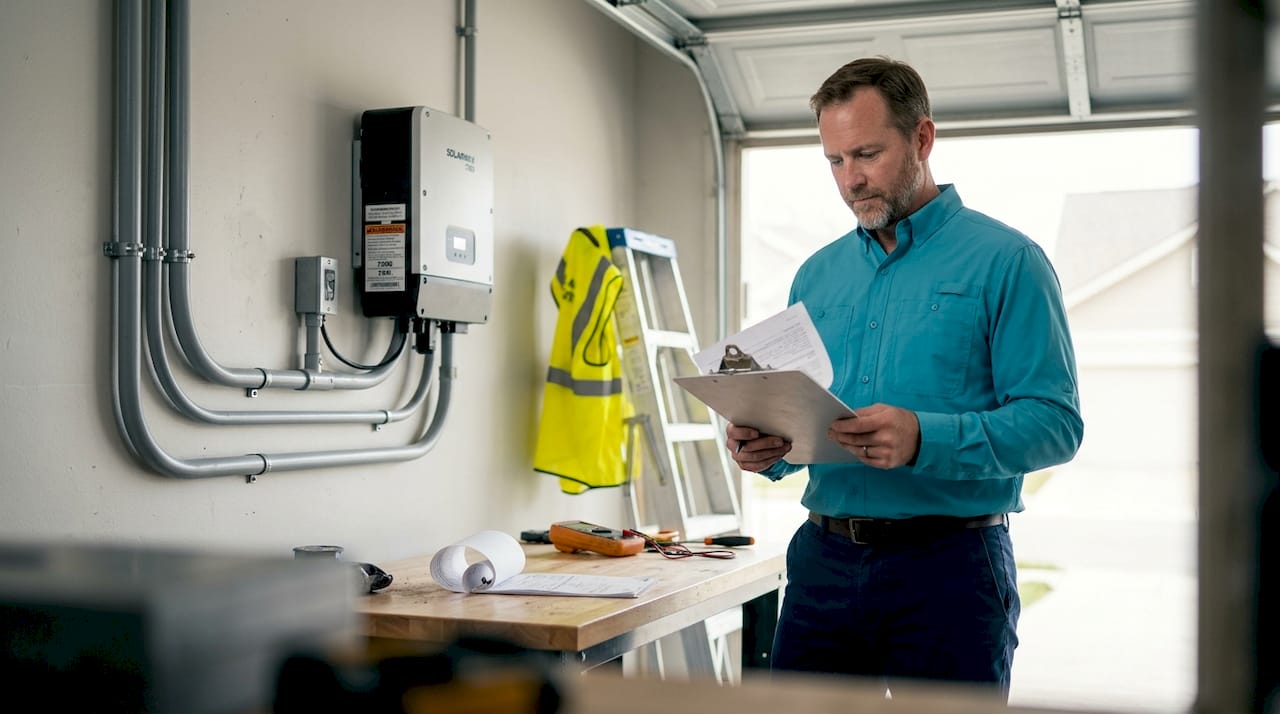
Permit approval is not the finish line. It is the starting gun for physical installation, followed by inspections, utility sign-off, and system activation. Understanding this sequence helps you set realistic expectations and avoid the costly delays from missed inspections that can add $475 per visit to your project.
Here is the typical post-approval sequence:
- Installation begins. Your installer schedules the physical work, which for most residential systems takes one to three days depending on system size and roof complexity.
- Rough inspection (if required). Some jurisdictions require an inspection before the system is fully closed up, particularly for electrical connections. Your installer will schedule this with the building department.
- Final building inspection. After installation is complete, the local building inspector visits the site to verify the work matches the approved plans. If everything passes, they sign off and issue a final approval.
- Utility inspection and interconnection. Your utility company sends its own inspector to verify the meter setup and bidirectional flow capability. This step can take one to four weeks depending on your utility’s schedule.
- Permission to operate (PTO). This is the official authorization from your utility to turn your system on and begin exporting power to the grid. Without PTO, your system cannot legally send power back to the utility.
- System activation and monitoring setup. Once PTO is granted, your installer activates the system and helps you set up solar system monitoring to track production and catch any performance issues early.
Key things to watch for after approval:
- Inspection scheduling delays. Building departments in busy seasons can have two to three week wait times for inspections. Schedule your final inspection as soon as installation is complete.
- Utility backlogs. Utility interconnection queues vary by provider. Some utilities process PTO in days; others take weeks. Ask your installer what to expect from your specific utility.
- Net metering enrollment. In Washington and Oregon, net metering billing does not start automatically. You or your installer may need to submit a separate enrollment form. Review net metering programs in WA and OR to confirm your utility’s specific process.
- Final documentation for incentives. Many state incentives require copies of your final permit, interconnection approval, and PTO letter. Keep these documents organized from the start.
Why most permitting delays are avoidable—and what homeowners should really focus on
With the step-by-step process covered, let’s dig into what industry veterans wish every homeowner knew about avoiding delays.
After working through hundreds of residential solar projects across Washington and Oregon, one pattern becomes clear: most permitting delays are not caused by slow government processes. They are caused by incomplete submissions, wrong equipment specifications, and poor coordination between installers and homeowners. The F grade Washington earned in solar permitting ease is real, but it is not the whole story.
Here is what experienced project coordinators have observed over and over. A homeowner signs with an installer, the installer submits a permit with a minor documentation error, and suddenly the project is four to six weeks behind before a single panel is touched. That delay is not the city’s fault. It is a process failure that better preparation would have prevented.
The conventional wisdom says “choose the cheapest installer.” The reality is that an installer who knows your local jurisdiction, has a relationship with the plan check department, and submits complete first-time applications is worth significantly more than a slightly lower quote. Permitting knowledge is part of what you are paying for.
There is also a broader point about communication. Many homeowners do not know they can call their local building department directly and ask questions. Municipal plan checkers are generally willing to clarify requirements before submission. A five-minute phone call can prevent a four-week delay.
The most effective approach combines three things: a thorough pre-submission checklist, an installer with local experience, and proactive communication with both the building department and the utility. Following solar process best practices is not just advice, it is a measurable strategy for a faster, lower-cost project. For additional context on how the broader industry is improving its approach to project timelines, renewable energy project coordination strategies offer useful perspective on what separates high-performing installers from the rest.
The homeowners who have the best experiences with solar are the ones who treat permitting as a project phase that deserves attention, not a formality they hand off entirely to their installer.
Get expert help for your solar project
Navigating the permitting process in Washington or Oregon is manageable when you have the right support from the start. At A&R Solar, we handle permitting coordination as part of every installation, with local knowledge built over two decades of residential projects across both states.
If you want to see what a well-managed solar project looks like from start to finish, our residential solar projects portfolio includes examples from homeowners across Washington and Oregon who moved from permit submission to system activation without costly delays. For homeowners weighing whether solar makes sense for their specific situation, our solar consulting benefits page explains how a personalized consultation can clarify your options, timeline, and expected savings before you commit to anything. Reach out to start the conversation.
Frequently asked questions
How long does solar permitting take in Washington and Oregon?
In Washington, permitting often exceeds 8 weeks due to inconsistent jurisdictional requirements; Oregon’s prescriptive path can reduce timelines to four to eight weeks for qualifying systems.
What documents do I need for a solar permit?
You typically need a site plan, engineering or structural letter, single-line electrical diagram, equipment datasheets, and a signed interconnection application filed with your utility company.
How much can delays cost me as a homeowner?
Each follow-up site visit from an incomplete submission adds a $475 truck roll fee, which can add up quickly if multiple resubmissions are required.
Can I speed up the permitting process?
Yes. Submitting a complete application on the first attempt and filing your utility interconnection application simultaneously with your building permit are the most effective ways to cut weeks off your timeline.
What happens after my permit is approved?
Your installer proceeds with physical installation, followed by a building inspection and a separate utility inspection before your utility issues permission to operate and you can officially turn your system on.