


TL;DR:
- Solar warranties include product, performance, and workmanship coverage with various exclusions.
- Real-world panel degradation often exceeds warranty promises, especially under harsh climate conditions.
- Proper documentation, choosing reputable installers, and understanding local incentives are key to protecting your investment.
Most homeowners in Washington and Oregon assume a solar panel warranty means 25 years of worry-free savings. That assumption can be costly. The fine print often tells a different story, and many homeowners only discover the gaps after a problem arises. This guide breaks down what solar warranties actually cover, how common exclusions can leave you exposed, how real-world panel performance compares to manufacturer promises, and how state incentives in Washington and Oregon affect the long-term value of your investment.
Table of Contents
- What solar panel warranties really cover
- How warranty promises compare to real-world panel performance
- What voids a solar panel warranty (and how to avoid it)
- The impact of Washington and Oregon incentives on your warranty’s value
- Why standard advice on solar warranties misses the real risks
- Get guidance for a worry-free solar investment
- Frequently asked questions
Key Takeaways
| Point | Details |
|---|---|
| Warranty types differ | Product, performance, and workmanship warranties cover different aspects and time frames. |
| Real-world loss varies | Actual solar panel power loss can exceed what warranties suggest, so be realistic. |
| Exclusions are common | Improper installation, DIY work, and harsh weather can all void your warranty. |
| Local incentives help | Washington and Oregon incentives lower costs but don’t extend warranty, so choose carefully. |
| Documentation is crucial | Keep records of installation and maintenance to ensure future warranty claims are honored. |
What solar panel warranties really cover
With the stage set, let’s dig into what most solar panel warranties actually promise and what they leave out.
There are three distinct warranty types that come with a residential solar installation. Each covers something different, and understanding the difference is the first step to protecting your investment.
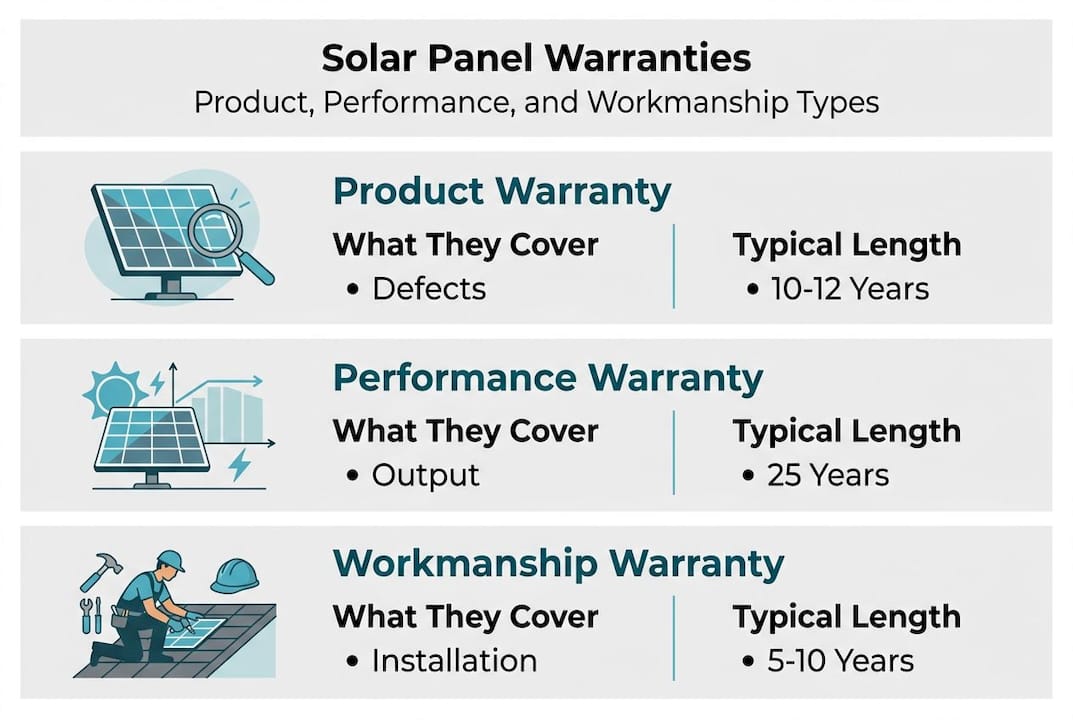
Product warranty covers manufacturing defects in the physical panel. This typically runs 10 to 12 years. If a panel cracks due to a defect in materials or workmanship from the factory, this is the coverage that applies.
Performance warranty (also called a power output warranty) guarantees the panel will produce a minimum percentage of its original rated output over time. Most manufacturers promise at least 80% output at the 25-year mark. This is the warranty most homeowners think of when they hear “25-year warranty.”
Workmanship warranty covers the installation itself, not the panels. This comes from your installer and typically runs 5 to 10 years. It covers issues like roof leaks caused by mounting hardware or faulty wiring connections.
| Warranty type | Typical length | What it covers | Common exclusions |
|---|---|---|---|
| Product | 10-12 years | Manufacturing defects | Weather damage, unauthorized work |
| Performance | 20-25 years | Minimum power output | Soiling, shading, improper maintenance |
| Workmanship | 5-10 years | Installation quality | DIY modifications, moved panels |
The exclusions are where most homeowners get caught off guard. Common warranty exclusions include damage from hail, wind speeds above 139 mph, salt exposure, unauthorized repairs, and a lack of maintenance records. Routine cleaning costs are almost never covered. Moving panels from their original installation site typically voids all coverage immediately.
Key exclusions to watch for:
- Extreme weather events (hail, high winds, flooding)
- Any DIY repairs or modifications
- Damage from salt air exposure in coastal areas
- Lack of documented maintenance history
- Panels relocated from the original installation address
Pro Tip: Start a simple folder, physical or digital, where you store every service record, inspection report, and installer communication from day one. Many warranty claims are denied not because the damage isn’t real, but because the homeowner cannot prove proper system care. You can review solar warranty FAQs for more details on what documentation matters most.
If you are exploring solar panels for your home, asking your installer to walk through each warranty type before signing is a smart move.
How warranty promises compare to real-world panel performance
After understanding what’s written in the warranty, it’s crucial to see how these promises stack up against actual panel performance.
Most performance warranties promise less than 0.5% annual output loss. The reality is more nuanced. Real-world degradation data from a large-scale meta-analysis shows the median field degradation rate is 0.94% per year, nearly double what many warranties suggest. Some panel technologies show even higher rates.
“Warranties often exceed field performance in harsh cases, with some polycrystalline silicon panels showing degradation as high as 2.56% per year in real conditions.”
For context, a panel rated at 400 watts that degrades at 0.5% per year would produce around 352 watts after 25 years. At 0.94% per year, that same panel would produce closer to 316 watts. That’s a meaningful difference in your energy bill over time.
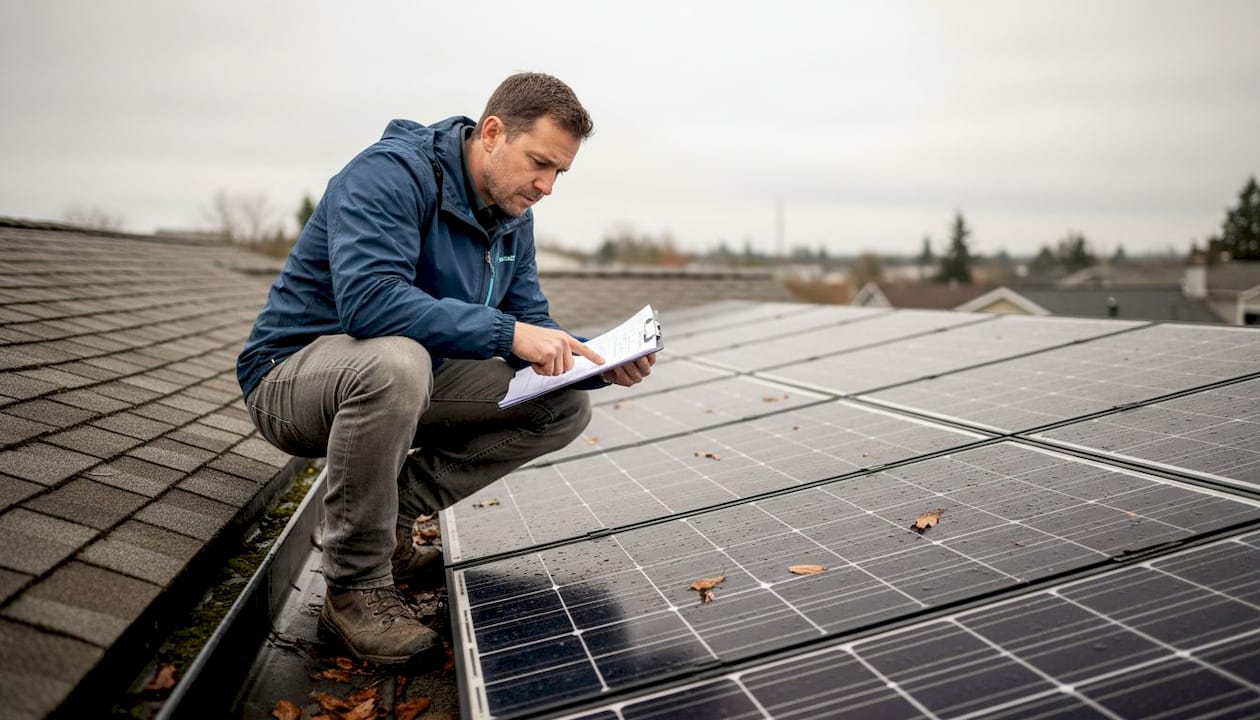
Panel degradation research also highlights that climate plays a significant role. The Pacific Northwest’s mild temperatures are actually favorable for panel longevity. High heat accelerates degradation, and Washington and Oregon see far less of that than Arizona or Nevada. However, consistent moisture, occasional heavy snow loads, and coastal salt air in some areas still create risks.
Typical annual degradation rates by panel technology:
- Monocrystalline PERC: 0.4 to 0.6% per year (top performers)
- Bifacial panels: 0.5 to 0.9% per year (varies by installation)
- HJT (Heterojunction): Can exceed 1% per year in some field conditions
- Polycrystalline silicon: Up to 2.56% per year in documented worst cases
- Top-brand monocrystalline (Jinko, Trina): 0.4 to 0.5% per year in early field data
The takeaway is straightforward. Not all panels perform equally, and the warranty language alone doesn’t tell you which technology holds up best in the Pacific Northwest’s specific climate. Ask your installer for field performance data, not just the warranty sheet. If a warranty claim sounds too optimistic, it probably is. Our guide on spotting overly optimistic warranty claims can help you ask the right questions.
What voids a solar panel warranty (and how to avoid it)
Knowing that not every issue is covered, you’ll want to ensure your warranty remains effective for decades.
The most common ways homeowners accidentally void their warranties are surprisingly avoidable. Here are the actions that put your coverage at risk:
- DIY repairs or modifications. Any work done outside of a certified installer immediately flags the warranty. Even replacing a single connector yourself can void the entire product warranty.
- Hiring an uncertified contractor. If you use someone other than your original installer or a manufacturer-approved service provider, the warranty may be void from that point forward.
- Moving the panels. Relocating panels to a new home or a different roof section typically voids all coverage. Warranties are tied to the original installation site.
- Failing to document maintenance. Manufacturers can and do deny claims when homeowners cannot show a history of proper care.
- Ignoring system alerts. Modern inverters flag performance issues. Ignoring those alerts and allowing damage to worsen is often cited as a reason for claim denial.
The legal warranty pitfalls around the claim process are also underestimated. Filing a claim typically requires photos of the damage, production data showing the output drop, and complete installer records. Manufacturers may send a site inspector, and if the visit is not covered under your warranty terms, you could pay that fee out of pocket.
“Too many homeowners find out their warranty means little when the installer is gone or they cannot prove proper use.”
Installer bankruptcy is a real risk. If your installer closes, the workmanship warranty often disappears with them. Choosing systems with module-level power optimizers or microinverters can simplify future claims because each panel’s output is tracked individually, giving you clear data to support any performance complaint.
Pro Tip: Before signing any installation contract, ask your installer directly: “What happens to my workmanship warranty if your company closes?” A reputable installer will have a clear answer. Review service and maintenance guidance to understand what ongoing care looks like after installation.
The impact of Washington and Oregon incentives on your warranty’s value
Finally, local incentives work hand in hand with good warranties to lock in long-term savings, if you know how to combine them.
Washington and Oregon both offer meaningful financial incentives for residential solar, and these directly affect how much your warranty protects in dollar terms.
Key incentives available in 2026:
- Washington sales tax exemption: A 6.5% sales tax exemption applies to solar equipment purchases, reducing your upfront cost immediately.
- Property tax exemption (both states): The added home value from a solar installation is exempt from property tax assessments in both Washington and Oregon.
- Net metering: Both states support net metering, allowing you to earn credits for excess power sent back to the grid, improving your long-term return.
- Energy Trust of Oregon incentive: Oregon homeowners using PGE or Pacific Power can receive a minimum $2,500 incentive for qualifying systems of at least 2 kilowatts.
- Federal Investment Tax Credit (ITC): A 30% federal tax credit applies to the full system cost, further reducing your net investment.
These incentives lower your upfront cost, which directly magnifies the financial value of a strong warranty. If you pay less to install the system, every year of protected performance represents a higher percentage return on what you actually spent.
Importantly, neither Washington nor Oregon has state-specific warranty laws that add extra protections beyond what manufacturers offer. The responsibility for choosing panels and installers with strong, enforceable warranties falls entirely on you. Reviewing Oregon solar incentives and Washington solar incentives can help you understand what you qualify for. Also confirm that your installer meets installer incentive eligibility requirements before signing anything.
Why standard advice on solar warranties misses the real risks
Bringing these points together, here’s the view from years in the Northwest solar market.
Most warranty guides focus on the numbers: 25 years, 80% output, 10-year product coverage. What they skip is the human side of the equation. Your installer’s financial stability matters as much as the warranty document itself. A manufacturer warranty backed by a company that’s been in business for decades is worth far more than one from a brand that may not exist in 10 years.
The claim process realities are also rarely discussed. Site visits, data requirements, and the burden of proof all fall on you as the homeowner. We’ve seen situations where valid claims were denied simply because the homeowner couldn’t produce a single maintenance record. That’s a preventable loss.
The uncomfortable truth is that your warranty is only as strong as your documentation and your installer’s longevity. Treat it as a financial asset from day one. Ask tough questions before signing. Keep records obsessively. And look at real-world residential case studies to understand what long-term solar ownership actually looks like in Washington and Oregon.
Pro Tip: Request a copy of your installer’s certificate of insurance and ask whether they carry a warranty bond. This protects you if they close before your workmanship warranty expires.
Get guidance for a worry-free solar investment
Ready to apply what you’ve learned? Here’s how to act on it with local experts.
At A&R Solar, we work with Washington and Oregon homeowners to select solar panels for your home that carry strong, enforceable warranties backed by manufacturers with proven track records. We don’t just install and move on. Our team provides ongoing solar repair and maintenance to keep your system performing and your warranty intact.
You can browse our local residential projects to see real installations across the region and understand what a well-documented, properly maintained system looks like over time. Whether you’re just starting to explore solar or ready to move forward, we’re here to help you make a confident, informed decision. Reach out to schedule a free consultation and get clear answers before you commit.
Frequently asked questions
What is typically not covered by a solar panel warranty?
Damage from extreme weather, unauthorized repairs, routine cleaning costs, and any DIY modifications are almost universally excluded from solar panel warranties. Moving panels from their original installation site also voids coverage in most cases.
How do Washington and Oregon incentives impact my solar panel warranty?
Incentives like Washington’s 6.5% sales tax exemption and Oregon’s Energy Trust rebates reduce your upfront cost but do not add any warranty coverage. They increase the financial value your warranty protects by lowering your net investment.
Do solar panels really last as long as the warranty says?
Panels often operate for 25 years or more, but real-world degradation rates average around 0.94% per year, which is higher than the 0.5% most warranties promise. Your actual output at year 25 may be lower than the warranty’s minimum threshold suggests.
What should I do to avoid voiding my solar panel warranty?
Always use certified installers, keep detailed maintenance records from day one, and never attempt repairs or modifications yourself. Verifying your installer’s long-term stability before signing also protects your workmanship warranty.