



TL;DR:
- The Residential Clean Energy Credit offers a 30% tax reduction on qualified solar system costs installed at primary or secondary homes owned in the U.S. and fully operational within the eligibility period running through 2025. Homeowners must own the property and equipment, accurately document costs, and file IRS Form 5695 in the year the system becomes operational to claim the benefit, which can be carried forward if unused. Utility rebates reduce the credit basis, while incentives like net metering do not, emphasizing the importance of precise record-keeping and timing.
The Residential Clean Energy Credit is a dollar-for-dollar reduction in your tax liability equal to 30% of the qualified costs of a new solar energy system installed at your home. Signed into law through the Inflation Reduction Act and governed by IRS IRC §25D, this 30% credit rate applies to systems placed in service from 2022 through December 31, 2025. On a $25,000 solar installation, that translates to $7,500 directly off your tax bill. Understanding how solar tax credits work means knowing exactly which costs qualify, when to claim, and how to avoid the filing mistakes that cost homeowners real money.
How solar tax credits work: the core mechanics
The Residential Clean Energy Credit reduces what you owe the IRS, not what you earn back as a refund. That distinction matters. A tax credit is more valuable than a deduction of the same dollar amount because it cuts your liability directly rather than reducing the income on which tax is calculated.

The credit is calculated as a percentage of your total qualified solar system costs. You claim it for the tax year in which your system is installed and placed in service, meaning it is operational and connected. The IRS does not allow you to claim the credit in the year you signed a contract or made a deposit. Only the year the system is fully operational counts.
The Inflation Reduction Act locked the credit at 30% through 2032, giving homeowners a long planning window. This rate applies to solar photovoltaic panels, battery storage systems, and associated equipment covered under IRC §25D.
Who qualifies for the solar tax credit?
Solar tax credit eligibility requires that you own both the property and the solar system. The installation must be at a residence you own in the United States, including your primary home or a qualifying secondary home. Rental properties where you do not live do not qualify.
Ownership of the system is non-negotiable. Leased solar systems and power purchase agreements (PPAs) do not qualify for the credit. The leasing company, not you, owns the equipment and therefore claims any available credit. If you are considering a lease or PPA arrangement, you forfeit this benefit entirely.
Eligible property types under the credit include:
- Solar PV panels and solar shingles
- Inverters and mounting hardware
- Wiring and balance-of-system components
- Battery storage systems with a minimum 3 kWh capacity
- Permitting fees and installation labor directly tied to the system
Battery storage is worth highlighting separately. Since 2023, a standalone battery system qualifies for the credit even if it is not paired with solar panels, provided its rated capacity meets the 3 kWh threshold. Confirming manufacturer specifications before purchase protects you from a denied credit after installation.
Pro Tip: If you are buying a home with an existing solar system, you cannot claim the credit for that system. The credit applies only to new systems you purchase and install yourself.
What costs count toward your credit calculation?
Qualified expenses for the Residential Clean Energy Credit include the full cost of equipment, installation labor, permitting fees, sales tax on materials, and all balance-of-system components. Most homeowners underestimate how many line items qualify, which means they often calculate a smaller credit than they are actually entitled to.
The table below shows which costs qualify and which do not:
| Cost item | Qualifies for credit? |
|---|---|
| Solar panels and inverters | Yes |
| Mounting hardware and wiring | Yes |
| Installation labor and permitting fees | Yes |
| Sales tax on qualifying equipment | Yes |
| Battery storage (3 kWh minimum) | Yes |
| Loan interest or financing fees | No |
| Roof replacement (unless required for installation) | No |
| Utility connection fees paid to the grid | No |
One area that trips up many homeowners involves rebates and subsidies. Utility subsidies paid to you or your contractor as a purchase-price adjustment must be subtracted from your qualified expenses before calculating the credit. If your utility company provides a $2,000 rebate that reduces your invoice, your credit base drops accordingly.
Net metering credits are treated differently. Performance-based incentives like net metering credits for electricity you send back to the grid do not reduce your qualified expense total. They are compensation for energy production, not a reduction in what you paid for the system.
Pro Tip: Request an itemized invoice from your installer that separates equipment costs, labor, permitting, and any rebates applied. This document becomes your primary record for calculating qualified expenses accurately.
Utility rebates paid directly to the contractor rather than to you can still affect your credit basis depending on how the transaction is documented. Ask your installer whether any utility incentives were applied at the contractor level before you finalize your credit calculation.
How to claim the solar tax credit using IRS Form 5695
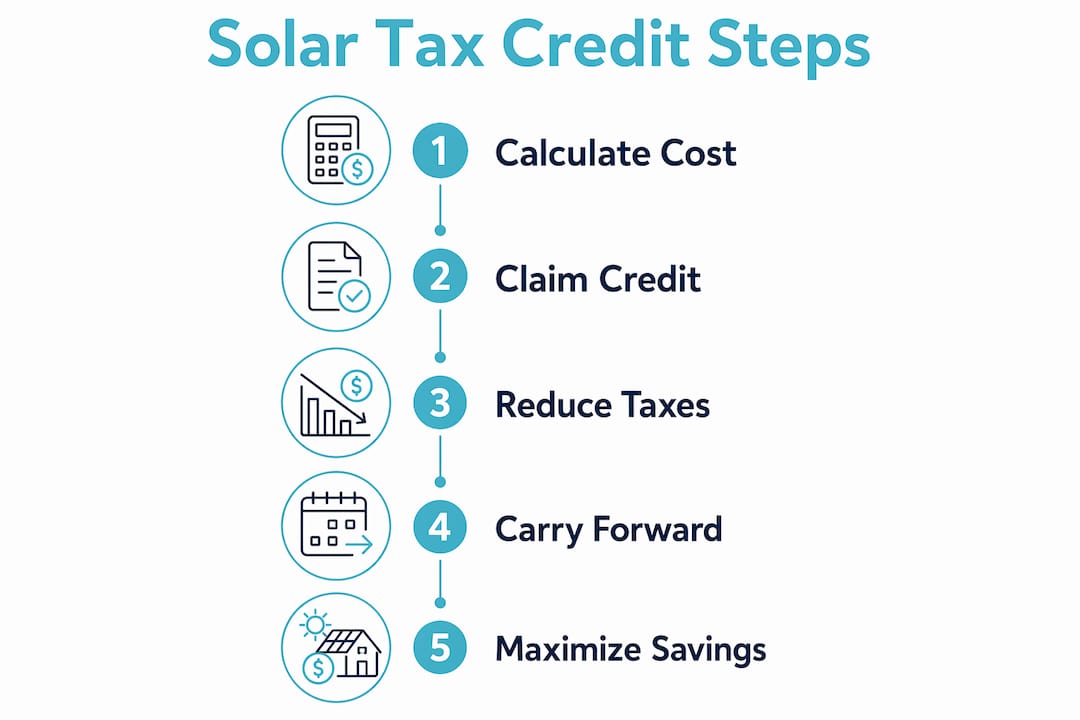
Claiming the credit requires completing IRS Form 5695 and filing it with your federal tax return for the year your system was placed in service. The process follows a straightforward sequence:
- Confirm your placed-in-service date. This is the date your system was fully installed, inspected, and operational. Signing a contract or making a payment does not establish this date.
- Total your qualified expenses. Add up all eligible costs from your itemized installer invoice, then subtract any utility subsidies classified as purchase-price adjustments.
- Calculate your credit amount. Multiply your qualified expense total by 30%. A $30,000 system yields a $9,000 credit.
- Complete IRS Form 5695, Part I. Enter your qualified costs and the resulting credit amount on the Residential Clean Energy Credit section.
- Transfer the credit to Schedule 3 of Form 1040. The credit flows from Form 5695 to Schedule 3, Line 5, and then reduces your total tax liability on Form 1040.
- Retain your documentation. Keep installation invoices, manufacturer certifications, permits, and your placed-in-service confirmation for at least three years in case of an IRS audit.
The credit is non-refundable, meaning it can reduce your tax liability to zero but will not generate a refund check. If your credit exceeds your tax liability for the year, the unused credit carries forward to future tax years indefinitely until it is fully used. This carryforward provision is particularly useful for homeowners with lower tax liability in the installation year.
Pro Tip: If you expect a large credit relative to your annual tax liability, consult a tax professional before filing. Strategic use of the carryforward provision across multiple years can maximize the total value you recover.
A common filing error is claiming the credit based on the purchase or contract date rather than the actual placed-in-service date. The IRS defines the qualifying year by when the system became operational, and misreporting this date can trigger an audit or a disallowed credit. For guidance on filing Form 5695 correctly, A&R Solar’s solar tax credit FAQ covers the most frequent homeowner questions in plain language.
How solar tax credits interact with other incentives
The Residential Clean Energy Credit stacks with state and local incentives, meaning you can claim both without one automatically canceling the other. Washington and Oregon homeowners, in particular, have access to additional programs that complement the federal credit. Oregon’s state solar incentives and Washington’s solar incentive programs each offer separate benefits that can be layered on top of the federal credit.
The key distinction to understand is how different incentive types affect your credit basis:
- State tax credits: Do not reduce your federal qualified expense total. You can claim both independently.
- Cash rebates from utilities classified as purchase-price adjustments: Reduce your federal credit basis dollar for dollar.
- Performance-based incentives (net metering): Do not affect your credit basis at all.
- Grants or subsidies paid directly to you: May reduce your qualified expense total depending on how they are classified.
Timing your installation strategically also matters. If your system is installed in late December but not placed in service until January, your credit claim shifts to the following tax year. Homeowners who plan installations for late in the calendar year should confirm the operational date with their installer before assuming which tax year applies.
Battery storage adds meaningful credit value when included in a solar project. A qualifying battery system with a capacity above 3 kWh adds its full cost to your qualified expense total, increasing the 30% credit calculation. On a $10,000 battery addition, that is an extra $3,000 in credit value.
Documentation best practices include retaining installation invoices, manufacturer spec sheets confirming battery capacity, permits, and any utility rebate correspondence. These records protect you if the IRS questions any element of your credit claim.
Key takeaways
The Residential Clean Energy Credit gives homeowners a 30% reduction in tax liability on qualified solar costs, claimed via IRS Form 5695 for the year the system is placed in service.
| Point | Details |
|---|---|
| Credit rate and timing | The 30% credit applies to systems placed in service through December 31, 2025, claimed for the installation tax year. |
| Ownership requirement | You must own both the property and the system. Leased systems and PPAs do not qualify. |
| Qualified expenses | Include equipment, labor, permits, sales tax, and battery storage above 3 kWh. Subtract utility purchase-price rebates. |
| Non-refundable with carryforward | The credit reduces your liability to zero but does not generate a refund. Unused amounts carry forward indefinitely. |
| Stacking incentives | State credits and net metering credits do not reduce your federal credit basis. Utility cash rebates may. |
What I’ve learned watching homeowners claim this credit
After working with hundreds of homeowners through the solar installation and incentive process, the single most common and costly mistake I see is treating the contract date as the placed-in-service date. Homeowners sign in October, assume they can claim the credit on that year’s taxes, and then discover their system was not operational until February. That shifts the entire credit to the following year, which can disrupt tax planning significantly.
The second mistake is underestimating the value of battery storage in the credit calculation. Many homeowners view battery backup as an optional add-on and defer it to save upfront costs. But including a qualifying battery system in the original installation increases the credit base and reduces the net cost of the battery substantially. On a $12,000 battery, the 30% credit covers $3,600. That changes the math on whether storage makes financial sense.
I also see homeowners accept installer invoices that lump all costs together without separating labor, equipment, and rebates. That creates real problems when calculating the credit basis, especially if utility rebates were applied at the contractor level. Always request a fully itemized invoice before you file.
The carryforward provision is underused. Homeowners with modest tax liability in the installation year sometimes assume they lose the unused credit. They do not. Planning your tax strategy around the carryforward, potentially over two or three years, can recover the full credit value even when your annual liability is lower than the credit amount.
— Shyerome
How A&R Solar helps you install a credit-eligible system
A&R Solar has spent two decades installing residential solar systems across Washington and Oregon, with every project designed to meet IRS eligibility requirements from day one. Their team handles permits, documentation, and placed-in-service confirmation so you have everything you need to file Form 5695 accurately.
If you are considering adding battery storage to maximize your credit, A&R Solar’s home battery backup solutions are sized and specified to meet the 3 kWh minimum threshold required for credit eligibility. Browse their residential project portfolio to see real installations across the Northwest and understand what a qualified system looks like in practice. Contact A&R Solar for a personalized consultation and get a clear picture of your credit potential before you commit.
FAQ
What is the current solar tax credit percentage?
The Residential Clean Energy Credit equals 30% of qualified solar system costs for systems placed in service through December 31, 2025. This rate was established by the Inflation Reduction Act under IRS IRC §25D.
Does a leased solar system qualify for the credit?
No. Leased solar systems and power purchase agreements do not qualify. Only the system owner can claim the credit, so you must purchase the system outright to be eligible.
What happens if my credit exceeds my tax liability?
The credit is non-refundable, so it cannot reduce your liability below zero or generate a refund. Any unused credit carries forward to future tax years indefinitely until it is fully applied.
Can I include battery storage in my credit calculation?
Yes. Battery storage systems with a rated capacity of at least 3 kWh qualify for the 30% credit, either as part of a solar installation or as a standalone system installed at your residence.
Do state solar rebates reduce my federal credit?
It depends on the rebate type. Cash rebates classified as purchase-price adjustments reduce your qualified expense total. State tax credits and net metering credits do not affect your federal credit calculation.