TL;DR:
- Inverters are essential for converting solar panel DC power into usable AC, monitoring performance, and supporting grid stability. Different types, like string, microinverters, and hybrids, suit various rooftop shading and backup needs, with smart features enhancing grid interactions. Proper inverter selection is crucial for maximizing energy, reliability, and future participation in grid services.
An inverter is defined as the device in a solar power system that converts direct current (DC) electricity from solar panels into alternating current (AC) electricity that powers your home and connects to the utility grid. The U.S. Department of Energy confirms that inverters do far more than convert electricity. They monitor system performance, communicate with homeowners and installers, and can enable backup power during outages when paired with battery storage. Understanding the role of inverters in solar power helps you make smarter decisions about your system before you ever sign a contract.
What do inverters actually do in a solar power system?
The function of solar inverters starts with DC-to-AC conversion, but that description barely scratches the surface. Solar panels produce DC electricity, which flows in one direction at a fixed voltage. Your home’s appliances, outlets, and the utility grid all run on AC electricity, which alternates direction 60 times per second in the United States. The inverter produces a clean sine wave output that matches grid frequency and voltage so your home can use solar energy without any modification to your existing wiring.
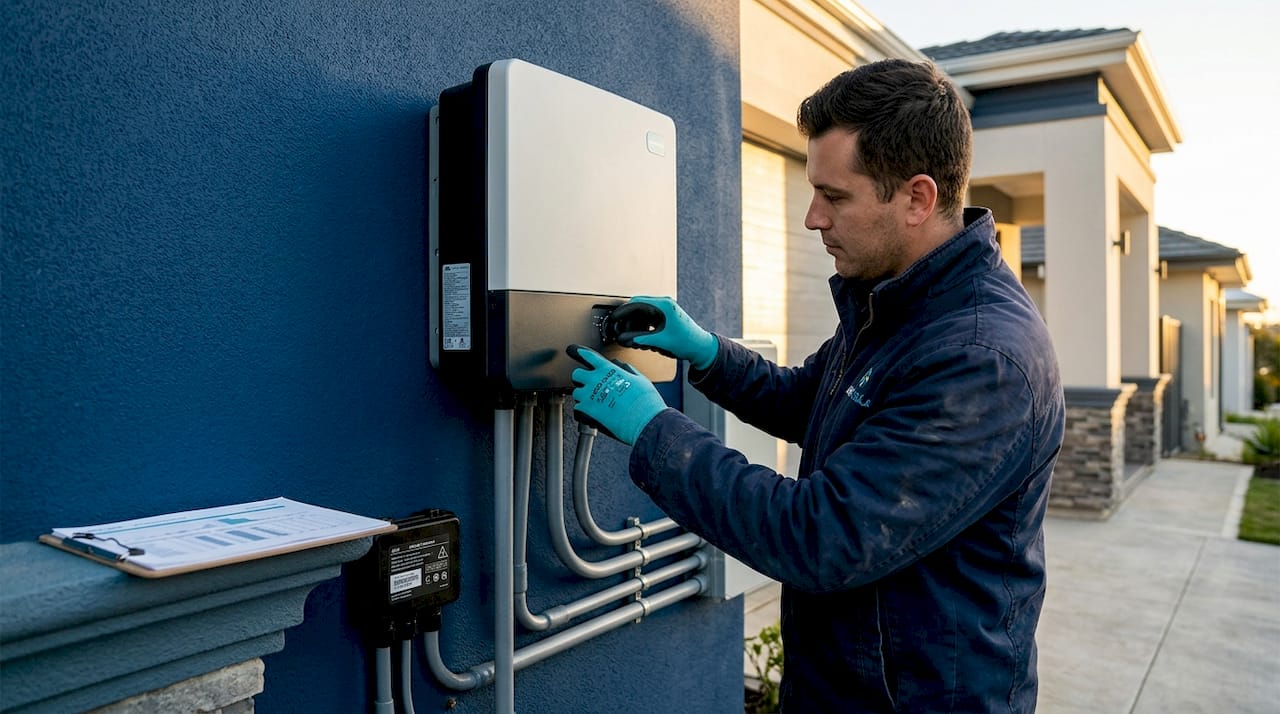
Beyond conversion, inverters perform maximum power point tracking (MPPT). This is an automated process where the inverter continuously adjusts the electrical load it draws from the panels to keep them operating at peak output. Temperature changes, cloud cover, and shading all shift the optimal operating point of a solar panel throughout the day. MPPT compensates for those shifts in real time, which means your system produces more energy than it would without this feature.
Inverters also serve as your system’s primary monitoring and communication portal. Most modern units connect to your home Wi-Fi and send production data to an app on your phone. Installers can access diagnostic information remotely, which reduces the need for on-site service calls. For homeowners in Washington and Oregon, where overcast days are common, this visibility into daily production is genuinely useful.
Smart inverter capabilities go further still. Smart inverter settings affect how your solar system supports grid balancing and provides flexibility to utilities. These features include reactive power provision, voltage regulation, and automatic generation control responses. You may not interact with these settings directly, but they affect how your utility views your system and, in some states, whether you qualify for certain grid services programs.
Pro Tip: When reviewing inverter specs, look for MPPT efficiency ratings separately from overall conversion efficiency. A unit with 99% MPPT efficiency and 97% conversion efficiency outperforms one with 98% conversion efficiency but weaker MPPT tracking.
How do different types of solar inverters compare?
Three primary inverter architectures exist for residential solar: string inverters, microinverters, and power optimizers paired with a string inverter. A fourth category, hybrid inverters, adds battery management to the mix. Each type has a distinct impact on system performance, cost, and flexibility.
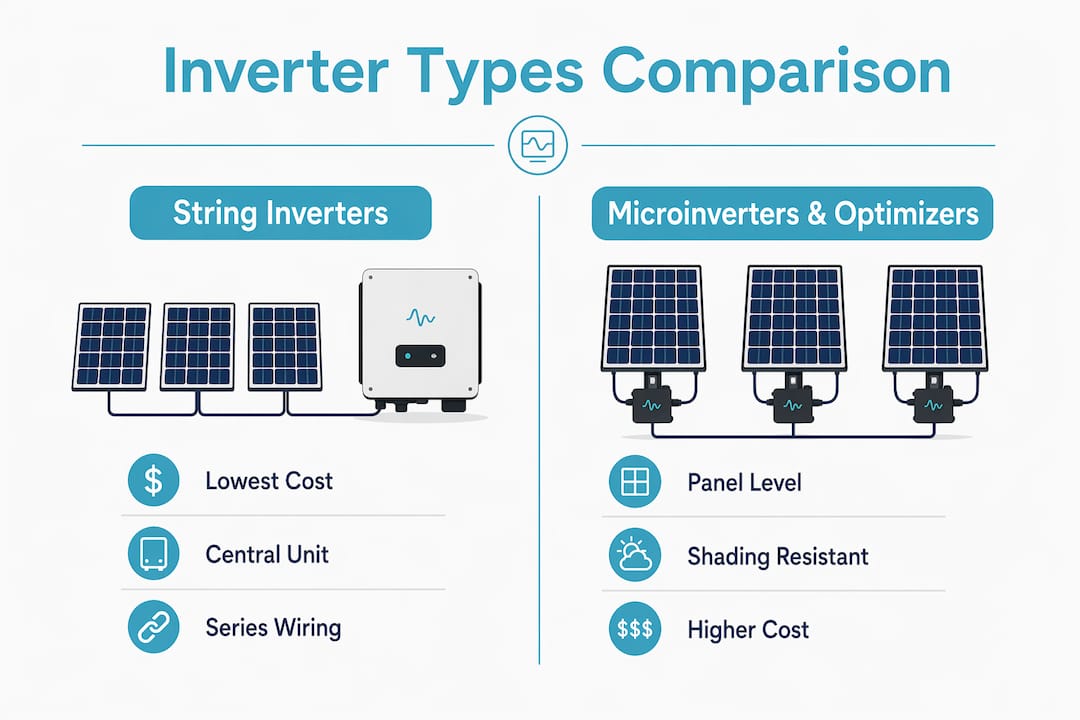
String inverters wire all panels in a series circuit, called a string, feeding into one central unit. They are the most cost-effective option for roofs with consistent sun exposure and no shading. The tradeoff is that the entire string performs at the level of the weakest panel. A single shaded panel can reduce output from every panel in that string.
Microinverters attach to each panel individually and convert DC to AC at the panel level. Microinverters prevent shading on one panel from reducing output on the rest of the array. This makes them the right choice for roofs with multiple orientations, obstructions like chimneys or skylights, or significant tree shading. The APsystems QT2, for example, is a high-performance microinverter designed for panel-level optimization and monitoring in residential installations.
Power optimizers are a middle-ground solution. They attach to each panel and condition the DC output before sending it to a central string inverter. You get panel-level monitoring and shading mitigation without the full cost of individual microinverters on every panel.
Hybrid inverters manage both solar generation and battery storage from a single unit. They direct energy to your home, charge your battery, export to the grid, or draw from the battery depending on conditions and your programmed preferences. The Deye SUN-12K hybrid inverter is one example of a smart hybrid unit built for residential systems that need both solar and battery management in one device.
| Inverter type | Key advantage | Main limitation | Best for |
|---|---|---|---|
| String inverter | Lowest cost, proven reliability | Shading affects whole string | Unshaded roofs, simple layouts |
| Microinverter | Panel-level optimization, monitoring | Higher upfront cost | Shaded or complex rooftops |
| Power optimizer | Shading mitigation, panel monitoring | Requires string inverter too | Partial shading, budget-conscious |
| Hybrid inverter | Manages solar and battery together | Higher cost, more complexity | Homes adding battery storage |
For a deeper look at how these architectures compare in real installations, A-rsolar’s inverter type comparison guide walks through the technical differences with residential examples from the Pacific Northwest.
What role do inverters play in grid stability?
Modern solar inverters are active participants in grid management, not passive devices that simply push power onto the line. Grid-following inverters synchronize their output to the existing grid voltage and frequency using a phase-locked loop. This is the standard approach for most residential systems. Grid-forming inverters take a different approach: they generate their own stable voltage and frequency reference independently, which allows them to operate without a grid signal present.
The distinction matters for grid health. Here is how smart inverters respond to grid disturbances:
- Ride-through: When voltage or frequency deviates slightly from normal, the inverter continues operating and adjusts its output to help stabilize the grid rather than disconnecting immediately.
- Frequency-watt response: If grid frequency rises above normal (indicating excess supply), the inverter automatically reduces its power output to help bring frequency back into balance.
- Reactive power support: Inverters can supply or absorb reactive power to help regulate voltage at the local distribution level, reducing stress on utility equipment.
- Automatic generation control: Inverter-based generation can respond to operator signals from the utility to adjust output and help balance supply and demand across the grid.
- Anti-islanding disconnect: If grid deviations are severe or prolonged, the inverter shuts down to prevent energizing a de-energized line, protecting utility workers and equipment.
“Smart inverters can ‘ride through’ small voltage or frequency disruptions but shut down if deviations are severe or prolonged, contributing to grid safety and stability.” — U.S. Department of Energy
Research published in MDPI’s Sensors journal found that disconnection times vary across inverter units and conditions, and that multi-inverter installations can extend detection times in ways that certification tests do not always capture. This finding reinforces why professional system design matters. The interaction between multiple inverters on a single property or neighborhood circuit is more complex than any single unit operating in isolation.
How do inverters enable backup power during outages?
Most homeowners assume that having solar panels means having power during a blackout. That assumption is incorrect for standard grid-tied systems. Standard grid-tied inverters shut down within 2 seconds when the grid goes down. This is an anti-islanding requirement designed to protect utility workers repairing lines. Without this protection, your solar system could energize a line that a technician believes is de-energized.
Backup power requires a different setup entirely. The key components are:
- A grid-forming inverter: This unit generates its own AC voltage and frequency reference without relying on the grid signal. It creates the electrical environment that your home’s loads and battery can operate within.
- Battery storage: The battery provides the energy source during an outage. Solar panels alone cannot power a home during a blackout because their output fluctuates with sunlight. The battery smooths that variability and provides power at night.
- A transfer switch or automatic transfer mechanism: This isolates your home’s critical loads from the utility grid during an outage, preventing your system from back-feeding the grid while also protecting your equipment.
True island mode operation requires all three of these components working together. Systems certified to UL 1741-SA or IEC 62116 standards have been tested for safe islanding behavior, which is a specification worth confirming with your installer before purchase.
Pro Tip: Not all hybrid inverters support full island mode. Before purchasing a battery system, confirm that the inverter is certified for island mode operation and that your installer will configure the transfer switching correctly. A battery paired with a non-island-capable inverter will not power your home during an outage.
For homeowners in the Pacific Northwest, where winter storms can cause multi-day outages, this distinction between a standard grid-tied system and a true backup-capable system is worth understanding before installation day. A-rsolar’s home battery backup page covers the specific options available for Washington and Oregon homes.
Key takeaways
Inverters are the operational center of every solar power system, managing conversion, monitoring, grid interaction, and backup power from a single device.
| Point | Details |
|---|---|
| Core function | Inverters convert DC from panels to AC for home use and grid export. |
| MPPT efficiency | Continuous tracking keeps panels at peak output regardless of weather changes. |
| Inverter type matters | String, micro, optimizer, and hybrid types each suit different roof conditions and goals. |
| Grid services role | Smart inverters provide ride-through, frequency response, and reactive power to stabilize the grid. |
| Backup power requirements | Island mode needs a grid-forming inverter, battery storage, and a transfer switch working together. |
Why inverter selection deserves more attention than it gets
I have seen homeowners spend weeks comparing solar panel brands and almost no time on inverter selection. That is a mistake. The panels capture sunlight, but the inverter determines what you actually do with it. It controls how much energy reaches your home, how your system responds to grid events, what data you can see, and whether your lights stay on during a blackout.
The shift toward smart inverter technology is accelerating. Utilities in Washington and Oregon are increasingly interested in the grid services that distributed solar systems can provide. The inverter is the device that either enables or blocks that participation. Choosing a unit with limited smart capabilities today may reduce your system’s value as grid programs expand over the next decade.
My practical advice: assess your roof’s shading conditions honestly before choosing between string and microinverter architectures. If you have any shading from trees, chimneys, or neighboring structures, microinverters or power optimizers will recover production that a string inverter would lose. If backup power matters to you, confirm island mode certification before signing anything. And work with an installer who can explain the inverter’s specific capabilities, not just its brand name.
The inverter’s control strategy is as important as its conversion efficiency. That is the insight most homeowners miss, and it is the one that separates a system that performs well for 25 years from one that underdelivers from year one.
— Shyerome
See how A-rsolar designs inverter solutions for real homes
A-rsolar has spent two decades designing and installing residential solar systems across Washington and Oregon, including projects that feature string inverters, microinverters, and hybrid inverter and battery combinations. Every system is designed around the specific conditions of your home: your roof layout, shading profile, utility rate structure, and backup power goals.
Browsing A-rsolar’s residential project portfolio shows real installations with documented results, including systems built around backup power and advanced inverter configurations. If you are ready to talk through which inverter setup fits your home, A-rsolar’s team can walk you through the options with no pressure and no guesswork.
FAQ
What does an inverter do in a solar system?
An inverter converts DC electricity from solar panels into AC electricity that powers your home and connects to the utility grid. Modern inverters also monitor system performance, communicate data to homeowners and installers, and manage battery storage in hybrid configurations.
Which inverter type is best for a shaded roof?
Microinverters are the most effective choice for shaded rooftops because they convert power at the panel level, preventing one shaded panel from reducing output across the entire array. Power optimizers paired with a string inverter offer a similar benefit at a lower cost.
Can solar panels power my home during a blackout?
Standard grid-tied solar systems shut down during a blackout due to anti-islanding requirements. Backup power requires a grid-forming inverter, a battery, and a transfer switch working together to isolate and power your home independently of the utility grid.
What is a hybrid inverter?
A hybrid inverter manages both solar generation and battery storage from a single unit, directing energy to your home, charging the battery, or exporting to the grid based on your settings and current conditions. It is the standard choice for homeowners adding battery backup to a solar system.
How do smart inverters help the grid?
Smart inverters can ride through minor voltage and frequency deviations, adjust power output in response to utility control signals, and provide reactive power support to regulate local grid voltage. These capabilities help utilities integrate more renewable energy while maintaining grid reliability.