

TL;DR:
- Solar panels generate meaningful energy even on overcast days in the Pacific Northwest.
- Monocrystalline panels are the most efficient and suitable for variable light conditions.
- Incentives and net metering policies make installing solar highly cost-effective in Washington and Oregon.
Most homeowners in Washington and Oregon assume their cloudy skies are a dealbreaker for solar. They’re not. Even on overcast days, solar panels still generate electricity from diffuse light, and 10-25% of clear-sky production is consistent enough to meaningfully offset your utility bill. This guide walks you through exactly how solar panels work, which types perform best in the Pacific Northwest, how local weather affects your output, and what financial incentives are available to you right now in Washington and Oregon.
Table of Contents
- What happens when sunlight hits your roof
- Solar panel types: Which work best in the Pacific Northwest?
- How PNW weather affects solar output (and how to maximize it)
- Solar incentives and net metering: Saving money in WA & OR
- Why solar panels are worth it in the PNW—if you optimize for local conditions
- Ready to make the switch? See what solar can do for your home
- Frequently asked questions
Key Takeaways
| Point | Details |
|---|---|
| Solar works in cloudy regions | Even under PNW clouds, solar panels generate significant power using diffuse light. |
| Choose the right panel | Monocrystalline panels and new high-tech options maximize rooftop output in WA and OR. |
| Weather can reduce efficiency | Clouds, dust, and snow can reduce production, but design choices can minimize losses. |
| Incentives reduce costs | Washington and Oregon homeowners can get thousands back for solar and batteries. |
| Optimize for local success | Expert installation, smart design, and pairing with batteries enable real energy independence. |
What happens when sunlight hits your roof
Solar panels are made up of photovoltaic (PV) cells, which are devices that convert light directly into electricity. Most residential panels use silicon as the core material. When photons from sunlight strike the silicon cells, they knock electrons loose and set them in motion, creating an electric current. This is called the photovoltaic effect, and it works whether the light is direct or indirect.
The current produced by your panels is direct current (DC). Your home, however, runs on alternating current (AC). That’s where the inverter comes in. The inverter converts DC power into AC power your appliances can use. Modern systems often use microinverters, which are small units attached to each individual panel rather than one central box. This matters a lot in the PNW, where partial shading from trees or clouds is common.
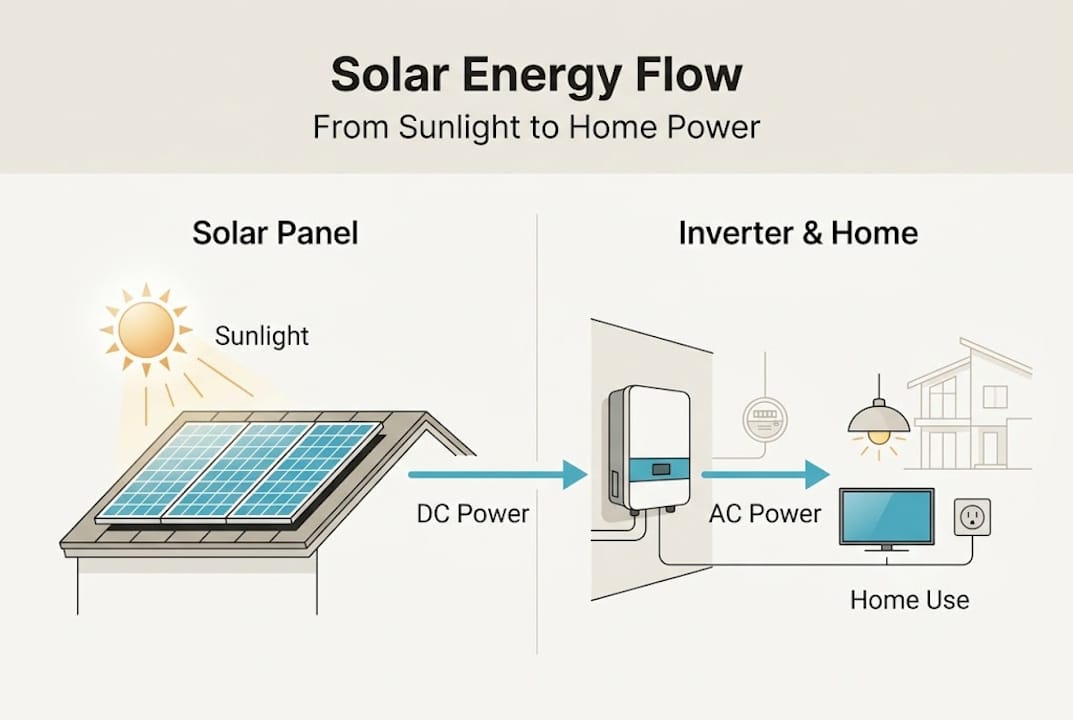
Once converted, that AC power flows into your home’s electrical panel and powers whatever is running at that moment. If your panels produce more than you need, the excess goes one of two places: into a home battery for later use, or back to the grid in exchange for credits. If your panels produce less than you need, you draw from the grid as normal.
Here’s a simple scenario: On a partly cloudy afternoon in Seattle, your panels are producing 2 kilowatts (kW). Your home is using 1.5 kW. The extra 0.5 kW charges your battery. That evening, when the sun is down, your battery covers part of your load before you pull from the grid. That’s how solar panels produce energy in a real home setting.
Residential panels can convert up to 24% of sunlight into electricity depending on the panel type. Efficiency matters more in the PNW than in sunnier states, because you’re working with less peak sunlight to begin with.
Pro Tip: Ask your installer about microinverters if your roof has any shading from trees or neighboring structures. They allow each panel to operate independently, so one shaded panel doesn’t drag down the output of your entire system.
Solar panel types: Which work best in the Pacific Northwest?
Not all solar panels are built the same, and the differences matter more when you live somewhere with variable light conditions. There are three main types used in residential installations: monocrystalline, polycrystalline, and thin-film.
| Panel type | Efficiency range | Best use case | Cost level |
|---|---|---|---|
| Monocrystalline | 20-24% | Most residential roofs, low-light areas | Higher |
| Polycrystalline | 15-17% | Budget installs, high-sun regions | Mid |
| Thin-film | 10-13% | Large flat surfaces, commercial | Lower |
Monocrystalline panels outperform polycrystalline and thin-film for WA and OR roofs, reaching up to 24% efficiency. They’re made from a single continuous crystal of silicon, which gives electrons more room to move and increases output per square foot. That’s a real advantage when roof space is limited or light levels are lower.
Polycrystalline panels are made from multiple silicon fragments fused together. They cost less but are less efficient, meaning you need more of them to produce the same power. In a region where you want to squeeze every kilowatt-hour out of available light, that tradeoff often doesn’t make sense.
Thin-film panels are lightweight and flexible, but their low efficiency makes them a poor fit for most residential roofs in the Pacific Northwest. They’re more common in large commercial installations.
Beyond these three, newer technologies are worth knowing about. N-type panels and bifacial designs offer better performance in low light, making them increasingly relevant for WA and OR homeowners. N-type panels use a different silicon structure that reduces energy loss over time. Bifacial panels capture light from both sides, picking up reflected light from rooftops or snow, which can add meaningful output on gray days.
Here’s what to consider when choosing a panel type for your home:
- Roof size and orientation: Smaller or south-facing roofs benefit most from high-efficiency monocrystalline panels.
- Shading conditions: If trees or chimneys shade part of your roof, efficiency matters even more.
- Budget vs. long-term return: Higher upfront cost on premium panels often pays off faster in the PNW due to lower peak sun hours.
- Warranty and degradation rate: Look for panels with low annual degradation (under 0.5% per year) to protect long-term output.
Pro Tip: When comparing quotes, look at cost per watt and projected annual output, not just the sticker price. A cheaper panel that produces less power may cost you more over 25 years.
For monocrystalline options for your home, a local installer familiar with PNW conditions can match the right panel to your specific roof and energy goals.
How PNW weather affects solar output (and how to maximize it)
The Pacific Northwest has a reputation for rain and clouds, and that reputation is mostly earned. But solar panels don’t need blue skies to work. They need light, and the PNW has plenty of it, even if it’s filtered through clouds.
That said, weather and environmental factors do reduce output. Here’s a breakdown of what affects your system:
| Factor | Estimated output reduction |
|---|---|
| Heavy cloud cover | 75-90% reduction vs. full sun |
| Light overcast | 10-25% of clear-sky output |
| Snow on panels | Up to 100% until cleared |
| Dust and soiling | Up to 25% if not cleaned |
| Extreme heat | 10-25% reduction in efficiency |
Dust, soiling, humidity, hail, and snow can reduce output by up to 60% in some conditions. The PNW’s frequent rain actually helps here. Rain naturally rinses dust and pollen off panels, which is a genuine advantage over drier climates where soiling builds up faster.
Temperature is another factor most homeowners don’t expect. Solar panels actually perform better in cooler temperatures. The PNW’s mild summers mean your panels won’t suffer the heat-related efficiency losses common in Arizona or California.
“Consistent diffuse light in the Pacific Northwest helps solar systems maintain steady output year-round, even when peak production hours are shorter than in sunnier regions.”
Here’s how to minimize losses and keep your system running at its best:
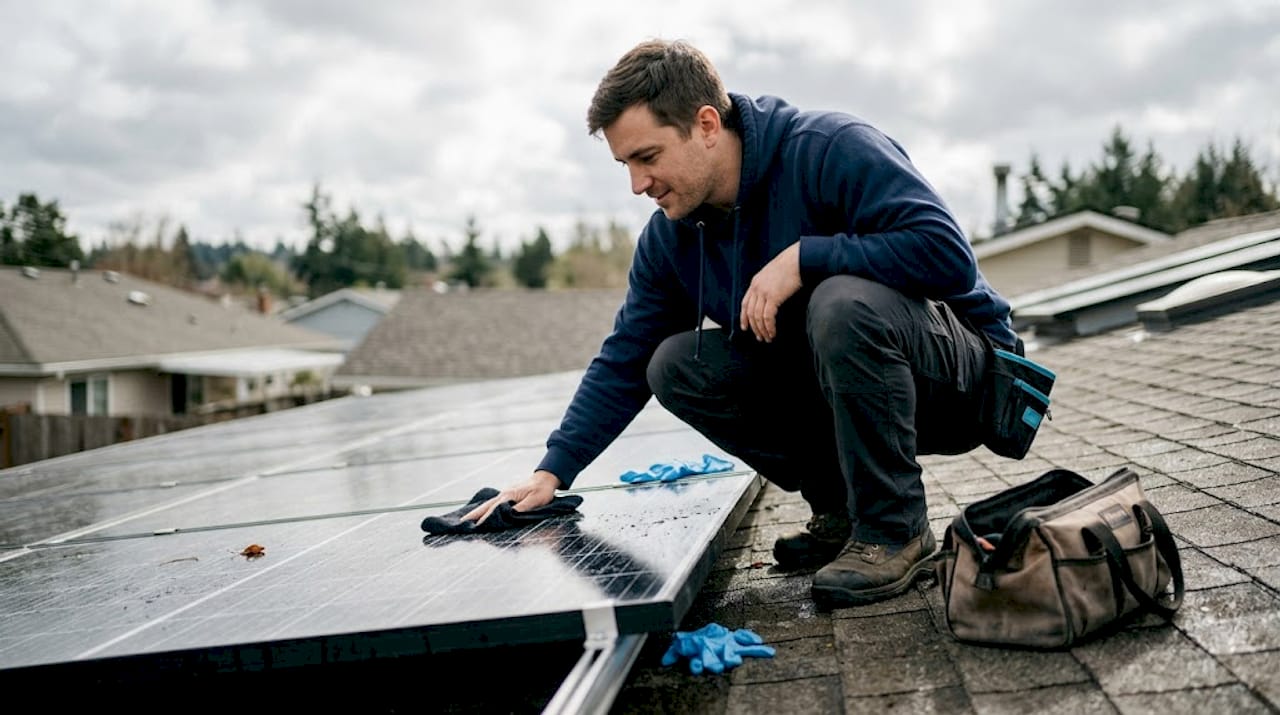
- Schedule an annual cleaning: Even with rain, panels benefit from a manual rinse once or twice a year to remove stubborn buildup.
- Trim nearby trees: Shade is the single biggest output killer. Keep branches clear of your panel footprint.
- Use microinverters or power optimizers: These devices ensure that shading on one panel doesn’t reduce output across your whole system.
- Optimize panel tilt: A tilt angle between 30 and 40 degrees is typically best for capturing winter sun in WA and OR.
Taking advantage of solar incentives in Oregon and Washington solar incentives can help offset the cost of system upgrades that improve performance in variable conditions.
Solar incentives and net metering: Saving money in WA & OR
The financial case for solar in Washington and Oregon is stronger than most homeowners realize. Between state incentives and net metering policies, a well-designed system can pay for itself significantly faster than in many other states.
Stat callout: WA and OR homeowners who qualify for available solar and battery incentives can receive up to $2,500 for solar installation and up to $5,000 for pairing a battery storage system, on top of net metering credits.
Net metering is the policy that allows you to send excess solar power back to the grid and receive a credit on your utility bill. When your panels produce more than you use, that surplus doesn’t go to waste. It reduces what you owe next month. During summer months in the PNW, many homeowners build up significant credits that carry into the darker winter months.
Here’s how to claim the incentives available to you in 2026:
- Confirm eligibility: Check with your utility provider and your state’s energy office to verify you qualify for current programs.
- Choose a certified installer: Many incentive programs require installation by a licensed, approved contractor.
- Apply for state and utility rebates: Oregon’s Energy Trust and Washington’s utility programs each have their own application processes and deadlines.
- Add a battery to maximize support: Battery storage qualifies for separate incentives and gives you the most control over your energy use.
Exploring regional incentives for solar before you install ensures you don’t leave money on the table. Detailed breakdowns of Oregon solar cash-back programs and Washington solar savings are available to help you plan your investment.
Why solar panels are worth it in the PNW—if you optimize for local conditions
Most solar guides treat the Pacific Northwest as a compromise. We don’t. After two decades of installing systems across Washington and Oregon, we’ve seen what separates a system that underperforms from one that consistently delivers.
The biggest mistake homeowners make is treating system design as a secondary decision. They focus on price and ignore shade analysis, panel selection, and inverter type. In a climate with variable light, those decisions are everything.
High-efficiency panels with good low-light performance, a low temperature coefficient, and battery storage for true security are the combination that actually works here. Batteries in particular change the equation. They’re not just a backup for outages. They let you store afternoon production and use it in the evening, which is exactly when PNW households draw the most power.
N-type and bifacial panels are also worth serious consideration. Their performance advantage in diffuse light is measurable, not theoretical. Paired with microinverters and proper tilt, they consistently outperform standard panels in our region’s conditions.
The homeowners who get the most from solar here are the ones who invest in A&R Solar’s process for optimal results, which starts with a real site assessment, not a generic quote.
Ready to make the switch? See what solar can do for your home
Understanding how solar panels work is the first step. The next is seeing what a well-designed system looks like in practice.
Browse our real-life solar projects to see completed installs across Washington and Oregon, including homes with similar roof types and energy needs to yours. If you’re weighing storage options, our home battery backup options page covers everything from system sizing to available rebates. And if you still have questions before taking the next step, our solar FAQ is a good place to start. We’re here to help you make an informed decision, not a rushed one.
Frequently asked questions
Can solar panels work well in the cloudy climate of Washington and Oregon?
Yes, high-efficiency panels still produce power under clouds. PNW homeowners can expect 10-25% of clear-sky output on overcast days, which adds up meaningfully over a full year.
Which type of solar panels are best for my Northwest home?
Monocrystalline panels with high efficiency and good low-light performance are typically the best choice. They reach 20-24% efficiency and outperform other types on WA and OR residential roofs.
Do solar panels need direct sunshine to generate power?
No. Solar panels generate electricity from diffuse light as well as direct sun. Consistent diffuse light in the PNW helps systems maintain steady output even on gray days, though output is lower than in full sun.
What incentives can I get to install solar panels in Washington or Oregon?
You can receive up to $2,500 for solar and up to $5,000 for pairing a battery system, plus net metering credits for excess power sent back to the grid.