

TL;DR:
- Residential solar options include grid-tied, off-grid, and hybrid systems, each with different costs and benefits.
- Monocrystalline panels are ideal for cloudy Northwest climates due to their high efficiency.
- The best system depends on location, budget, outage risk, and energy independence goals.
Most homeowners assume that solar is solar. You put panels on the roof, the sun does its job, and your electricity bill shrinks. The reality is more nuanced, and the system you choose has a direct impact on your costs, your energy independence, and how your home performs during an outage. Washington and Oregon homeowners face specific conditions, from cloudy winters to grid reliability concerns, that make these differences even more significant. This guide walks you through grid-tied, off-grid, and hybrid systems, plus panel technology options, so you can make a well-informed decision rather than just going with whatever a salesperson recommends first.
Table of Contents
- Core types of home solar systems explained
- Comparing solar panel and technology options
- Energy independence and cost: What really matters
- Considerations for Washington and Oregon homeowners
- The unconventional truth: Why there’s no perfect solar solution
- Ready to explore your solar options?
- Frequently asked questions
Key Takeaways
| Point | Details |
|---|---|
| Solar system options | Grid-tied, off-grid, and hybrid systems offer distinct trade-offs for cost, independence, and reliability. |
| Panel and tech choices | Monocrystalline panels and PV systems fit most homes, while thermal is best for niche heating needs. |
| Local factors matter | Washington and Oregon’s unique climate and policies strongly influence which solar system is best. |
| Cost vs. independence | The right size and type of system will balance your energy freedom and long-term savings. |
Core types of home solar systems explained
There are three main configurations for residential solar, and each one serves a different set of priorities. Understanding them upfront saves you from costly mistakes later.
Grid-tied systems connect your home directly to the utility grid. Excess power you generate flows back to the grid, and you earn credits through net metering. These systems have no battery storage, which keeps costs low. Grid-tied systems typically run $45,000+ for a 5 to 10 kW array and offer the fastest payback, usually 4 to 7 years. The trade-off is that when the grid goes down, so does your power, even on a sunny day.
Off-grid systems cut the utility connection entirely. Your home runs on solar generation and battery storage alone. This setup is ideal for rural properties where grid connection is expensive or unavailable. The cost is significantly higher because you need enough battery capacity to cover multiple cloudy days. Upfront investment often exceeds $30,000 depending on your energy needs.
Hybrid systems combine grid connection with battery backup. You benefit from net metering during normal operation and keep the lights on during outages. This is the most flexible option and increasingly popular in the Pacific Northwest where grid outages from storms or wildfires are a real concern.
| System type | Avg. cost | Battery backup | Grid connection | Best for |
|---|---|---|---|---|
| Grid-tied | $5,000–$15,000 | No | Yes | Cost savings, urban homes |
| Off-grid | $25,000–$50,000+ | Yes (large) | No | Rural, remote properties |
| Hybrid | $15,000–$35,000 | Yes | Yes | Resilience + savings |
Key factors that influence your best fit:
- Location: Rural properties with unreliable grid access lean toward off-grid or hybrid
- Budget: Grid-tied offers the lowest entry point
- Outage risk: Wildfire-prone areas benefit from battery backup
- Energy goals: Full independence vs. bill reduction vs. backup power
Pro Tip: Review your solar basics for PNW homes before finalizing any system type. Your roof orientation, local shading, and average daily usage all affect which configuration delivers the best return.
Comparing solar panel and technology options
Once you understand the core system types, it’s time to examine the panels and technologies that power them.
Not all solar panels perform the same way, and the difference matters in a climate like Washington or Oregon where overcast skies are common for months at a time.
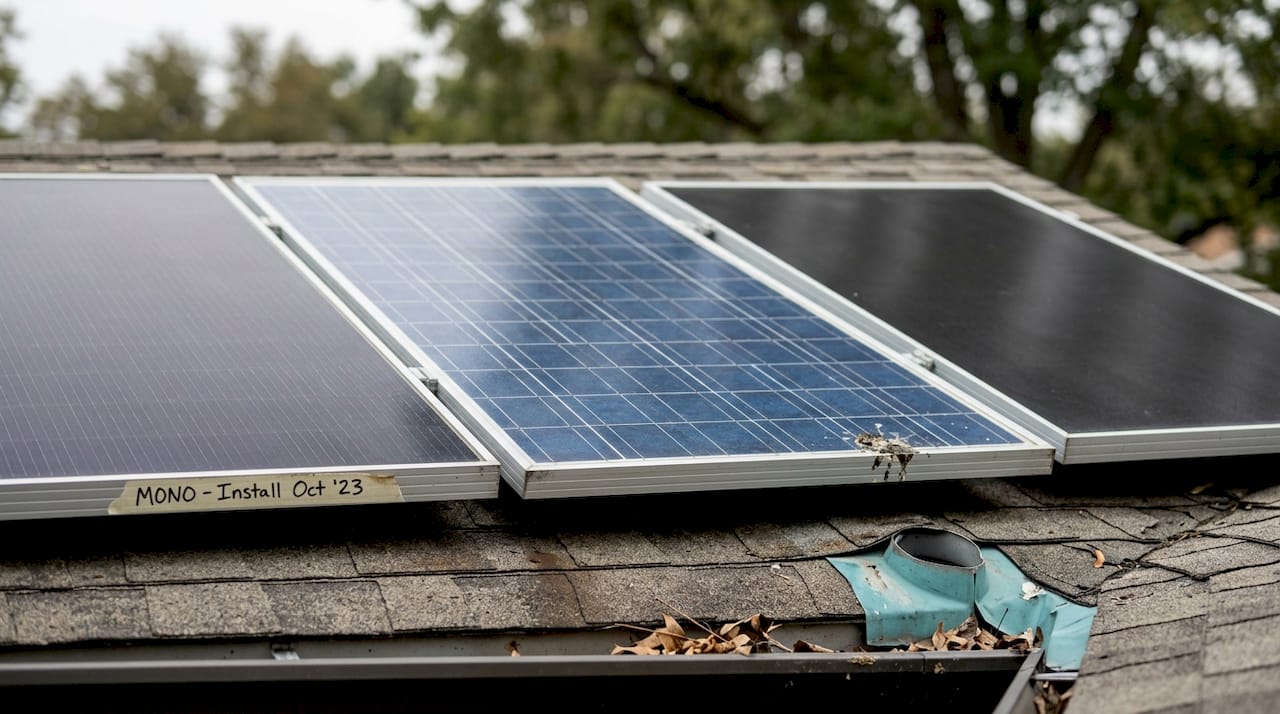
Monocrystalline panels are made from a single silicon crystal, which gives them the highest efficiency. They convert 18 to 22 percent of sunlight into electricity and are the best choice when roof space is limited. They cost more per panel but generate more power per square foot. Polycrystalline panels use multiple silicon fragments, which lowers production cost but also reduces efficiency to roughly 15 to 17 percent. They work well on larger roofs where space is not a constraint. Thin-film panels are flexible and lightweight, with efficiency ranging from 10 to 13 percent. They are rarely the best choice for residential rooftops but have niche applications on curved surfaces or RVs.
| Panel type | Efficiency | Cost per watt | Best application |
|---|---|---|---|
| Monocrystalline | 18–22% | $0.90–$1.50 | Limited roof space, high output |
| Polycrystalline | 15–17% | $0.70–$1.00 | Larger roofs, budget builds |
| Thin-film | 10–13% | $0.50–$0.75 | Specialty/flexible surfaces |
For the Pacific Northwest, monocrystalline panels are generally the right call. Because the region gets diffuse light rather than direct intense sun for much of the year, higher efficiency panels extract more energy from lower-intensity conditions. Understanding how solar panels generate energy helps clarify why efficiency ratings matter more here than in sunnier climates.
There is also an important distinction between solar PV (photovoltaic, which generates electricity) and solar thermal (which captures heat for water or space heating). Solar PV is more versatile for most homes, while thermal is a niche option suited to households with very high hot water demand. In the PNW, clouds reduce thermal system output significantly, making PV the stronger choice for most homeowners.
“For most Washington and Oregon homeowners, a high-efficiency monocrystalline PV system paired with a heat pump will outperform a solar thermal setup in both energy output and long-term value.”
If you want to see how panels actually perform in your region, check the data on solar performance in the Northwest before committing to a specific panel brand or configuration.
Energy independence and cost: What really matters
With the technology in focus, it’s crucial to see how these options affect your household’s bottom line and day-to-day energy independence.
Cost and independence pull in opposite directions. The system that gives you the most energy independence costs the most upfront. The system that saves you money fastest gives you the least resilience during outages. Here is how to think through the trade-offs:
- Grid-tied delivers the fastest financial return. With payback in 4 to 7 years through net metering, it is the most cost-effective path for homeowners whose primary goal is reducing their electricity bill.
- Hybrid costs more upfront but adds meaningful resilience. You keep net metering benefits while also having battery backup for outages. For many Northwest homeowners, this balance is worth the added investment.
- Off-grid maximizes independence but requires a large battery bank and careful energy management. It is rarely the most cost-effective choice unless you are far from the grid.
Key stat: A standard grid-tied 5 to 10 kW system costs $5,000 to $15,000 before incentives, while a comparable off-grid setup with battery storage can run two to three times more.
Net metering is a critical piece of the financial picture. Both Washington and Oregon have net metering policies that allow you to earn credits for excess generation. However, the value of those credits depends on your specific utility. Some utilities offer full retail rate credits; others offer a lower avoided-cost rate. Review your utility’s current policy before calculating your expected savings. You can explore home solar installation costs and ROI and get a clearer sense of actual solar panel costs to build a realistic financial model.
For a detailed breakdown of how net metering for cost savings works in Washington specifically, the rules have been favorable for homeowners and are worth reviewing before you size your system.
Pro Tip: If you are adding battery storage, do not undersize it. A battery that only covers 4 hours of usage will not get you through a winter night in the Northwest. Size for at least 8 to 12 hours of your average daily load for real resilience.
Considerations for Washington and Oregon homeowners
Regional specifics can dramatically impact your decision, so let’s zoom in on what matters most for Northwest homeowners.
The Pacific Northwest is not the sunniest region in the country, but solar still works well here. Seattle averages about 4 peak sun hours per day annually, and Portland does slightly better. The key is sizing your system correctly for the season with the least sunlight, typically November through February.
When it comes to technology, PNW diffuse light conditions actually favor high-efficiency monocrystalline PV panels over thermal collectors. A PV system paired with an electric heat pump handles both electricity and heating loads more effectively than a thermal system in this climate.
Regional incentives worth knowing:
- Washington state: No sales tax on solar equipment, plus net metering
- Oregon: Residential Energy Tax Credit plus utility rebates from some providers
- Both states: Utility-specific rebates vary, so check with your provider directly
Common goals we hear from Northwest homeowners:
- Reducing monthly electricity bills, especially as utility rates rise
- Having backup power during storm-related outages
- Cutting carbon emissions as part of a broader sustainability commitment
- Preparing for EV charging needs at home
“Homeowners who slightly oversize their solar array today are better positioned to add EV charging or battery storage in the future without needing a full system redesign.”
If you are worried about whether solar is viable in your specific location, the data on solar viability in the Northwest is reassuring. And if your energy needs grow over time, understanding the process of expanding a solar array is worth planning for from day one.
The unconventional truth: Why there’s no perfect solar solution
With all the facts and comparisons covered, here’s what most homeowners and experts miss about choosing a solar system.
After two decades of working with homeowners across Washington and Oregon, we have seen one pattern repeat itself: people spend enormous energy searching for the perfect system and not enough time planning for their actual life. The “best” system on paper is not always the best system for your household.
Some homeowners fixate on efficiency ratings. Yes, solar thermal systems can reach 80 percent heat efficiency compared to PV’s 20 percent, but PV generates electricity that powers everything in your home. Thermal only heats water or air. That versatility gap matters far more than the efficiency number.
The same logic applies to off-grid versus hybrid. Off-grid sounds like the ultimate independence, but it demands careful daily energy management and significant battery investment. For most suburban homeowners in Washington and Oregon, a well-designed hybrid system delivers 90 percent of the independence benefit at a fraction of the complexity.
Our honest recommendation: invest your planning energy into understanding your actual usage patterns, your utility’s net metering terms, and your backup power needs. Then choose the system that fits those realities. Explore real solar system case studies to see how other Northwest homeowners made these trade-offs in practice.
Ready to explore your solar options?
Understanding the differences between solar systems is the first step. The next step is seeing how those options translate into real projects and real savings for homes like yours.
A&R Solar has spent over 20 years helping Washington and Oregon homeowners navigate exactly these decisions. Browse real residential solar projects to see what different system types look like in practice. If backup power is a priority, explore our home battery backup options designed specifically for the Northwest climate. When you’re ready to take the next step, get started with solar and connect with our team for a personalized recommendation based on your home, your goals, and your local utility.
Frequently asked questions
What’s the main difference between grid-tied, off-grid, and hybrid solar systems?
Grid-tied connects to the utility for the lowest cost and fastest payback at 4 to 7 years, off-grid uses batteries for complete independence, and hybrid blends both for backup power and ongoing savings.
Which solar panel type is best for small roofs?
Monocrystalline panels are the best fit for limited roof space because they deliver 18 to 22 percent efficiency, producing more power per square foot than any other residential panel type.
Does solar thermal make sense in the Pacific Northwest?
For most PNW homeowners, a PV system paired with a heat pump outperforms thermal. Evacuated tube thermal collectors handle diffuse light better than flat-plate systems, but PV still offers greater overall value.
How long does it take to break even with a new solar system?
Grid-tied systems typically pay for themselves in 4 to 7 years, depending on local incentives, your utility’s net metering rate, and your household’s energy consumption.