

TL;DR:
Aging solar panels in the Pacific Northwest face challenges like moss, pollen, and seasonal swings that reduce performance over time. Regular monitoring, cleaning, and identifying physical damage help homeowners maintain efficiency, while significant drops indicate when professional inspection is necessary. Keeping detailed records and early detection of issues extend the system’s lifespan and optimize energy production.
Your solar system was running strong when it was first installed, but lately you’ve noticed your electric bill creeping up even on sunny days. That nagging doubt is worth paying attention to. Aging solar panels in the Pacific Northwest face a specific set of challenges, from heavy moss growth and persistent pollen to the region’s dramatic seasonal swings, and many homeowners don’t realize how much performance they’re quietly losing every year. This article walks you through the exact signals to watch for, the most common root causes of underperformance, a practical DIY checklist, and a clear breakdown of when it’s time to bring in a professional.
Table of Contents
- How to tell if your solar panels need restoring
- Common culprits: Soiling, shade, or real degradation?
- Restoration checklist: What you can do yourself
- When to call a pro: DIY vs. expert service comparison
- What most DIY guides miss about restoring aging solar panels
- Take your solar restoration to the next level with expert help
- Frequently asked questions
Key Takeaways
| Point | Details |
|---|---|
| Track output drops | Compare year-over-year production and watch for sustained declines of 5% or more. |
| Diagnose the cause | Distinguish between routine soiling, shading, and signs of physical panel degradation before taking action. |
| DIY what you can | Safely clean panels and monitor results but recognize when it’s time to call in a pro. |
| Know when to call | Visible defects or large performance drops signal the need for expert assessment and repair. |
How to tell if your solar panels need restoring
To tackle solar panel restoration, you first need to know when your system actually needs it.
Not every dip in production means something is wrong. Output naturally varies with the seasons, and a cloudy February will always look different from a bright July. The key is learning to separate normal seasonal variation from a real, sustained drop in performance.
The most reliable method is a year-over-year comparison. Pull your production data from the same month in previous years and compare it against current output. If you’re seeing sustained drops of 5% or more on similar weather days, that’s a signal worth investigating further. A 10% or larger gap is a clear red flag.
Here are the key numbers and signals every homeowner should track:
- Year-over-year production data for the same calendar month
- Daily peak output compared against the rated capacity of your system
- Weather-adjusted comparisons: avoid comparing rainy stretches to sunny ones
- Inverter error codes or warning lights that appear repeatedly
- Monitoring app alerts for panels producing significantly below average
“Comparing year-over-year production on similar weather days and looking for sustained drops indicates real issues that go beyond normal weather variation.” — HowToGoSolar annual checklist
Your inverter or monitoring app is your best diagnostic tool. Most modern systems allow you to track individual panel output, and monitoring your system’s production regularly makes it much easier to catch problems early. If your monitoring app flags one or two panels consistently underperforming compared to the rest of the array, that’s meaningful data. It points you directly to where the problem lives rather than leaving you guessing across the whole roof.
Bookmark your utility account’s production history and review a panel maintenance checklist at least once a year. Consistent record-keeping is what separates homeowners who catch small problems early from those who discover large, expensive ones later.
Common culprits: Soiling, shade, or real degradation?
Once you know your output is down, it’s time to dig into the most likely causes.
The Pacific Northwest presents a unique combination of environmental factors that affect solar panels differently than most other regions. Wet winters encourage moss and algae growth. Spring brings heavy pollen deposits. Summer can add dust, smoke residue, and dried bird droppings. Each of these affects your panels differently, and not all of them require the same fix.
Soiling is the most common and most fixable cause of underperformance. Dust, pollen, and moss create a physical barrier between sunlight and your panel’s surface, reducing the amount of energy converted. The good news is that soiling is usually reversible with proper cleaning. Check out these panel cleaning tips to understand what works best for the PNW environment.
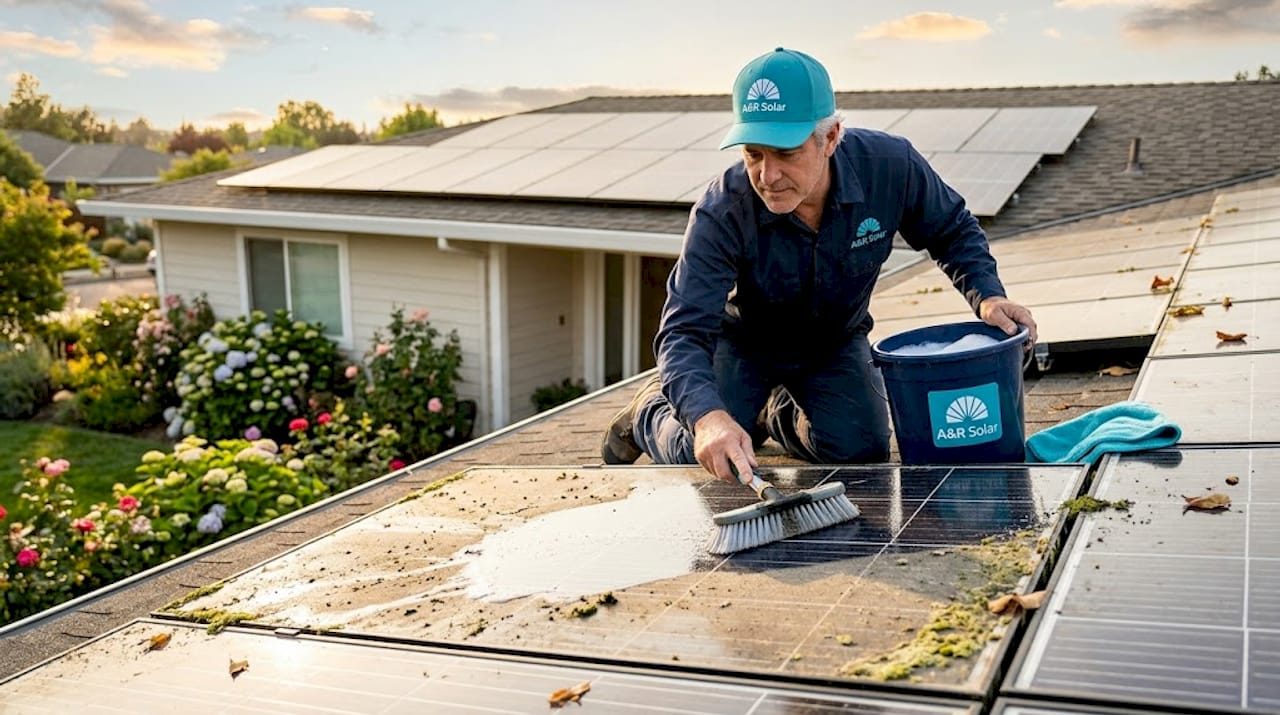
Shade is the second major culprit. Trees grow. Neighbors add structures. Rooftop HVAC equipment shifts. Even a single branch casting a shadow over part of your array can significantly reduce system-wide output, especially in systems without panel-level power optimizers or microinverters. Walk your property and look at the roofline from multiple angles at different times of day.
Physical degradation is the most serious category. Signs include:
- Yellowing or browning of the cells visible through the glass
- Cracks in the glass or along the panel frame
- Dark spots or irregular patterns on individual cells (hot spots)
- Visible delamination, where layers of the panel separate from each other
- Burn marks near connectors or junction boxes
Soiling can usually be addressed by cleaning or shade mitigation, while visible signs of physical degradation or defects point to more serious issues that require professional evaluation.
The industry standard degradation rate for monocrystalline panels, the most common panel type installed in the last decade, is about 0.5% per year under normal conditions. That means a 10-year-old system should realistically be producing about 5% less than it did when new, all else being equal. If you’re seeing much larger drops, soiling, shade, or physical defects are far more likely explanations than natural aging alone.
Pro Tip: If you’re unsure whether you’re dealing with soiling or degradation, clean the panels first. If production recovers significantly after cleaning, soiling was your issue. If production stays low, you’re likely dealing with a deeper problem. Always review best solar maintenance practices before assuming the worst. For cleaning solutions, consider eco-friendly cleaning options that won’t damage panel coatings or introduce harmful runoff into your yard.
Restoration checklist: What you can do yourself
Now that you can spot the cause, let’s turn to the most effective DIY restoration actions.
Many homeowners can recover meaningful output just by following a structured, careful process. Monthly monitoring is recommended, and basic soiling can be addressed by homeowners using safe cleaning methods. Here’s a step-by-step checklist to walk through before calling anyone:
Review your production history. Log into your inverter monitoring app or your utility account and pull the last 12 to 24 months of production data. Note any months where output dropped significantly compared to prior years.
Document current conditions. Take photos of each panel from the ground or from a safe vantage point. Note visible soiling, shading, or damage before you start any cleaning. This creates a useful baseline for comparison.
Check for shading changes. Walk the perimeter of your home and note any new tree growth, added structures, or roof debris that may be casting shadows on the array during peak production hours.
Clean the panels safely. Use a soft brush or sponge with plain water or a mild, non-abrasive soap. Avoid pressure washers, as they can damage seals. Avoid cleaning during peak heat hours to prevent thermal shock. Review how to clean panels for detailed technique guidance specific to the Pacific Northwest’s conditions.
Allow 24 to 48 hours and re-check output. Compare production before and after cleaning on similar weather days. A meaningful improvement confirms soiling was the primary issue.
Monitor for 30 days post-cleaning. Keep tracking daily output to confirm improvement holds. If you see continued underperformance, the problem is likely beyond soiling alone.
Consult resources on cleaning needs in the PNW. The specific climate factors in Washington and Oregon create a cleaning schedule that differs from drier regions.
Safety is non-negotiable. If your panels are steeply pitched, wet, or your roof has limited traction, do not attempt roof access. Ground-level cleaning with an extension pole is a safer alternative for most homeowners.
Pro Tip: After cleaning, use your monitoring app to compare individual panel output. If one or two panels are still lagging behind after cleaning, those specific units may have physical issues worth flagging for a professional inspection. You’ll also want to review maintenance best practices to build a routine that fits your roof type and local conditions.
When to call a pro: DIY vs. expert service comparison
Even with regular care, some problems require the expertise of a trained solar technician.
There’s a clear tipping point where continued DIY work stops adding value and professional service becomes the better investment. Understanding that line helps you make cost-effective decisions rather than spending time on fixes that won’t fully resolve the underlying issue.
Visible signs of physical degradation including discoloration, cracks, and hot spots, or production drops over 10%, signal that it’s time for expert help. These are not problems that cleaning or shade trimming will fix.
| Situation | DIY restoration | Professional service |
|---|---|---|
| Visible soiling, pollen, or moss | Best option | Not needed |
| New tree shading the array | Homeowner can trim | Needed for rerouting or optimizer install |
| Output drop of 5% or less | Monitor and clean first | Consider if it persists |
| Output drop of 10% or more | Not sufficient | Strongly recommended |
| Cracked glass or discoloration | Not safe or effective | Required |
| Hot spots or burn marks | Cannot resolve | Required |
| Inverter faults or error codes | Check manual first | Required if fault persists |
| Annual system health check | Good supplemental practice | Recommended every 1-3 years |
Use this table as a quick guide, but don’t wait too long if you’re on the fence. A maintenance checklist for the PNW can help you categorize what you’re seeing and decide which column you’re in.
A few red flags that should prompt an immediate professional call:
- Any burning smell near the inverter or junction boxes
- Persistent inverter error codes that reappear after resetting
- One or more panels producing zero output consistently
- Production drops that appeared suddenly rather than gradually
- Storm or hail damage to any part of the array
What most DIY guides miss about restoring aging solar panels
Most guides focus on cleaning schedules and shade trimming, and those are genuinely useful. But after years of working with homeowners across Washington and Oregon, we’ve seen a consistent pattern: the homeowners who protect their system’s long-term value are the ones who pay attention to subtle physical changes long before those changes become expensive problems.
Here’s what that means in practice. A small crack along the edge of a panel frame, one that’s easy to dismiss as cosmetic, can allow moisture to enter over time. In the wet Pacific Northwest climate, that moisture penetrates the internal laminate layers and causes delamination and corrosion that spreads slowly across the cell surface. By the time output drops noticeably, the damage is significantly worse than it would have been if caught at the crack stage.
The same logic applies to hot spots. A hot spot is a localized area of a panel that runs hotter than the surrounding cells, usually because of a cell defect, physical damage, or shading. They’re essentially invisible to the naked eye under normal conditions. A professional inspection using infrared thermal imaging can locate hot spots precisely and determine whether they represent an early-stage problem or an advanced one requiring panel replacement. This is the kind of diagnostic that no amount of careful cleaning or visual inspection can replicate.
We also see homeowners underestimate the value of detailed production records. Tracking monitoring best practices doesn’t just help you catch problems. It also provides concrete data when you’re filing a warranty claim or asking for a professional assessment. Technicians can work much faster and more accurately when you arrive with two years of production logs rather than a vague sense that “things seem slower lately.”
The most cost-effective solar restoration strategy isn’t the most aggressive cleaning schedule. It’s a combination of regular monitoring, annual visual inspections, and periodic professional checkups timed to catch early-stage issues before they compound.
Take your solar restoration to the next level with expert help
If your panels need more than a little cleaning, here’s your fastest path to full system performance.
A&R Solar has spent over two decades working with homeowners across Washington and Oregon to restore, optimize, and extend the life of solar energy systems. As a local, employee-owned certified B Corporation, we understand the specific climate, utility structures, and panel aging patterns that affect systems in the Pacific Northwest.
Whether you’re seeing a significant output drop, dealing with physical damage, or simply due for an annual tune-up, our team provides thorough diagnostics and hands-on repair service tailored to your system. Homeowners in Washington can explore solar repair in Washington, and those in Oregon can learn more about solar repair in Oregon. To see how we’ve helped homeowners like you recover system performance, browse our real-world restoration case studies and get in touch to schedule a professional system evaluation.
Frequently asked questions
How often should I clean my solar panels in Washington or Oregon?
Clean solar panels at least once per year, and more frequently if you notice visible buildup from moss, pollen, or debris. Monthly monitoring is recommended to catch performance changes between cleanings.
What are the first signs my solar panels need restoration rather than just cleaning?
Sudden drops in output, visible damage like cracks or discoloration, and low production that persists after cleaning all point to deeper issues. Discoloration, cracks, and hot spots are physical defects that require a professional inspection rather than routine maintenance.
Can I restore solar panel performance myself, or do I need a professional?
You can safely clean panels and remove shade-causing debris on your own, but output drops over 10% or visible physical damage require professional service. A 10% or greater decrease is a clear indicator that a trained technician should evaluate your system.
How much performance should I expect to lose each year as my panels age?
Modern panels in the Pacific Northwest typically degrade by about 0.5% per year under normal conditions. The industry-standard degradation rate for monocrystalline panels means a 15-year-old system operating at 92 to 93% of its original capacity is performing as expected, and larger losses suggest an underlying problem worth investigating.