

TL;DR
Across Washington and Oregon, schools aren’t just adopting solar—they’re becoming places that generate energy, support their communities, and stay powered during outages. We’ve seen this firsthand in projects like La Conner and Franklin Pierce. This shift isn’t theoretical. It’s already happening across the Northwest.
Intro
Solar used to be a residential story. Today, the most important energy story in the Northwest is written on the rooftops of our public schools.
We’ve had a front-row seat to that shift. And what’s happening right now is bigger than any single project.
Why schools are uniquely positioned for solar
Schools are built for the long term. They serve communities for decades, not years. That changes how decisions get made.
When a school invests in solar, it’s not a trend or a quick win. It’s a 25+ year decision tied to operating costs, public accountability, and community values.
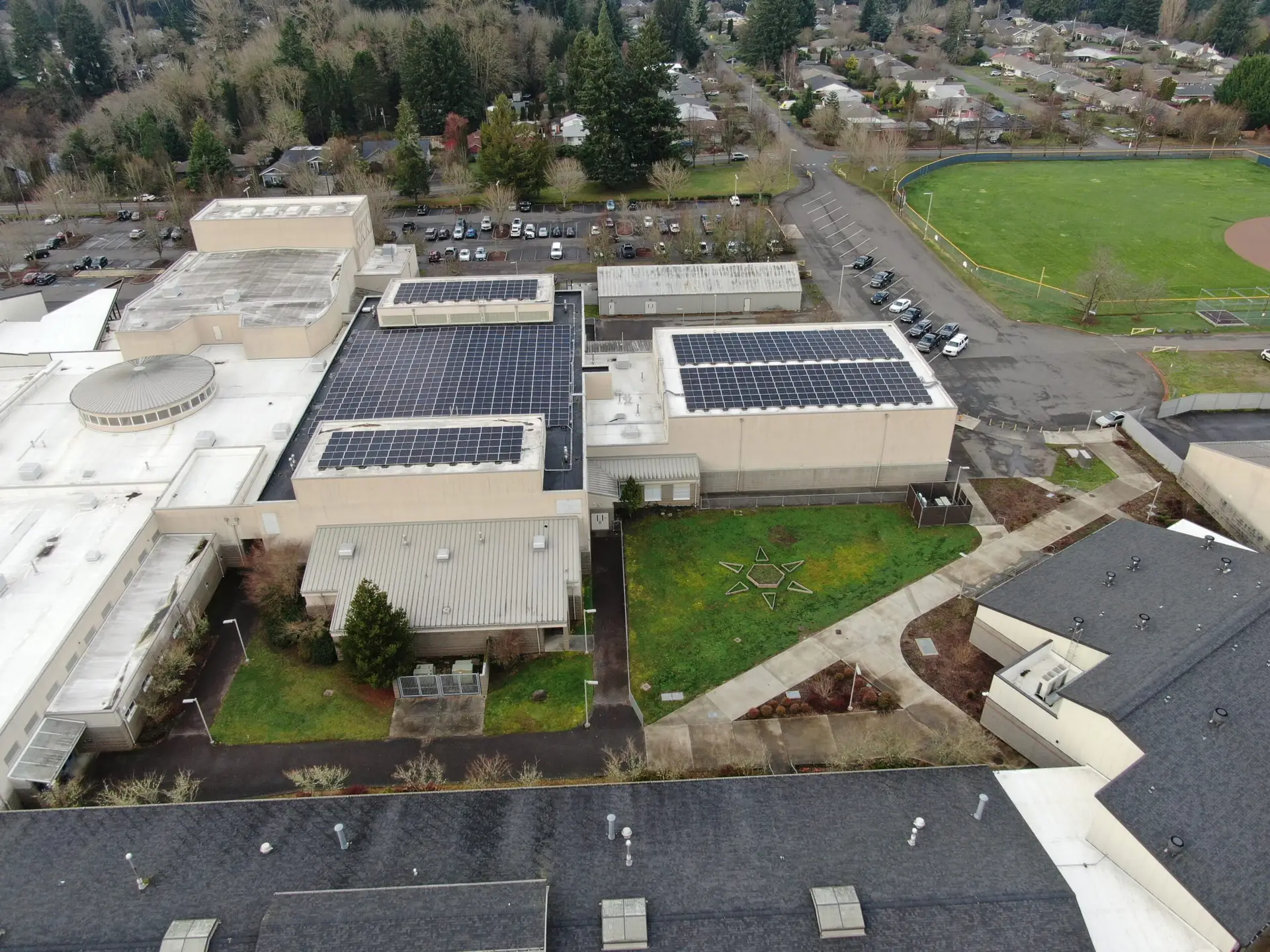
We’ve seen this in projects like Whatcom Community College, one of our earliest commercial installations, and later with their Learning Commons expansion. Watching a system we installed years ago still humming along while the building around it evolves—that’s the definition of a sound investment.
The same pattern is playing out across the region. Institutions that plan long-term are quietly aligning with where energy is going.
From one campus to community-wide impact
Some projects stay contained to a single building. Others ripple outward.
At Franklin Pierce Schools, solar connects directly to how students experience the campus. It’s not just about reducing energy costs—it’s part of a broader system that includes land use, food, and education. Students are surrounded by it. It becomes normal.
That’s what schools do best. They normalize things.
When solar shows up on a school, it doesn’t feel experimental. It feels like the way things are done now. Parents see it. Students grow up with it. The community absorbs it.
And that shift—from new to normal—is where real change happens.
When the power goes out, where do people go?
This is where the story gets real.
Solar by itself is powerful. But solar paired with battery storage changes what a building can do.
At La Conner School District, we worked on a system designed not just to generate energy, but to support the school during outages. With battery storage in place, critical parts of the campus can remain powered when the grid goes down.
That means lights stay on. Refrigeration continues. Communication systems work.
And in a real scenario, it means the school can function as a gathering place when people need it most.
Across the Northwest, that idea is gaining traction.
In Oregon, projects like Pinehurst School District are being designed specifically as resilience hubs—solar + storage systems that can support communities during wildfire-related outages or other disruptions.
If the power goes out, where do people go?
Increasingly, the answer is: places that are built to stay on.
How a school stays powered during an outage
Think of it like this:
SUN → Solar Panels → Battery Storage → School (critical loads stay on)
↓
Grid goes down
↓
School stays powered
- During the day, solar powers the building and charges the battery
- When the grid goes down, the system isolates and the battery takes over
- Critical systems (lighting, refrigeration, communications) continue running
It’s not theoretical. It’s already in place.
What’s happening in Washington and Oregon
This shift isn’t happening in isolation. There’s real momentum behind it—just expressed differently in each state.
State of the States
Washington: Scaling fast through state-supported funding (Commerce)
Oregon: Building deeper resilience through programs focused on equity and outage preparedness (ODOE)
In Washington, we’re seeing scale. State-backed funding is helping more districts move forward with solar, reducing barriers and accelerating adoption. Schools across the state—from Tukwila to Shoreline to Edmonds—are taking steps that would have been much harder just a few years ago.
In Oregon, the focus leans more toward resilience and equity. Programs are structured to prioritize projects that can operate during outages and serve rural or historically underserved communities. That’s why you see systems like Pinehurst’s, where backup power is part of the design from the start.
The outcomes aren’t identical—and that’s what makes this moment interesting.
One state is expanding access quickly.
The other is designing for what happens when the grid fails.
Both are moving toward a future where schools do more than consume energy—they provide it.
What this looks like on the ground
We’ve seen this shift up close.
It doesn’t usually start with a big statement. It starts with practical questions:
- How do we reduce operating costs?
- How do we make this building more reliable?
- How do we serve our community better?
Solar—and increasingly storage—becomes the answer to all three.
Over time, those individual decisions add up. What used to feel like a special project starts to look like standard practice.
And that’s where we are now.
Closing
The shift happening at schools across Washington and Oregon isn’t dramatic. It’s practical. Lower costs, fewer emissions, backup power when the grid goes down.
It just happens to add up to something bigger.
Wondering whether solar makes sense for your building? Start where every school district starts—with your current energy use.