



TL;DR:
- Many homeowners in Washington and Oregon overlook substantial financial support options for solar energy.
- Combining state, and utility incentives, including tax credits and rebates, can significantly reduce installation costs and improve returns.
Many homeowners across Washington and Oregon dismiss solar as financially out of reach, but that assumption overlooks a significant layer of financial support available right now. Solar incentives reduce installation costs through programs including tax credits, sales tax exemptions, and rebates that can collectively cut your total project cost by thousands of dollars. Understanding which programs apply to your home, your utility, and your timeline is what separates homeowners who overpay from those who get the most out of their solar investment.
Table of Contents
- What are solar incentives and why do they matter?
- Washington’s solar incentives: Tax credits, sales tax exemptions, and net metering
- Oregon’s solar incentives: Rebates, Energy Trust offers, and storage bonuses
- How to qualify and maximize solar incentives in the Pacific Northwest
- Our take: What most guides miss about solar incentives
- How A&R Solar helps homeowners tap every incentive
- Frequently asked questions
Key Takeaways
| Point | Details |
|---|---|
| State incentives differ | Washington and Oregon offer unique programs including sales tax exemptions and cash rebates. |
| Eligibility matters | Approved contractors are almost always required to qualify for incentives and rebates. |
| Timing impacts savings | Incentive programs can change or close quickly, so monitoring funding is essential. |
What are solar incentives and why do they matter?
Solar incentives are programs created by state, and local governments, as well as utilities, to lower the financial barrier to installing solar energy. They cover a wide range of mechanisms designed to reduce both upfront costs and long-term electricity expenses. Solar incentives include programs like Washington’s sales tax exemption and utility bill credits through net metering.
For homeowners considering solar panels for your home, these programs are not minor line items. They can meaningfully change your payback period and lifetime return on investment.
The incentives available in Washington and Oregon have helped thousands of homeowners. Each state has built its own programs targeting local utilities and homeowners, and many of these benefits are designed to stack, meaning you can combine state, and local programs for maximum savings.
Key categories of solar incentives include:
- State sales tax exemptions: Waives state sales tax on qualifying solar equipment and installation
- Net metering: Utility bill credits for excess energy your system sends to the grid
- Cash rebates: Direct payments from utilities or state agencies for installing solar
- Battery storage bonuses: Additional rebates or credits for pairing solar with energy storage
Eligibility for many of these programs depends on working with approved solar installers, so contractor selection is not just a quality decision. It is a financial one.
Washington’s solar incentives: Tax credits, sales tax exemptions, and net metering
Washington state homeowners have access to a practical combination of incentives that can reduce the total cost of a residential solar system substantially. The most notable state-level program is the sales tax exemption.
The Washington sales tax exemption applies to qualifying solar equipment and installation costs and is currently available through 2029. Washington’s state sales tax rate is 6.5%, and with local taxes often pushing effective rates above 9%, this exemption generates real savings. On a $25,000 system, a 9% exemption is more than $2,200 back in your pocket at the point of sale.
Washington also has net metering policies that allow homeowners to receive bill credits for surplus electricity sent to the grid. When your system produces more energy than your home uses, that excess flows to the utility, and the utility credits your bill at a rate tied to the retail price of electricity. Over a year, this can offset a large share of your winter electricity bills when solar production is lower.
Here is a summary of Washington’s main solar incentive programs:
- State sales tax exemption: Exempts solar equipment and installation from state/local sales tax through 2029
- Net metering: Retail-rate bill credits for excess solar energy sent to the grid
- Utility-specific programs: Some Washington utilities offer additional local rebates or incentives, particularly in rural cooperative territories
Statistic callout: Using Washington’s sales tax exemption on an average residential system priced at $25,000 to $50,000 can reduce your total project cost by $2,500 to $5,000 or more before any utility-level benefits are factored in.
Understanding Washington solar incentives fully requires knowing your specific utility, because program availability and net metering terms can vary between investor-owned utilities and public utility districts.
Pro Tip: Sign up for your utility’s email notifications and check their website periodically. Utilities in Washington occasionally open limited additional incentive programs or announce changes to net metering policies with relatively short notice windows.
One important eligibility note: to qualify for the Washington sales tax exemption, your installation must meet state requirements, including using properly licensed contractors. The solar permitting guide covers what permits are typically required and how the process works in Washington, which can help you plan your project timeline and avoid compliance issues that could delay or disqualify benefits.
Oregon’s solar incentives: Rebates, Energy Trust offers, and storage bonuses
Oregon’s incentive landscape is structured differently from Washington’s, and in several ways it is more aggressive in targeting specific utility customers and rewarding battery storage adoption. Two primary programs anchor Oregon’s solar incentive ecosystem: the Energy Trust of Oregon incentives and the Oregon Department of Energy (ODOE) Solar and Storage Rebate Program.
The Energy Trust of Oregon offers utility-specific incentives of $2,500 per home for customers of Portland General Electric (PGE) and Pacific Power. These incentives are paid directly to approved contractors, which then pass the savings on to homeowners in the form of reduced project costs. Energy Trust also offers additional per-kilowatt-hour incentives for battery storage paired with solar systems, up to defined maximums per project.
The ODOE Solar and Storage Rebate Program operates separately and has seen significant renewed funding. The ODOE rebate program reopened June 15, 2026 with $1.1 million in available rebates, offering up to $5,000 for solar installations and up to $2,500 for paired battery storage. These rebates are paid to approved contractors who apply on behalf of homeowners, and funding is limited, meaning early action is critical.

Oregon incentive comparison by utility
| Program | Utility/Source | Solar Incentive | Storage Incentive | Notes |
|---|---|---|---|---|
| Energy Trust | PGE | $2,500 per home | Per kWh, up to max | Requires approved contractor |
| Energy Trust | Pacific Power | $2,500 per home | Per kWh, up to max | Requires approved contractor |
| ODOE Rebate | Statewide (when funded) | Up to $5,000 | Up to $2,500 | Paid to approved contractor |
Statistic callout: Oregon homeowners who combined the Energy Trust rebate, ODOE solar rebate, ODOE storage rebate on a solar-plus-storage system in 2026 could potentially reduce their total project cost by $15,000 or more, depending on system size and specific program eligibility.
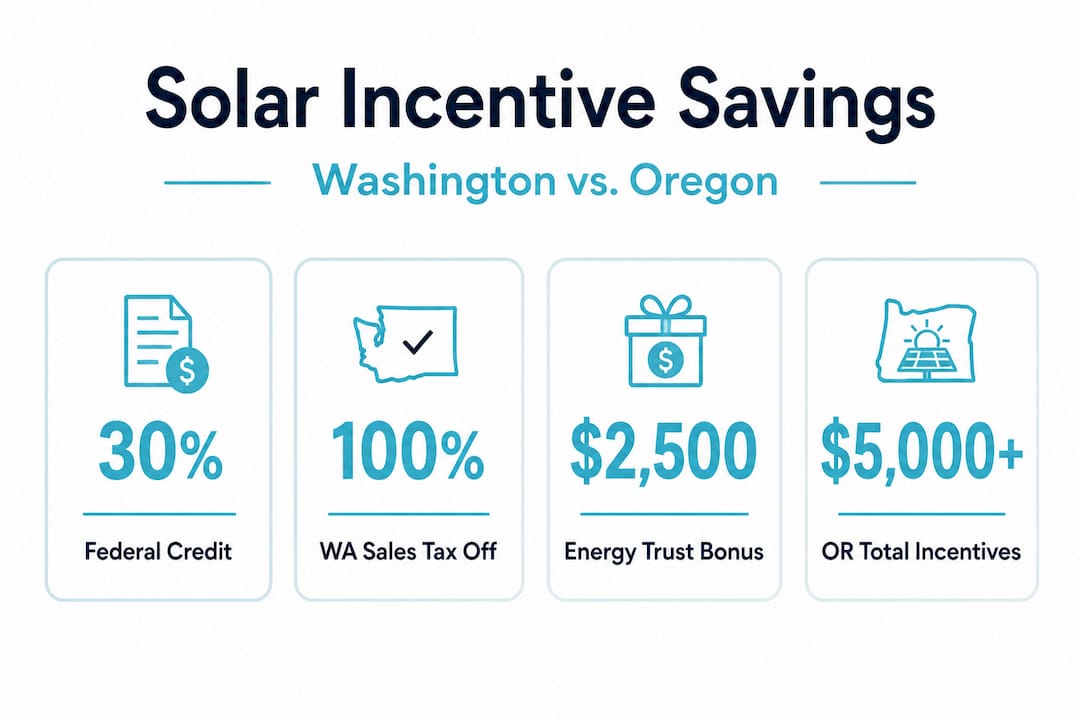
For homeowners exploring Oregon solar incentives, the storage bonus deserves particular attention. Battery storage adds resilience to your solar system, especially during grid outages, and the current financial incentives make adding storage considerably more affordable than it was just a few years ago.
Practical eligibility requirements for Oregon programs include:
- You must be a customer of an eligible utility (for Energy Trust programs)
- Installation must be performed by an Energy Trust-approved contractor
- For ODOE rebates, the contractor must be on the approved list and apply on your behalf
- The system must meet technical specifications set by the program
- Projects must be approved before installation begins in many cases
Areas like Bend, Oregon and other parts of central and eastern Oregon fall under Pacific Power territory, which means Energy Trust incentives are available there alongside ODOE rebates. Homeowners in Hillsboro and the Portland metro area on PGE can access the same core structure, and battery storage incentives are particularly well-suited to those regions where grid events occur during high-demand periods.
For a deeper look at available programs by region, the detailed Oregon incentives breakdown covers current program status, utility-specific terms, and what to watch for as programs evolve.
How to qualify and maximize solar incentives in the Pacific Northwest
Understanding available incentives is just the start. Knowing how to qualify and avoid common mistakes is what determines whether you capture the full financial benefit of going solar.
Oregon’s Energy Trust incentives and the ODOE rebate program both require use of eligible utilities and approved contractors, with funding availability directly affecting access. Missing one requirement can eliminate access to thousands of dollars in rebates.
Here are the key steps to unlock all available incentives:
- Confirm your utility. Determine whether you are served by PGE, Pacific Power, or another utility. This determines which Energy Trust incentives apply to you in Oregon, and whether you fall under specific net metering policies in Washington.
- Select a certified, approved contractor. Many programs require installation by contractors on approved lists. Verify your installer’s status before signing any contract. Check certified installer eligibility to confirm your installer qualifies for relevant programs.
- Confirm program funding status before committing. Programs like the ODOE rebate open and close as funding is allocated. Apply or reserve your position as early as possible.
- Get pre-approval where required. Some Oregon programs require project approval before installation begins. Skipping this step can disqualify you from a rebate even if everything else is in order.
- Document everything. Keep copies of your contract, equipment specs, permits, and utility interconnection agreements. You will need these for tax filings and rebate applications.
- Watch for new announcements. Program terms, funding levels, and eligibility rules change. A program that was closed six months ago may have reopened with new funding, as the ODOE program did in June 2026.
To better understand the full solar installation process from site assessment to interconnection, walking through each step helps set expectations and ensures nothing procedural falls through the cracks.
Pro Tip: Never assume a program is still open or that its terms are unchanged from what you read online six months ago. Program details shift frequently in both states, and a quick call to your installer or the program administrator can save you from a costly eligibility mistake.
Common mistakes homeowners make include choosing an installer based solely on price without verifying approval status, missing pre-approval deadlines, failing to claim the ITC because of confusion about how tax credits work, and overlooking battery storage rebates that could have been included in their original project scope. Each of these mistakes is avoidable with a little proactive planning when exploring solar panels for your home.
Our take: What most guides miss about solar incentives
Most solar incentive guides focus on listing numbers: 30% here, $5,000 there. What they rarely address is how quickly the ground shifts beneath those numbers, and how much your choice of installer determines whether you actually receive what you expect.
We work with homeowners across Washington and Oregon every year, navigating program changes, funding pauses, and updated eligibility rules. From that experience, the single most consistent source of missed savings is installer selection. Homeowners sometimes choose a contractor who is not on an approved list because the quote was lower or the sales pitch was compelling. The result is that they complete an installation and then discover they are not eligible for the rebate or incentive they planned their finances around.
Incentives are not universal; Oregon’s incentives vary by utility, require approved installation partners, and funding can change rapidly. That is not a footnote. It is the central operational reality of navigating solar incentives in the Pacific Northwest.
The financial case for solar should never rest on a single incentive. Build your analysis around what is confirmed available today, with approved contractors, and treat any additional programs as welcome bonuses rather than guaranteed line items.
Timing also matters more than most homeowners expect. The ODOE rebate program reopened in June 2026 with $1.1 million available. At the application pace seen in prior rounds, that funding allocates quickly. Homeowners who wait to see how things develop often find themselves on a waitlist for the next funding cycle, which may be months away.
Verifying installer approval details before signing a contract takes less than ten minutes and could be worth several thousand dollars in preserved eligibility. That is the kind of practical step most incentive guides skip over entirely.
How A&R Solar helps homeowners tap every incentive
Navigating solar incentives across two states, multiple utilities, and changing program rules is genuinely complex. Knowing what is available is one thing; making sure every qualifying program is captured for your specific project requires experience and up-to-date knowledge of current program status.
A&R Solar is a local, employee-owned, B Corporation-certified solar company with two decades of experience in Washington and Oregon. Our team actively tracks program changes, maintains approval status with relevant incentive programs, and guides homeowners through every step from initial qualification to final filing. Browse our residential solar projects to see what real installations look like across the region, and explore case studies from Northwest homeowners who have successfully claimed available incentives. When you are ready to understand exactly what your home qualifies for, our Oregon solar incentives and Washington solar incentives pages give you a current, detailed breakdown with no guesswork.
Frequently asked questions
How much can I save on solar installations with incentives in Washington?
Most homeowners can save up to 10% (depending on local tax rates) using the Washington sales tax exemption. Stacking this with other utility provider incentives can further reduce upfront costs, often saving thousands of dollars in combined savings on a typical residential system.
Do solar incentives in Oregon include battery storage?
Yes, the ODOE rebate program includes storage bonuses of up to $2,500 for paired energy storage when funding is available, and Energy Trust of Oregon also offers per-kilowatt-hour storage incentives for eligible utility customers.
What happens if incentive funding runs out?
Programs may pause or close temporarily when their funding allocation is exhausted, and timing and funding availability affect rebate access significantly, so homeowners should monitor program announcements and apply as early as possible.
Do I need a certified installer to qualify for incentives?
Yes, most incentive programs require installation by an approved or certified contractor, and eligibility typically depends on approved contractors, so confirming your installer’s status before signing any agreement is essential.
Can solar incentives be combined across state, local, and utility programs?
Yes, most homeowners can combine multiple programs for larger total savings, and state incentives combine with local rebates for maximum benefit, though each program has its own eligibility rules and application requirements.