



TL;DR:
- Reading a solar energy bill involves understanding key components like energy charges, delivery fees, fixed customer charges, and solar credits to evaluate your savings accurately. Net metering credits offset energy costs by applying export credits at retail or lower rates, and verified data from inverter apps complements utility meter readings for precise analysis. The effective rate per kWh is the most reliable measure of your system’s financial performance, as fixed charges and rate structures influence overall savings.
Reading a solar energy bill is the process of identifying your electricity charges, solar production credits, and usage metrics to understand exactly what you owe and how much your system is saving you. Most solar homeowners receive their first post-installation bill and feel more confused than before they went solar. That confusion is normal, but it’s also fixable. This guide walks you through every line item, explains how net metering credits work, and shows you how to verify your bill against your inverter data using tools like Enphase Enlighten and monitoring dashboards from utilities like Pacific Power and Puget Sound Energy.
How to read solar energy bills: key components and line items
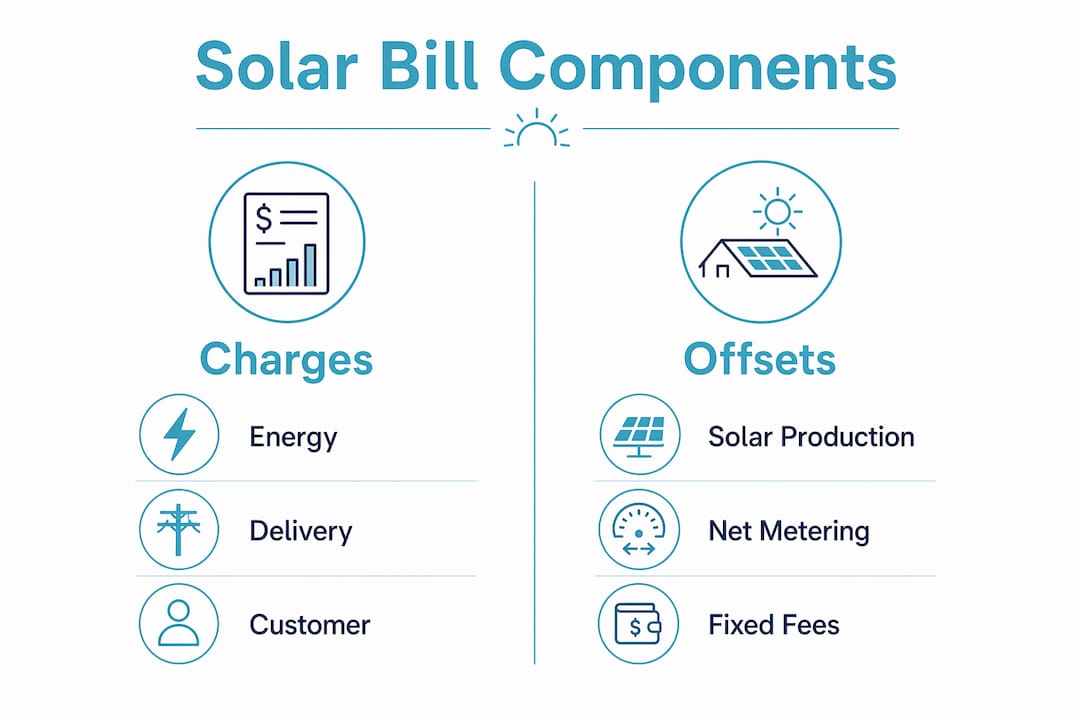
A solar energy bill tracks four distinct categories: energy supply charges, delivery and transmission fees, fixed customer charges, and solar credits. Understanding each one tells you exactly where your money goes and where your panels are saving it.

Typical electric bills in 2026 consist of energy and supply charges that make up 40 to 70% of the total, plus fixed customer charges between $5 and $20 per month, plus delivery fees that solar does not eliminate. That last point surprises most new solar owners. Your panels can zero out your energy consumption charges, but they cannot remove the fixed infrastructure fees your utility charges every account.
Here is what each line item means for your household:
- Energy/supply charges: The cost per kWh you consume from the grid. Solar directly offsets this.
- Delivery and transmission fees: Charges for moving electricity through the grid to your home. These persist regardless of solar production.
- Fixed customer charges: A flat monthly fee for maintaining your grid connection. Solar does not reduce this.
- Net metering credits: A dollar credit applied when your panels export excess electricity to the grid. This appears as a negative charge on your bill.
- Taxes and regulatory surcharges: State and local fees, public purpose charges, and wildfire mitigation surcharges that vary by utility.
Solar bills also track four key metrics: Delivered kWh (energy imported from the grid), Received kWh (energy exported to the grid), Net kWh (the difference between the two), and in some cases Total Solar Production. Net kWh is the number your bill uses to calculate what you owe or what credit you carry forward.
| Charge type | What solar offsets |
|---|---|
| Energy/supply charges | Yes, directly reduced by solar production |
| Delivery and transmission fees | Partially or not at all |
| Fixed customer charges | No, these remain every month |
| Net metering credits | Applied as a reduction to energy charges |
| Taxes and surcharges | Minimal reduction |
Pro Tip: Look for the “effective rate” on your bill, calculated as your total bill divided by total kWh consumed. This single number tells you more about your solar system’s financial performance than the monthly dollar total alone.
How does solar billing work and how are credits applied?
Net metering is the billing mechanism that credits solar homeowners for electricity exported to the grid, reducing the amount owed on future bills. When your panels produce more than your home consumes, the surplus flows to the grid and your meter records it as Received kWh. Your utility then applies a credit at either the retail rate or a lower export rate, depending on your state’s policy.
Net metering credits are usually applied at retail rates, but some states and utilities apply wholesale or lower export rates, which reduces the credit value and can cause confusion when expected savings don’t appear. Washington homeowners can review the specifics of Washington net metering policy to understand exactly how their exported energy is valued in 2026.
Here is how the billing cycle works from production to credit:
- Your panels produce electricity. Some is consumed directly by your home (self-consumption), and the rest is exported to the grid.
- Your utility meter records exports. The Received kWh register logs every kWh sent to the grid.
- Credits accumulate on your bill. Each exported kWh generates a credit at your utility’s applicable rate.
- Carry-forward credits roll over monthly. Unused credits typically carry forward to the next billing cycle rather than being paid out as cash.
- An annual true-up statement reconciles the year. Annual true-up statements reconcile credits and debits over the full year, sometimes resulting in a payment due if consumption exceeded production.
One detail that catches homeowners off guard: your bill will almost never be zero, even in peak summer months. Fixed customer charges remain on every bill regardless of how much solar you produce. A $10 monthly fixed fee adds roughly $0.05 per kWh for a household using 200 kWh from the grid, compared to just $0.005 per kWh for a household using 2,000 kWh. Solar users pay a higher effective per-kWh rate because fixed costs are spread over fewer grid kilowatt-hours.
Pro Tip: Cross-reference your inverter app data with your bill every month. Your Enphase Enlighten or SolarEdge monitoring app shows total production, while your utility bill shows only grid imports and exports. Both numbers together give you the full picture.
How to verify your solar bill against your monitoring data
Utility meters measure only energy exchanged with the grid, which means they miss all the solar electricity your home consumes directly. This is why your inverter app and your utility bill will never show the same production number, and that discrepancy is not an error.
Total solar production equals exported kWh plus self-consumed energy. Your utility only sees the exported portion. To calculate total production, add the Received kWh on your bill to the self-consumption figure from your inverter dashboard. If those numbers don’t add up to what your monitoring app reports, that’s worth investigating.
Steps to reconcile your bill with your monitoring data:
- Pull your inverter dashboard report. Enphase Enlighten, SolarEdge, and SMA Sunny Portal all provide monthly production summaries. Download the report for the same period as your utility bill.
- Compare exported kWh. Your inverter app reports total export. Your bill’s Received kWh register should match within a small margin.
- Check for meter reading lag. Some utilities delay credit application by one to two billing cycles, which can make a month look worse than it actually was.
- Read your meter manually. Manual meter reading helps verify utility bill accuracy for delivered and received kWh registers, especially where automatic readings lag or errors occur. Your meter has two registers: one for Delivered kWh and one for Received kWh. Photograph both at the start and end of your billing period.
- Use a home energy monitor. Devices like Sense and Emporia provide appliance-level consumption data and help identify unexpected usage that inflates your grid imports.
If your bill consistently shows higher grid imports than your monitoring data suggests, contact your utility’s customer service with your inverter report as documentation. Most billing disputes are resolved quickly when you present specific kWh figures rather than general complaints.
Pro Tip: Keep a simple spreadsheet logging your monthly Delivered kWh, Received kWh, and inverter production totals. After six months, patterns become clear and you can spot anomalies before they compound.
What are common misconceptions about solar energy bills?
The most persistent misconception about solar billing is that panels eliminate your electricity bill entirely. They reduce it significantly, but fixed charges, time-of-use rate structures, and seasonal variation mean most households still pay something every month.
Time-of-use billing breaks usage into peak, mid-peak, and off-peak periods with varied rates. Peak rates often occur in the late afternoon and evening, precisely when solar production drops. This means your panels produce the most electricity during off-peak hours and you draw from the grid during the most expensive hours. A home battery like a Tesla Powerwall or Enphase IQ Battery can store midday solar production and discharge it during peak hours, directly addressing this gap.
Other common misunderstandings worth clarifying:
- “My bill should be zero every month.” Fixed customer charges make a true zero bill nearly impossible for grid-tied systems. Off-grid systems are the only path to a zero bill.
- “Net metering pays me cash for excess production.” Most utilities apply credits to future bills, not cash payments. Credits that exceed annual consumption may be forfeited or paid at a lower rate depending on your utility’s policy.
- “My bill went up after going solar.” This sometimes happens because fixed monthly fees cause solar households to pay a higher effective per-kWh cost due to lower grid energy consumption. The total dollar amount is lower, but the effective rate per kWh can appear higher.
- “Summer credits will cover my winter bills.” Carry-forward credits help, but the annual true-up often reveals a balance due if winter consumption significantly exceeded summer production.
- “Net metering and net billing are the same thing.” Net billing typically compensates exports at a lower rate than retail, reducing the value of excess production compared to traditional net metering.
Understanding these distinctions helps you set accurate expectations and avoid frustration when your bill doesn’t match what you anticipated.
What are best practices for tracking usage and maximizing savings?
Consistent monitoring is the single most effective habit for maximizing your solar system’s financial return. Homeowners who review both their utility bill and inverter data monthly catch problems faster and make better decisions about energy use.
Follow these practices to stay on top of your solar billing:
- Check your inverter app weekly. Enphase Enlighten and SolarEdge monitoring apps show daily and monthly production trends. A sudden drop in production often signals a panel or inverter issue before it appears on your bill.
- Save every utility bill. Keep digital or paper copies for at least three years. Year-over-year comparisons reveal whether your system is degrading or your utility’s rates are climbing.
- Know your billing cycle and true-up date. Most utilities in Washington and Oregon run annual true-ups. Mark that date on your calendar and review your credit balance in the months leading up to it.
- Shift high-consumption loads to off-peak hours. Running your dishwasher, washing machine, and EV charger during midday solar production hours reduces grid imports during peak rate periods. This is especially valuable under time-of-use rate structures.
- Review your billing plan annually. Utilities update rate schedules, and a plan that was optimal at installation may not be the best option two years later. Call your utility once a year to confirm you’re on the most favorable rate for solar customers.
- Use a home energy monitor for deeper insight. Devices like Sense and Emporia track real-time consumption and help verify utility bills or identify unexpected energy usage at the appliance level.
Pro Tip: Schedule a brief annual review with your solar advisor to assess your system’s production against your utility bills. A-rsolar offers ongoing support for residential customers in Washington and Oregon, and a one-hour review can identify savings opportunities you’d otherwise miss.
Key takeaways
Reading your solar energy bill accurately requires understanding four metrics: Delivered kWh, Received kWh, Net kWh, and total solar production from your inverter, combined with fixed charges that solar cannot eliminate.
| Point | Details |
|---|---|
| Fixed charges persist with solar | Customer and delivery fees remain on every bill regardless of solar production. |
| Net kWh drives your bill total | The difference between grid imports and exports determines what you owe each month. |
| Inverter data fills the gap | Utility meters miss self-consumed solar; add exported kWh to self-consumption for true production. |
| Annual true-up settles the year | Credits and debits reconcile once a year, sometimes resulting in a balance due. |
| Effective rate reveals real savings | Divide your total bill by total kWh consumed to measure your system’s true financial performance. |
Why most solar owners are looking at the wrong number
I’ve reviewed hundreds of solar bills with homeowners across Washington and Oregon, and the pattern is consistent. People fixate on the monthly dollar total and declare their system a success or failure based on that one figure. That’s the wrong number to watch.
The effective rate is what actually tells you how your system is performing. A homeowner paying $18 a month with a $0.04 effective rate is doing far better than one paying $12 with a $0.09 effective rate, even though the second bill looks lower. Fixed charges distort the monthly total, especially in shoulder seasons when production is moderate.
The other mistake I see regularly is treating the inverter app and the utility bill as competing sources of truth. They measure different things. Your inverter sees everything your panels produce. Your utility meter sees only what crosses the grid connection. Both are correct. Both are necessary. The homeowners who understand solar billing best are the ones who track both numbers side by side every month and look for trends over a full year rather than reacting to any single bill.
My honest advice: don’t wait for a confusing bill to prompt you to learn this. Set up your monitoring app, pull your first bill, and spend 20 minutes matching the numbers. That one session will save you hours of frustration later.
— Shyerome
See your solar savings clearly with A-rsolar
Understanding your solar bill is the first step. Knowing your system is performing at its best is the next one. A-rsolar has spent two decades installing and supporting residential solar systems across Washington and Oregon, and our team helps homeowners interpret their bills, verify system performance, and identify opportunities to increase savings.
Whether you’re a new solar owner trying to decode your first bill or a long-term customer wondering why your credits have shifted, A-rsolar’s residential service and maintenance team is ready to help. Browse our residential project case studies to see real system performance data from homeowners like you, and contact us to schedule a system review.
FAQ
What is the difference between Delivered kWh and Received kWh?
Delivered kWh is the energy your home imports from the grid, and Received kWh is the energy your solar panels export to the grid. Your net bill is calculated from the difference between these two figures.
Why do I still have a bill after going solar?
Fixed customer charges between $5 and $20 per month remain on every bill regardless of solar production, because they cover your grid connection and infrastructure costs rather than energy consumption.
How does the annual true-up work?
The annual true-up reconciles all credits and charges accumulated over the year. If your grid imports exceeded your exported credits, you pay the balance. If credits exceeded imports, you may receive a small payment or carry the surplus forward depending on your utility’s policy.
Why does my inverter app show more production than my utility bill reflects?
Utility meters only measure energy exchanged with the grid. Solar electricity consumed directly by your home never passes through the meter, so total production always exceeds what the bill shows. Add your Received kWh to your self-consumption figure to get the true total.
What is net billing and how is it different from net metering?
Net metering credits exported energy at the full retail rate, while net billing compensates exports at a lower wholesale or avoided-cost rate. The difference directly affects how much your excess solar production reduces your bill.