TL;DR:
- Most homeowners mistakenly believe that grid-tied solar systems can supply power during outages, which is false without added backup. These systems rely on the utility grid for surplus export and consumption, but shut down during power failures due to safety regulations. Understanding local policies, inverter types, and energy usage helps optimize system design and long-term savings.
Most homeowners assume that installing solar panels means their lights stay on during a power outage. That assumption is wrong, and it catches people off guard after they’ve already signed a contract. Defining grid-tied solar correctly from the start saves you from that frustration. This article walks you through what a grid-tied system actually is, how it works alongside your utility, what it costs, and where it falls short compared to other options — so you can make a well-informed decision before spending a dollar.
Table of Contents
- Key takeaways
- Defining grid-tied solar: the foundation
- How grid-tied solar works day to day
- Benefits and limitations vs. off-grid and hybrid systems
- Practical steps before choosing a grid-tied system
- Emerging technologies in grid-tied solar
- My take on the misconceptions I see most often
- Ready to explore solar for your home?
- FAQ
Key takeaways
| Point | Details |
|---|---|
| Grid-tied systems use the utility grid | Your solar panels work alongside your utility, drawing power from the grid when needed and exporting surplus energy back. |
| Standard systems shut off during outages | Without battery backup or specialized inverters, grid-tied solar provides no power when the grid goes down. |
| Net metering reduces your electricity bill | Exporting surplus solar energy earns you credits that can reduce your bill by 80–100% in many regions. |
| Lower upfront cost than off-grid | Grid-tied systems skip the $10,000–$30,000 cost of battery storage, shortening payback timelines considerably. |
| Batteries add value under TOU rates | If your utility uses time-of-use pricing, adding battery storage often makes stronger financial sense than going grid-only. |
Defining grid-tied solar: the foundation
A grid-tied solar system, also called a grid-connected solar system, is a setup where your solar panels are electrically connected to your local utility grid. The system generates electricity from sunlight during the day. That electricity either powers your home directly or flows out to the grid when production exceeds your demand. When the sun goes down or when your usage exceeds what your panels produce, you pull power back from the grid seamlessly.
The core components of a grid-connected solar system are:
- Solar panels: Convert sunlight into direct current (DC) electricity
- Inverter: Converts DC electricity into alternating current (AC) electricity that your home appliances use
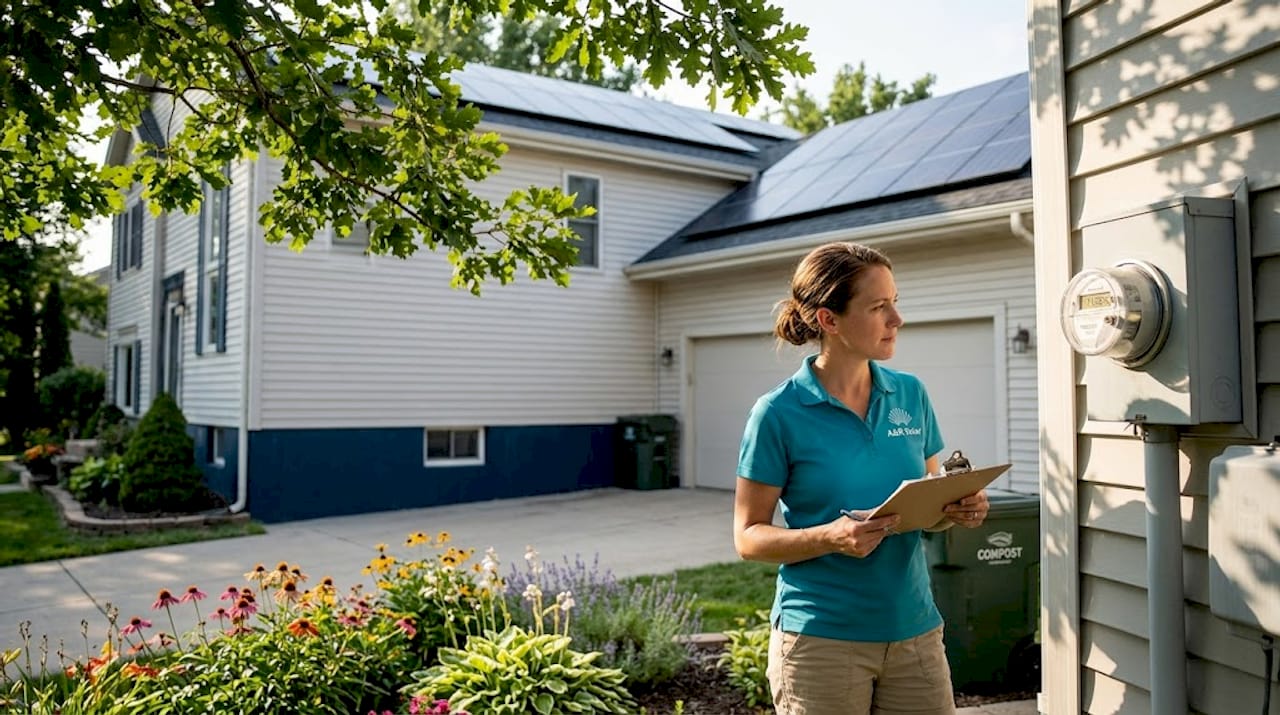
- Bi-directional utility meter: Tracks both the electricity you consume from the grid and the surplus you export back to it
- Disconnect switch: Allows the system to be safely isolated from the grid for maintenance or during emergencies
The bi-directional meter is where net metering enters the picture. Net metering credits let you bank the value of electricity you export during sunny hours and apply those credits against what you consume at night or on cloudy days. This arrangement is what makes grid-tied solar financially practical without requiring a battery bank. Net metering policies vary by state and utility, so the credit rate you receive will depend on where you live and who your utility provider is.
Pro Tip: Before you size your solar system, request 12 months of electricity usage data from your utility. Matching your system size to your actual annual consumption gives you the best shot at fully offsetting your bill through net metering.
How grid-tied solar works day to day
Understanding the energy flow in a grid-tied system removes most of the confusion homeowners experience. Here is the process from sunlight to your outlet:
- Solar panels generate DC electricity when exposed to sunlight. Output varies by panel orientation, tilt, shading, and time of day.
- The inverter converts DC to AC electricity at the correct voltage and frequency to match your home and the utility grid.
- Your home uses solar power first. Any appliances running during daylight hours consume solar electricity before grid electricity.
- Surplus electricity flows to the grid. When production exceeds demand, the excess travels through your bi-directional meter to the utility, earning you net metering credits.
- The grid supplies power when solar falls short. At night, on overcast days, or during high-demand periods, your home pulls electricity from the grid as usual.
This two-way relationship means the grid acts as virtual storage, replacing the need for physical batteries in most standard installations. Your home stays powered 24 hours a day without you ever noticing the transitions.
One operational detail many homeowners miss: grid-tied inverters must shut down automatically when a grid outage occurs. This is an anti-islanding safety requirement that protects utility workers repairing lines from accidentally encountering live power fed by your solar panels. The result is that a standard grid-tied system goes dark during an outage, just like your neighbor’s home with no solar at all.
| Inverter type | Best for | Key trade-off |
|---|---|---|
| String inverter | Simple, unshaded roofs | Lower cost; whole system affected by one shaded panel |
| Microinverters | Shaded or complex roof layouts | Better per-panel output; higher upfront cost |
| Power optimizers + string | Mixed conditions | Per-panel optimization with a single central inverter |
Microinverters offer panel-level optimization to address shading losses, while string inverters are more cost-effective on clean, south-facing roofs. The right choice depends on your specific roof conditions.
Pro Tip: If your roof has any shading from trees, chimneys, or neighboring structures, get a shading analysis before choosing an inverter type. A shaded string system can lose disproportionately more output than the shaded area alone would suggest.
Typical payback periods for grid-tied solar run 6 to 10 years when regional incentives are applied. Washington and Oregon both offer state-level incentives that can meaningfully shorten that timeline.
Benefits and limitations vs. off-grid and hybrid systems
Defining grid-tied solar also means understanding what it is not. The three primary system types each serve different priorities.
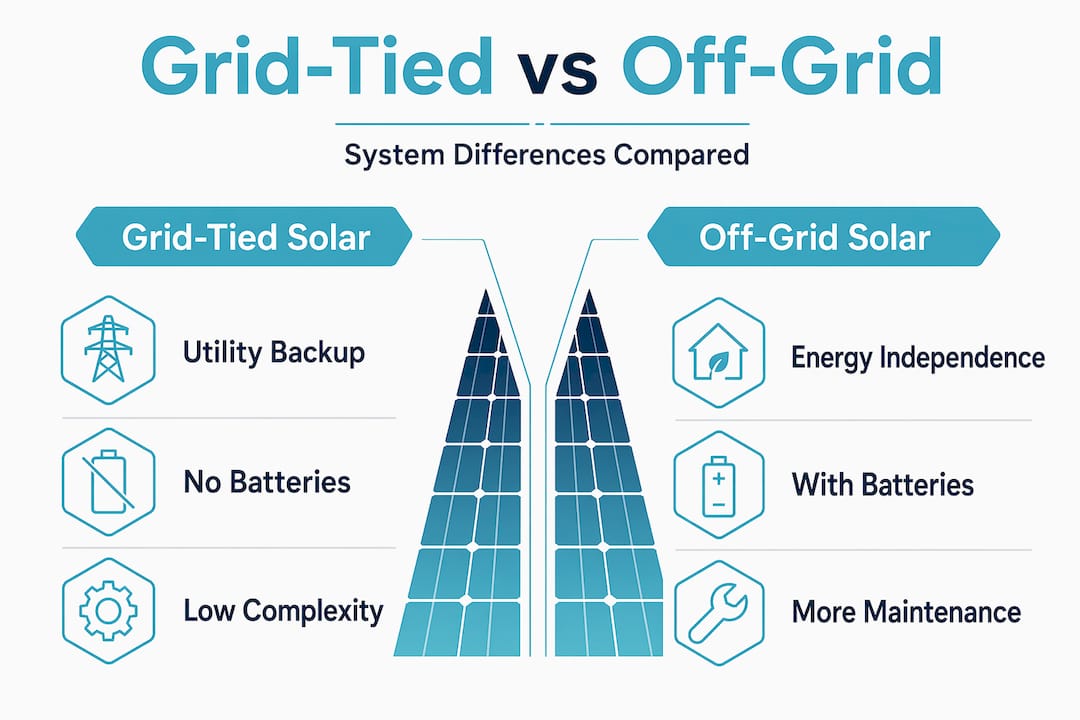
| System type | Upfront cost | Outage protection | Ongoing complexity |
|---|---|---|---|
| Grid-tied only | Lowest | None without batteries | Low |
| Grid-tied + battery (hybrid) | Moderate to high | Partial (battery capacity dependent) | Moderate |
| Off-grid | Highest | Full (self-sufficient) | High |
The biggest financial advantage of grid-tied systems is what they skip: battery storage. Battery storage costs $10,000 to $30,000, and for homeowners in areas with reliable utility grids and good net metering policies, that cost rarely pays back quickly. Grid-tied systems keep the installation scope focused and the return on investment cleaner.
That said, grid-tied solar has real limitations worth acknowledging:
- No outage backup without adding battery storage or a generator with a transfer switch
- Net metering policy risk: Some utilities are actively reducing credit rates, which affects long-term savings projections
- Time-of-use rate exposure: If your utility charges peak rates from roughly 4 p.m. to 9 p.m., your solar panels are typically producing less at that point in the day, meaning you still buy expensive power in the evening
TOU rate structures can extend payback periods for solar-only grid-tied systems without batteries. The 4 p.m. to 9 p.m. peak window is the most financially challenging for grid-only solar owners, since panels produce little power during those hours and grid rates are at their highest. Homeowners in regions with complex TOU pricing may find that a hybrid system with battery storage makes stronger financial sense long-term.
You can read more about what off-grid solar involves if full energy independence is a priority you are considering alongside grid-tied options.
Practical steps before choosing a grid-tied system
Once you understand the benefits of grid-tied solar, the practical decisions start. Here are the factors most worth investigating before you commit:
- Roof condition and orientation: Solar panels perform best on south-facing roofs in the Northern Hemisphere with minimal shading. If your roof needs replacement within the next 5 years, address that first.
- Local net metering policy: Net metering rules vary significantly between utilities. Understanding your credit rate and any caps on system size directly affects your financial projections. Washington homeowners can review Washington net metering details, while Oregon homeowners should check Oregon solar incentives for current program specifics.
- Inverter selection based on shading: As noted above, roof shading is one of the most underappreciated factors limiting solar performance. Choosing microinverters or power optimizers on shaded roofs can recover meaningful output that a string inverter would lose entirely.
- Whether to add battery storage now or later: Some homeowners choose to install battery-ready systems initially and add storage later. Understand the costs and wiring requirements upfront so you are not paying for a retrofit.
- Monitoring your system post-installation: Most modern inverters include monitoring apps that show real-time production data. Reviewing this monthly catches performance drops early, before they silently erode your savings.
Pro Tip: Ask your installer to walk you through your first utility bill after your system goes live. The billing changes under net metering can be confusing at first, and understanding exactly what each line item means helps you track whether your system is performing as projected.
The primary value of grid-tied solar has shifted over time from simply replacing grid power to controlling utility cost inflation and gaining pricing predictability. That framing matters for long-term planning.
Emerging technologies in grid-tied solar
The grid-tied solar market continues to develop. Several trends will affect how these systems work and what value they deliver in the coming years.
- Grid-forming inverters: Unlike standard grid-following inverters, grid-forming inverters can create a stable electrical signal and operate during outages. They require batteries and are not yet common in residential installations, but they represent the direction the industry is heading.
- Advanced power electronics: Microinverters and power optimizers continue improving in efficiency and declining in cost, making panel-level optimization more accessible for standard residential projects.
- Battery integration for TOU management: As time-of-use rates become more common, pairing grid-tied systems with battery storage specifically to avoid peak-rate purchases is becoming a financially practical strategy rather than a luxury.
- Smart grid interaction: Newer systems can communicate with utility smart grids, potentially allowing homeowners to participate in demand response programs and earn additional credits or compensation.
These trends do not change what grid-tied solar is today. They do suggest that a well-designed system installed now should be battery-ready and use monitoring infrastructure that supports future upgrades.
My take on the misconceptions I see most often
I’ve had a lot of conversations with homeowners who walked into a solar consultation with the firm belief that panels on their roof meant the power would stay on during a storm. Setting that expectation straight is one of the most consistent parts of advising people on residential solar projects, and it matters because the disappointment of discovering it later is real.
In my experience, the outage question is not just a misunderstanding. It reflects a deeper assumption that solar equals energy independence. Grid-tied solar does not deliver independence. It delivers cost management, and a very good version of it when you have solid net metering policies and a reliable utility.
What I’ve learned from working through dozens of residential grid-tied projects is that the homeowners who get the most out of their systems are the ones who understood the utility rate structure before they installed. They sized their systems to their actual usage, not to some optimistic number. They knew what net metering would pay them, and they planned accordingly.
My honest opinion on batteries: if you live in an area with frequent outages, or if your utility has moved to aggressive TOU pricing, adding storage is not a luxury upgrade. It’s the financially rational choice. For everyone else on a reliable grid with fair net metering, standard grid-tied is likely the right starting point.
Do your research on local policies before you sign anything. The technology is proven. The financial returns depend almost entirely on the policy environment where you live.
— Shyerome
Ready to explore solar for your home?
A&R Solar has spent over two decades installing grid-tied solar systems for homeowners across Washington and Oregon. As a local, employee-owned B Corporation, the company brings regional expertise that national installers simply do not carry. Whether you are considering a straightforward grid-tied setup or want to understand whether battery backup makes sense for your situation, A&R Solar’s team can walk you through real project data and local utility specifics.
Browse completed residential installations to see how grid-tied systems have performed for homeowners in your region. If outage protection is a priority, learn more about home battery backup options designed for the Pacific Northwest. Contact A&R Solar to get a project assessment tailored to your roof, your utility, and your energy goals.
FAQ
What does “grid-tied solar” mean?
A grid-tied solar system connects your solar panels directly to the utility grid, allowing your home to use solar energy first and draw from or export to the grid as needed. It is the most common residential solar configuration.
Does grid-tied solar work during a power outage?
No. Standard grid-tied systems shut off automatically during outages due to anti-islanding safety requirements. You need battery storage or a grid-forming inverter to maintain power when the grid is down.
How does net metering work with grid-tied solar?
Net metering credits you for surplus electricity your panels export to the grid. Those credits offset what you consume from the grid at night or on cloudy days, and in many regions can reduce your electricity bill by 80 to 100%.
What is the difference between grid-tied solar vs off-grid?
Grid-tied systems rely on the utility grid for backup power and virtual storage, eliminating the need for batteries. Off-grid systems operate independently using battery banks, making them more expensive and complex but fully self-sufficient.
How long does it take for grid-tied solar to pay for itself?
With regional incentives applied, most grid-tied systems reach payback in 6 to 10 years. TOU rate structures and changes to net metering policies in your area can affect that timeline in either direction.