


TL;DR:
- Solar consultants conduct detailed site assessments and system design to optimize performance and savings.
- They navigate regional incentives, ensure proper paperwork, and maximize financial returns for Northwest homeowners.
- Expert guidance provides system reliability, resilience during outages, and peace of mind throughout the project.
Solar panels are not a one-size-fits-all solution, especially for homeowners in Washington and Oregon. The Pacific Northwest has its own climate patterns, utility regulations, and incentive programs that directly affect what system makes sense for your home. Without expert guidance, it is easy to overspend, miss out on significant rebates, or end up with a system that underperforms on cloudy winter days. Solar consulting bridges that knowledge gap. This guide walks you through exactly how professional solar consultants help Northwest homeowners get the most financial return, the best system performance, and true energy independence for years to come.
Table of Contents
- What does a solar consultant actually do?
- Unlocking incentives and financial returns with expert guidance
- Designing for performance, reliability, and resilience
- From project management to peace of mind: What to expect during and after installation
- Perspective: The one thing most solar buyers overlook (and how consulting changes everything)
- Next steps: Connect with solar consulting experts in the Northwest
- Frequently asked questions
Key Takeaways
| Point | Details |
|---|---|
| Consultant expertise | Solar consultants streamline system design, incentive navigation, and compliance to maximize your investment. |
| Maximized incentives | Expert guidance can secure up to $18,000 in rebates or tax savings, making solar far more affordable for homeowners. |
| Energy independence | Consultants tailor your solar system for battery backup and resilience, keeping your home powered—even during outages. |
| Ongoing support | From paperwork to maintenance, a good consultant ensures long-term performance and peace of mind. |
What does a solar consultant actually do?
Many homeowners assume that hiring a solar company means someone shows up, puts panels on your roof, and that is the end of it. The reality is far more involved, and the planning phase is where most of the value is created or lost.
A qualified solar consultant begins with a thorough site assessment. They examine your roof’s age, pitch, and orientation, identify shading from trees or nearby structures, and review 12 months of your utility bills to understand your actual energy consumption. This load analysis is the foundation of every good system design. From there, they build a complete picture using sun path diagrams or specialized software tools that model how much solar energy your home can realistically capture across every month of the year.
The technical work that follows is detailed and highly specific. According to solar system design principles, a full residential design includes load analysis from utility bills, shading analysis via sun path diagrams or software, system sizing using the formula kWp equals annual kWh divided by yield factor, panel and inverter selection, stringing configurations, energy yield simulation, and permit documentation. Each of these steps requires knowledge that most homeowners simply do not have time to develop.
Here is what that process covers in practical terms:
- Load analysis: Reviewing your electricity bills to determine peak usage, seasonal variation, and total annual consumption
- Shading analysis: Mapping where shadows fall on your roof throughout the year, which directly affects panel placement and output
- System sizing: Calculating the correct number of panels and kilowatt-peak capacity to meet your goals without oversizing or undersizing
- Equipment selection: Choosing panels, inverters, and batteries based on your specific roof type, energy needs, and budget
- Energy yield simulation: Running software models to project annual production and verify it matches your consumption
- Permit documentation: Preparing all required paperwork for local building departments and your utility company
For solar panels for your home to deliver their rated performance, every one of these steps has to be completed correctly. Skip the shading analysis and you might install panels in a spot that gets blocked by your neighbor’s tree every afternoon. Skip the load analysis and you may end up with a system too small to make a meaningful dent in your bills.
“The difference between a well-designed solar system and a poorly designed one is not visible on installation day. It shows up over 25 years in kilowatt-hours produced and dollars saved.”
Pro Tip: Ask any solar company you’re considering to show you their energy yield simulation report before signing a contract. If they can’t produce one, that is a red flag worth taking seriously. You can learn more about our proven process to see what a thorough design workflow looks like in practice.
Unlocking incentives and financial returns with expert guidance
Once you understand the technical groundwork consultants lay, the next major advantage they bring is financial. Washington and Oregon both offer meaningful incentive programs, but they are not automatic. You have to know what exists, qualify for it, apply correctly, and in some cases, work with a contractor who is officially recognized by the program.
Here is a quick look at the major financial programs available to Northwest homeowners:
| Incentive | State | Estimated Value | Notes |
|---|---|---|---|
| Sales tax exemption | Washington | 6.5% to 10% of system cost | Applied at point of sale |
| Energy Trust rebates | Oregon | Up to $18,000 | Income-qualified homeowners |
| Net metering | Both | Ongoing bill credits | 1:1 rate for excess generation |
The Energy Trust of Oregon offers rebates of up to $18,000 for income-qualified Oregonians, along with standard rebates for all homeowners investing in solar and storage. Consultants who are recognized Trade Allies with the Energy Trust can directly access and process these rebates on your behalf, streamlining a process that can otherwise be time-consuming and easy to get wrong.
The step-by-step process a consultant uses to maximize your financial return:
- Review your tax situation and utility account to determine which incentives you qualify for
- Verify whether you meet income thresholds for enhanced Energy Trust rebates in Oregon
- Confirm the system qualifies for the Washington sales tax exemption at point of purchase
- Apply for net metering with your utility as part of the interconnection process
- Stack state and utility programs for maximum savings
- Document everything properly so your tax preparer can apply credits correctly
One common mistake homeowners make is assuming all contractors have equal access to incentive programs. They do not. A contractor who is not a recognized Trade Ally cannot process certain rebates for you directly. That matters when you are talking about Oregon solar incentives worth thousands of dollars.
Stat to know: Qualified Oregon homeowners can access up to $18,000 in rebates through the Energy Trust, but only when working with a certified Trade Ally contractor who processes the application correctly.
Exploring all available incentives and financing options before signing any contract is one of the most important steps a consultant takes on your behalf. Getting this wrong does not just cost you money today. It affects your system’s payback period by years.
Designing for performance, reliability, and resilience
With your financial plan in place, the consultant’s next priority is making sure your system is designed to actually perform in the Pacific Northwest. That requires a different mindset than designing for, say, Arizona or Southern California.
The Pacific Northwest gets roughly 140 to 160 sunny days per year in most areas, with long stretches of overcast skies in fall and winter. A system designed without accounting for this will underperform during precisely the months when you are running heaters and using the most electricity. Good consultants design for this reality from day one.
| System type | Grid tied | Hybrid | Off grid |
|---|---|---|---|
| Grid connection | Yes, primary power source | Yes, with battery backup | No |
| Battery storage | No | Yes | Yes |
| Works during outages | No | Yes, within battery capacity | Yes |
| Best suited for | Low-outage areas, cost savings | Most homes in WA/OR | Rural or remote properties |
| Upfront cost | Lowest | Moderate to high | Highest |
Most Washington and Oregon homeowners benefit most from a hybrid system, which combines grid connection with battery storage. Here is why that matters: a standard grid-tied system shuts off during a power outage, even if your panels are producing at full capacity. This is a safety requirement to protect utility workers, but it leaves you without power during the exact moments when backup energy matters most.
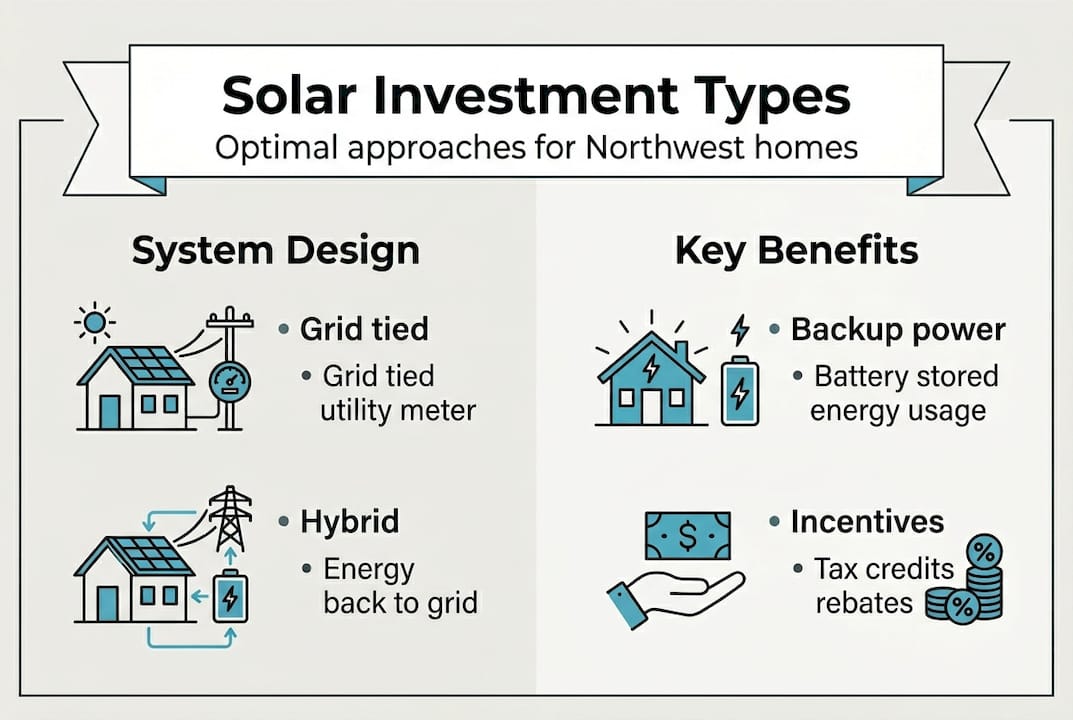
A consultant who understands residential battery backup options will help you right-size a battery system to cover your critical loads, whether that is your refrigerator, medical equipment, or heating system. They factor in how long outages typically last in your area, your average daily consumption, and how quickly your panels are likely to recharge the battery given the season.
Key strategies consultants use to maximize year-round performance in the Northwest:
- Tilt angle optimization: Adjusting panel tilt to favor winter sun angles, which are lower on the horizon in our region
- Microinverter or power optimizer selection: These technologies reduce the impact of partial shading, which is common under Pacific Northwest cloud cover
- Battery sizing for real outage scenarios: Sizing storage based on actual local outage history and your household’s critical load requirements
- Production monitoring setup: Configuring remote monitoring so you and your installer can catch production dips before they become costly problems
Most reputable consultants also provide a solar performance guarantee that commits the system to producing a minimum annual output. If production falls short, there are clear remedies in place. This kind of accountability is something you will not get from a contractor who just installs and moves on.
Pro Tip: Before finalizing your system design, ask your consultant to show you the projected monthly production curve across all 12 months. If November and December show near-zero output without a reasonable explanation, the design may need to be revisited.
From project management to peace of mind: What to expect during and after installation
Optimizing your system design and locking in incentives is only part of the picture. The installation process itself involves multiple parties, layers of paperwork, and several inspections. Without a consultant managing the process, coordination problems and delays are common.
Here is the typical sequence of consultant involvement from contract through final inspection:
- Contract review: Verifying that equipment specifications, production guarantees, and warranty terms are clearly spelled out
- Permit filing: Preparing and submitting permit documentation to the local building department and utility, including all required electrical diagrams and structural calculations
- Installer coordination: Scheduling the installation crew and confirming equipment delivery timelines so there are no delays on site
- Installation oversight: Conducting quality checks at key milestones to confirm panels are placed per the design, wiring is up to code, and battery systems are properly configured
- Inspection support: Attending or coordinating the final building and utility inspections to address any questions on the spot
- Interconnection approval: Following up with the utility to ensure net metering is activated and the system is officially approved to export power
After installation, the consultant’s role shifts to ongoing support. That includes:
- Remote monitoring: Reviewing production data to catch any underperformance early
- Troubleshooting: Diagnosing issues when the monitoring system flags a problem, whether it is a faulty inverter or a panel that has been shaded by a new obstruction
- Cleaning and maintenance scheduling: Advising on when and how to clean panels, especially after pollen season or windstorms
- Warranty management: Helping you file claims if panels or inverters fail within their warranty period, and ensuring production guarantees are honored by the installer
Learn more about what to expect from solar service and maintenance after your system is live. Having an expert who already knows your system’s design, equipment, and history makes troubleshooting faster and warranty claims easier to navigate.
“Homeowners who have a dedicated point of contact after installation are far more likely to catch production issues early, before small problems compound into significant energy losses.”
The peace of mind that comes from having an experienced advocate on your side throughout the entire process is difficult to put a dollar value on. But in terms of energy produced, dollars saved, and problems avoided, it is consistently significant.
Perspective: The one thing most solar buyers overlook (and how consulting changes everything)
Most homeowners who go solar focus almost entirely on the panel brand and the price per watt. That is understandable. Those are visible numbers. But in our experience working with homeowners across Washington and Oregon, the biggest financial and performance losses we see come from decisions that happen long before installation day and from the lack of follow-through after.
The Pacific Northwest has specific pitfalls that catch unprepared buyers off guard. Shading from Douglas firs that have grown since the last roof replacement. Incentive applications filed incorrectly because the contractor was not a recognized Trade Ally. Battery systems sized for a California climate, not a western Washington winter. These are real situations we see regularly.
The uncomfortable truth is that a cheaper installation quote often means something was left out. Load analysis skipped. Shading study not performed. Battery sizing based on a standard template rather than your actual usage. And real residential stories from Northwest homeowners consistently show that the ones who invested in proper consulting at the start spent less money correcting problems later.
Expert consulting is not a luxury add-on. It is the part of the process that protects every other dollar you spend.
Next steps: Connect with solar consulting experts in the Northwest
If you are considering solar for your Washington or Oregon home, starting with a clear picture of what is actually possible for your property is the most valuable first step you can take.

Reviewing real homeowner case studies from our regional projects gives you a realistic view of what a well-designed system looks like and what kind of financial returns are achievable in the Northwest climate. You can also browse more residential projects to see the range of system types and home configurations we work with. When you are ready to talk through your specific situation, schedule a consultation with our team. We will start with your home’s actual energy data and build a plan that makes sense for your goals, your budget, and your region.
Frequently asked questions
What is the main benefit of hiring a solar consultant in Washington or Oregon?
A consultant ensures you maximize available incentives, design your system for regional performance, and stay compliant with local utility requirements. This directly translates to better financial returns and fewer problems over the life of your system, including access to rebates up to $18,000 for qualifying Oregon homeowners.
How do solar consultants help with net metering?
They handle the interconnection application with your utility and confirm your system is set up to export excess power for credit. This ensures you receive the full 1:1 net metering rate available in Washington and Oregon rather than a reduced compensation arrangement.
Can a solar consultant help with battery backup or blackout resilience?
Yes, consultants evaluate your critical loads and local outage patterns to recommend the right battery system for your home. Without this guidance, grid-tied systems shut off during outages, leaving you without power even when your panels are generating electricity.
Do consultants help with permits and paperwork?
Consultants prepare and manage all permit documentation including electrical diagrams, structural calculations, and utility interconnection applications, ensuring your installation meets every legal and code requirement without delays.
How do I find a qualified solar consultant near me?
Look for contractors with verified regional project histories, active Trade Ally status with the Energy Trust of Oregon, and a demonstrated process that includes shading analysis, load assessment, and production guarantees. Reviewing local project portfolios is a reliable way to evaluate experience before committing.