


TL;DR:
- Monocrystalline panels perform best in the low-light, cloudy conditions typical of the Pacific Northwest.
- Net metering credits surplus energy sent to the grid, reducing overall utility bills.
- Owning the system through purchase or loan maximizes financial incentives and long-term savings.
Many homeowners in Washington and Oregon assume their rainy, overcast climate disqualifies them from going solar. That assumption costs real money. The truth is that monocrystalline panels at 20-23% efficiency are specifically designed to generate power in low-light, cloudy conditions, and both states have strong net metering programs that make solar financially viable year-round. What often holds homeowners back is not the weather. It is the terminology. Words like irradiance, PPA, string inverter, and ITC can make the decision feel overwhelming. This guide cuts through the confusion and gives you the plain-language knowledge you need to evaluate solar quotes, ask the right questions, and make a confident decision.
Table of Contents
- Key solar system components and terminology
- Understanding efficiency, performance, and climate factors
- Installation options: roof mounts, ground mounts, and site-specific terms
- Solar incentives, financing, and ownership explained
- What most solar guides miss: Making terminology actionable for homeowners
- Ready to apply your knowledge? Connect with local experts
- Frequently asked questions
Key Takeaways
| Point | Details |
|---|---|
| Monocrystalline panels excel | They deliver highest efficiency for cloudy WA and OR conditions. |
| Net metering maximizes value | Homeowners can offset most energy costs by crediting surplus production. |
| Ownership impacts incentives | Purchasing your system unlocks full tax credits and local rebates. |
| Site factors drive installation | Roof mounts dominate, but ground mounts make sense for shaded sites. |
| Terminology enables confidence | Understanding solar language empowers smarter, clearer decisions. |
Key solar system components and terminology
Understanding a residential solar energy system starts with knowing what each major component does and what installers mean when they use industry terms. This knowledge helps you evaluate proposals and compare options without being misled by unfamiliar language.
Panel types
The three main types of solar panels available for residential installation are monocrystalline, polycrystalline, and thin-film. Each has a different structure and performance profile, and each serves different needs in the PNW.
- Monocrystalline panels are made from a single continuous crystal of silicon. They deliver the highest efficiency (typically 20-23%) and perform well in low-light conditions, making them the most common choice for homes in western Washington and Oregon where clouds are frequent.
- Polycrystalline panels are made from multiple silicon fragments melted together. They cost slightly less and are slightly less efficient (15-17%), but still work in the PNW. They are a reasonable option for homeowners with plenty of roof space and a tighter budget.
- Thin-film panels use a much thinner layer of semiconductor material. They are lightweight and flexible but have lower efficiency (10-13%). They are rarely used in residential installations in the PNW because you need significantly more roof area to generate comparable power.
Inverter types
An inverter converts the direct current (DC) electricity your panels produce into the alternating current (AC) your home uses. There are three main types:
- String inverters connect all panels in a series circuit, or “string.” They are cost-effective but can reduce output if one panel is shaded because all panels perform at the level of the weakest one.
- Microinverters attach to each panel individually, converting power panel by panel. This means shading on one panel does not drag down the whole system.
- Hybrid inverters work with both solar panels and battery storage systems, making them the right choice if you plan to add a home battery in the future.
Other core terms
Your solar array is the complete group of panels installed on your property. Net metering is the billing arrangement where your utility credits you for surplus electricity you send back to the grid. The PVWatts calculator is a free tool from the U.S. Department of Energy that estimates how much energy a proposed solar system would generate at your specific location based on real weather data.
Pro Tip: If your roof has limited space, monocrystalline panels maximize output per square foot. In a state like Washington, where many homes have steep-pitch roofs with limited south-facing exposure, higher-efficiency panels do more work in the same footprint.
Understanding efficiency, performance, and climate factors
Now that you know the basics, let’s see how these components actually perform in your local climate. Efficiency and output in the Pacific Northwest are shaped by specific regional conditions that are worth understanding before you commit to a system size or panel type.
Panel efficiency and what affects it
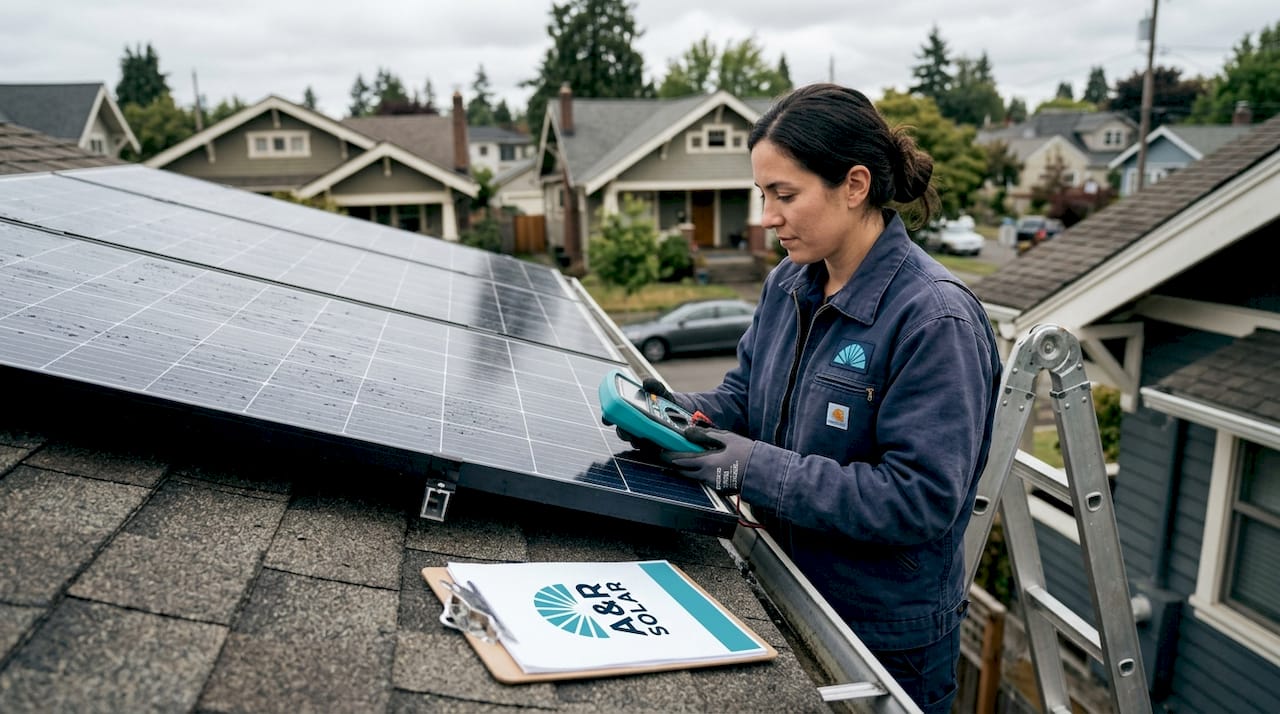
Panel efficiency measures what percentage of sunlight hitting a panel gets converted into usable electricity. Temperature, shading, soiling, and panel angle all affect real-world output. Notably, solar panels actually produce more power in cool temperatures than hot ones, which gives the Pacific Northwest a subtle advantage over hotter climates during summer months.
Regional sunlight and cloud cover
Monocrystalline panels excel in PNW low-light conditions, and east of the Cascades, higher irradiance (a measure of sunlight intensity per square meter) makes solar even more productive. Western Washington and western Oregon see more cloud cover, but systems there remain viable thanks to strong net metering programs and longer summer days.
Here is a quick comparison of average solar production potential by subregion:
| Region | Avg. Peak Sun Hours/Day | Annual Viability |
|---|---|---|
| Eastern Washington | 4.5 to 5.5 hours | Very high |
| Western Washington | 3.5 to 4.5 hours | Strong with net metering |
| Eastern Oregon | 5.0 to 6.0 hours | Excellent |
| Western Oregon | 3.5 to 4.5 hours | Strong with net metering |
“The Pacific Northwest gets enough solar resource to make rooftop solar financially worthwhile for most homeowners, especially when combined with net metering credits that offset low-production months.” — Washington Solar Energy Industries Association
How net metering works in practice
Net metering in Washington and Oregon credits your utility account for excess power your system sends to the grid. In practice, your meter runs backward when your panels produce more than your home uses. You draw those credits back at night or during cloudy stretches. This makes the annual average more relevant than any single day’s production.
Here is how to think about your actual energy offset using a numbered approach:
- Determine your average monthly kilowatt-hour (kWh) consumption from your utility bill.
- Use the PVWatts calculator with your address to estimate annual system production.
- Size your array so annual production is 80-100% of annual consumption.
- Account for net metering credits to cover months where production is lower than demand.
- Review your utility’s specific net metering cap and compensation rate before finalizing system size.
With proper sizing and solar performance in the PNW taken into account, most residential systems can offset between 60% and 100% of annual household energy use. The specific number depends on your roof characteristics, local shading, and how well the installer sizes the system to your actual consumption data.
Installation options: roof mounts, ground mounts, and site-specific terms
Once you know how efficiency works, it is time to look at where the system sits and the terms installers use during the site assessment process. The physical placement of your solar array shapes its performance more than most homeowners realize.
Roof mounts vs. ground mounts
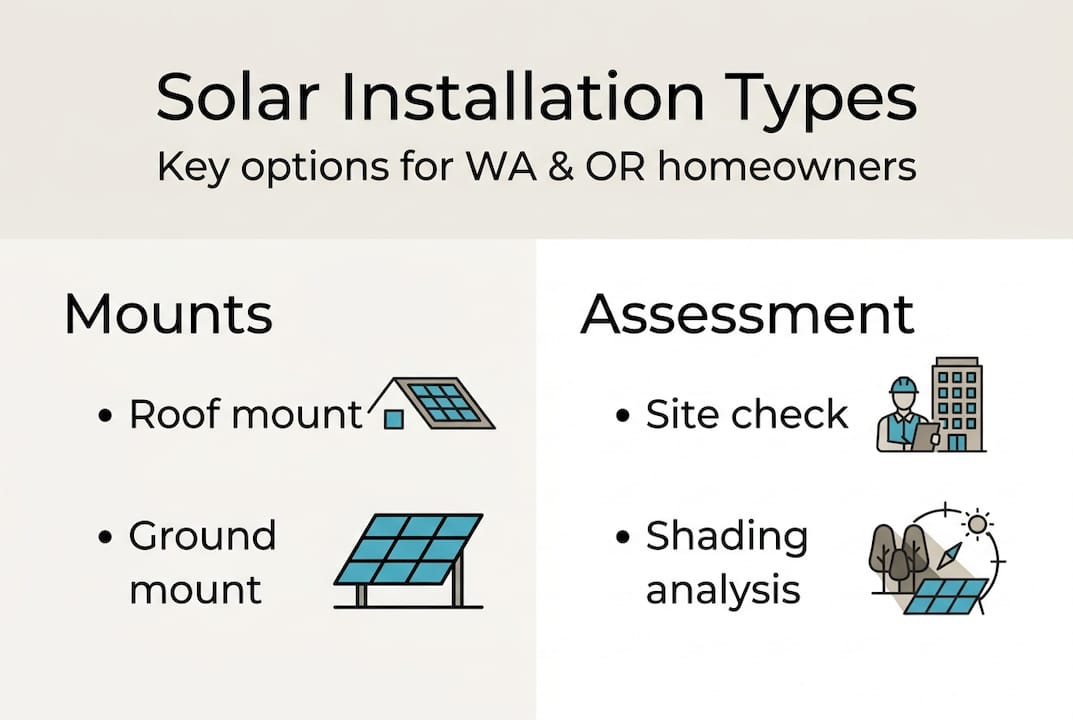
In the Pacific Northwest, rooftop mounts dominate residential installations. They use existing structure, require no additional land, and keep installation costs lower. Ground-mounted systems make sense when the roof is heavily shaded, structurally unsuitable, or oriented in a way that limits output.
| Factor | Roof mount | Ground mount |
|---|---|---|
| Upfront cost | Lower | Higher (foundation and racking) |
| Best for | South-facing, unshaded roofs | Shaded roofs, large lots |
| Maintenance access | Harder | Easier |
| Flexibility | Fixed to roof layout | Adjustable tilt and orientation |
| Common in PNW | Very common | Used when roof isn’t suitable |
Key site-specific terms
Installers will use several terms during a site assessment. Knowing what these mean helps you participate in the conversation and understand what they are recommending and why.
- Irradiance refers to the amount of solar energy hitting a surface per unit of area. Higher irradiance means more power production potential. East of the Cascades, irradiance is measurably higher than on the western side.
- Orientation describes which direction your roof faces. South-facing roofs receive the most sunlight throughout the day in the Northern Hemisphere. Southwest and southeast orientations also work well. North-facing roofs are not ideal for solar.
- Shading from trees, chimneys, neighboring structures, or roof features can significantly reduce output. Even partial shading matters, especially in string inverter systems where one shaded panel can reduce production across the entire string.
- Tilt angle is the angle of the panels relative to horizontal. For most PNW locations, a tilt angle between 30 and 45 degrees maximizes annual production.
What a site assessment covers
During a solar panel mounting options consultation, a qualified installer will evaluate your roof’s structural integrity, age, material, pitch, and orientation. They will also document shading patterns throughout the day using shade analysis software. This assessment drives the final system design, so it is worth asking to see the data they collect rather than accepting a quote without supporting documentation.
A thorough site assessment protects you. If an installer skips shading analysis or does not check your roof’s age before recommending a 25-year system, that is a red flag worth addressing directly.
Solar incentives, financing, and ownership explained
Understanding the physical and site terms brings you halfway to a confident decision. The other half is understanding how the financial language shapes your system’s affordability and long-term returns.
The main financial terms
- Federal Investment Tax Credit (ITC): As of 2026, homeowners who purchase and own their solar system can claim a 30% federal tax credit on the total installed cost. This credit reduces what you owe in federal income taxes dollar for dollar.
- Net metering credit: As covered above, this is a billing mechanism, not a direct payment. But over a year, it significantly reduces your utility bill.
- State and utility rebates: Oregon and Washington both have additional programs. Reviewing Oregon solar incentives and Washington solar incentives will show you what applies to your situation, including utility-specific programs.
- Sales tax exemptions: Washington exempts solar equipment from state sales tax, which can reduce upfront system costs by several thousand dollars.
- Property tax exemptions: Both states offer exemptions that prevent your property tax assessment from increasing because of the added value a solar system brings to your home.
Ownership models: cash purchase, loan, lease, and PPA
This is where terminology confusion leads to the most significant financial mistakes. The four main ways to go solar each carry different terms and consequences.
- Cash purchase: You own the system outright from day one. You claim the full 30% federal ITC, all state incentives, and every net metering credit. Your payback period is typically 7 to 10 years in the PNW.
- Solar loan: You borrow money to purchase the system and still own it. You still qualify for the ITC and all incentives. Monthly loan payments often approximate or replace your current utility bill, making the transition cost-neutral in many cases.
- Solar lease: A third party owns the panels. You pay a fixed monthly lease payment to use the system. Cash purchase maximizes savings while leases shift ownership risk but remove your ability to claim the ITC or state incentives.
- Power Purchase Agreement (PPA): Similar to a lease, but instead of a flat payment, you buy the electricity the panels produce at a set per-kWh rate. The third-party owner claims all tax credits. Understanding the solar lease vs PPA distinction matters because PPAs can extend 20 to 25 years and may complicate home sales.
Pro Tip: In Washington and Oregon, homeowners who purchase their systems (either cash or loan) stack the most value because they qualify for the federal ITC, state incentives, net metering credits, and property and sales tax exemptions simultaneously. Leases and PPAs eliminate ITC eligibility entirely.
The ownership structure you choose shapes the financial outcome for the life of the system, often two to three decades. Read every term carefully before signing.
What most solar guides miss: Making terminology actionable for homeowners
Most solar guides stop at definitions. They hand you a glossary and assume you can take it from there. In our experience working with homeowners across Washington and Oregon, the terminology only becomes useful when you connect it to real decisions.
Jargon confusion creates real financial risk. A homeowner who does not understand the difference between a lease and a loan may sign a 25-year PPA believing they own the system, only to discover when selling their home that the buyer must assume the agreement. That single misunderstanding can complicate or derail a home sale.
Glossed-over site assessments are another common pitfall. If an installer does not discuss irradiance, shading, and roof orientation in concrete terms, they are likely proposing a generic system size rather than one tailored to your property. Ask for the shade analysis report. Ask for the PVWatts estimate used to size your array. These are not unreasonable requests.
Incentive stacking is where practical solar financing knowledge pays off most. Homeowners who understand that the federal ITC, state rebates, net metering, and tax exemptions work together are better positioned to evaluate total cost of ownership rather than focusing only on the sticker price. The terminology is not just academic. It is the foundation of every financial decision in this process.
Ready to apply your knowledge? Connect with local experts
With a clearer understanding of solar terminology, the next step is putting that knowledge to work with a team that knows the Washington and Oregon markets from the ground up.

At A&R Solar, we have spent two decades installing residential systems across both states, and we know that informed homeowners make better decisions. Browse residential case studies to see how real PNW homeowners have applied these concepts to their own homes. If you are considering adding storage, our guide to home battery backup explains how hybrid inverters and batteries work together. When you are ready to review your options for financing and incentives, start with our incentives and financing resource. Our local, employee-owned team is here to walk through every term and every number with you.
Frequently asked questions
Which solar panel type is best for the Pacific Northwest?
Monocrystalline panels are the most efficient and perform best in low-light, cloudy conditions. Their 20-23% efficiency makes them the right choice for most WA and OR homes.
How does net metering work for homeowners in Washington and Oregon?
Net metering credits you for surplus solar electricity sent to the grid, which you draw back during low-production periods. Because all PNW regions are viable with net metering, even western Washington homeowners see strong annual results.
Do solar leases and PPAs offer the same incentives as cash purchases?
No. Only system owners can claim the federal Investment Tax Credit and state incentives. Cash purchases maximize savings while leases and PPAs transfer those benefits to the third-party owner.
How much of my energy use can a properly designed solar system offset?
With site-specific design and accurate sizing, systems can offset 60-100% of your annual household energy consumption. The exact figure depends on your roof, location, and local shading.