

TL;DR:
- Most homeowners avoid battery costs by utilizing the utility grid as backup in grid-tied solar systems that generate power during the day and send surplus energy to the grid for credits.
- However, standard systems do not provide power during outages due to safety protocols, but adding a hybrid system with batteries can restore backup capability.
- Understanding utility policies, inverter types, and proper system sizing ensures optimal savings and resilience, with most viewers finding grid-tied systems preferable to off-grid setups.
Most homeowners exploring solar assume they need a battery bank to make the system worthwhile. That assumption is both common and costly. The role of grid-tied systems, technically known as grid-connected photovoltaic systems, is to use the utility grid itself as your backup power source, effectively sidestepping battery costs entirely. Your solar panels generate power during the day, your home uses what it needs, and any surplus flows to the grid in exchange for credits. Understanding how this works, and where it falls short, puts you in a far better position to design a system that actually fits your home and budget.
Key takeaways
| Point | Details |
|---|---|
| Grid replaces costly batteries | The utility grid acts as your backup supply, so most homeowners avoid battery costs entirely. |
| Net metering earns you credits | Excess solar production flows to the grid, crediting your account and reducing monthly bills. |
| Standard systems go dark in outages | Grid-tied inverters shut down during blackouts, even in full sunlight, for safety reasons. |
| Hybrid systems add outage resilience | Adding a battery and the right inverter creates backup capability without going fully off-grid. |
| Local policy shapes your savings | Metering rules vary by utility, so checking your specific compensation structure is critical. |
How grid-tied solar systems work
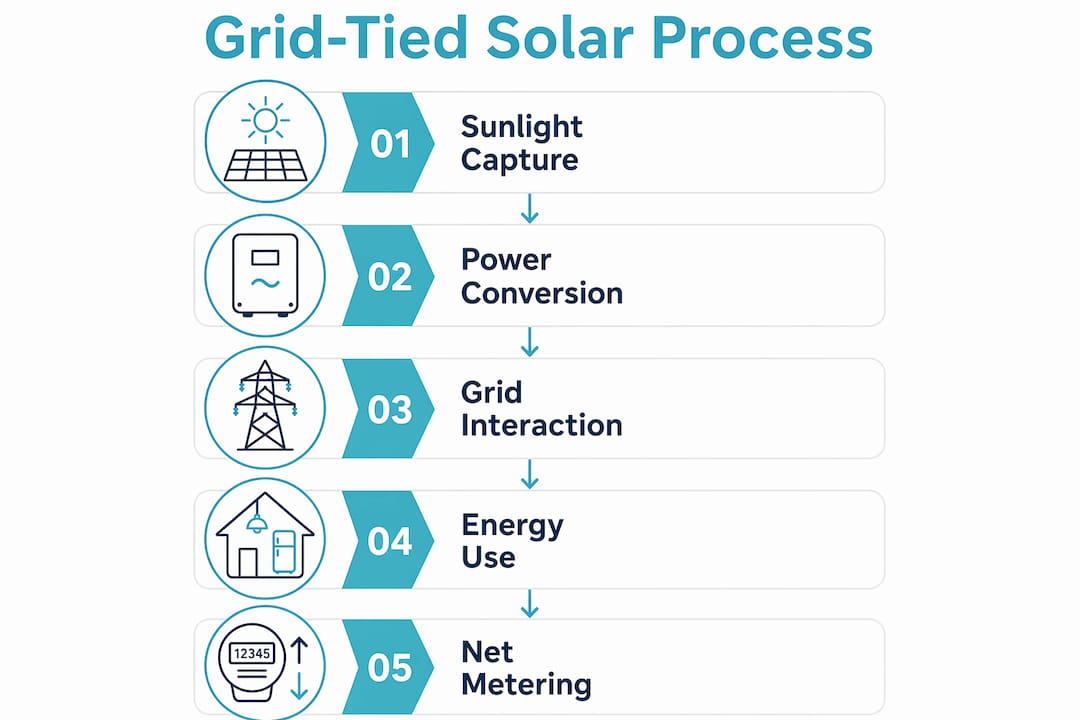
A grid-connected photovoltaic system has three core elements working together: solar panels, a grid-tie inverter, and a bi-directional utility meter. The panels generate direct current (DC) electricity from sunlight. The inverter converts that DC power into alternating current (AC) that your home’s appliances can use. Whatever your home doesn’t consume at that moment gets pushed back onto the utility grid. When the sun isn’t producing enough, the grid fills the gap automatically, with no action required on your part.
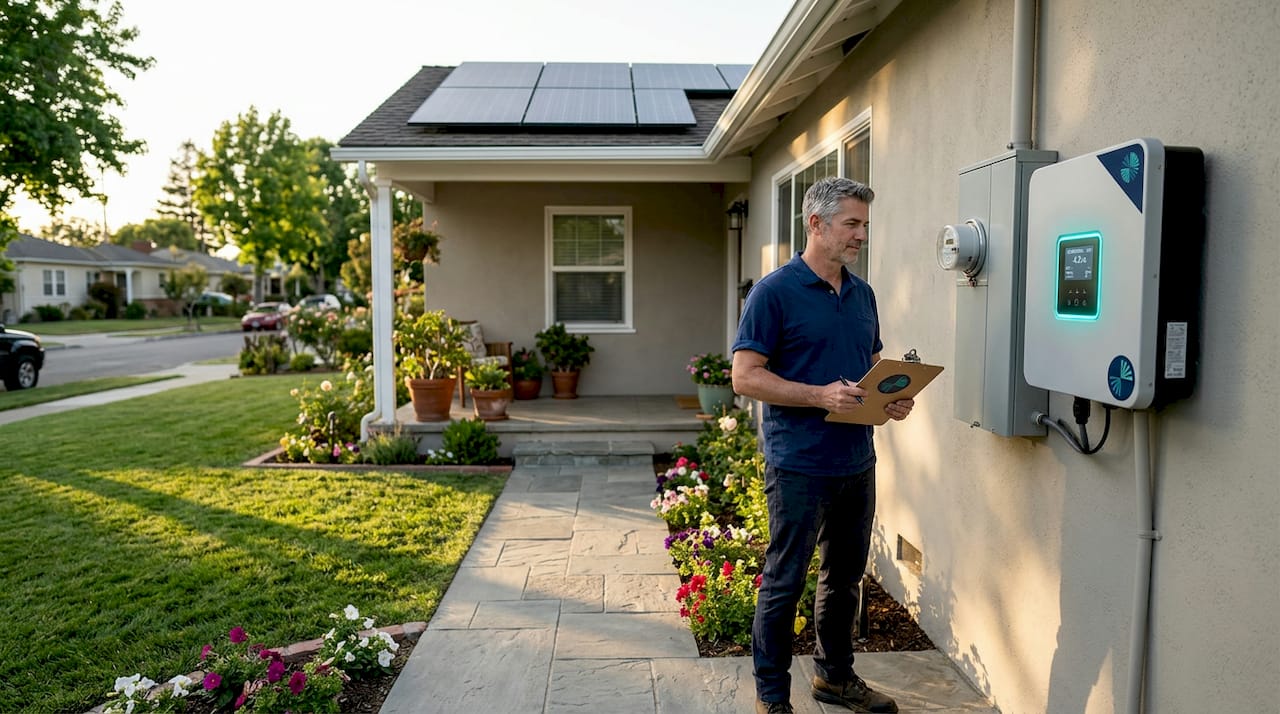
The bi-directional meter is worth understanding. Unlike a standard utility meter that only measures power coming in, this meter tracks flow in both directions. Electricity exported to the grid spins it one way; electricity imported spins it the other. Your bill reflects the net difference, which is the foundation of net metering credits that make grid-tied solar financially attractive.
Key components in a standard grid-tied setup include:
- Solar panels: Convert sunlight into DC electricity.
- Grid-tie inverter: Synchronizes with the grid’s voltage and frequency, converting DC to usable AC power.
- Bi-directional meter: Measures both imported and exported electricity for billing purposes.
- Main service panel: Connects solar output with your home’s circuits and the utility grid.
- Disconnect switch: Required by code for utility worker safety.
One feature most homeowners don’t expect is the anti-islanding protection built into every grid-tie inverter. Inverters disconnect within 2 seconds of detecting grid loss to prevent energizing utility lines that workers may be repairing. A residential example is the SMA Sunny Boy inverter, one of the most widely installed grid-tie inverters in the U.S., which handles this synchronization and shutdown automatically.
Pro Tip: Ask your installer for documentation on your inverter’s anti-islanding certification. It confirms the device meets IEEE 1547 and UL 1741 standards, which utilities often require before approving your interconnection agreement.
Benefits of grid-tied solar for homeowners and developers
The financial case for grid-connected solar starts with what you don’t have to buy. The U.S. Department of Energy notes that grid connection eliminates battery expenses for homeowners who simply want to reduce their electricity bills. Battery systems add thousands of dollars to a project and require replacement over time. Skipping them significantly shortens your payback period.
Beyond upfront savings, the economics of grid connection improve your long-term position in several ways:
- Net metering credits offset future utility bills, sometimes reducing them to near zero in summer months.
- Simpler system design means fewer components to maintain and fewer points of failure over a 25-year system life.
- Right-sized panels are possible because you don’t need to oversize your array to charge a battery bank. You size for your average consumption, not your worst-case night.
- Scalability is straightforward. Adding more panels to a grid-tied system is generally easier than reconfiguring a battery-based off-grid setup.
- Grid reliability provides a seamless fallback. In Washington and Oregon, where utility reliability is generally strong, this makes practical sense for the majority of homes.
The numbers matter here. Residential solar installations that use grid connection rather than off-grid battery setups typically cost 20 to 30 percent less upfront, primarily because battery storage hardware represents a large share of total project cost. For a 7 kW residential system in the Pacific Northwest, that difference can be $8,000 to $15,000.
The function of grid-tied systems compared to off-grid alternatives also shows up in reliability. An off-grid system depends entirely on battery state of charge and system management. A grid-tied system has a utility company as its backup partner. For most homeowners, that trade-off is straightforward.
Outage vulnerability and backup options
Here is where standard grid-tied systems have a real limitation: they cannot power your home during a utility outage, even if the sun is shining brightly. This surprises many homeowners. The reason goes back to anti-islanding protection. When the grid goes down, your inverter shuts off to keep utility lines de-energized. That’s a safety requirement, not a design flaw.
Understanding your options for addressing this limitation involves a few distinct paths:
-
Accept the limitation. For homeowners in areas with reliable grid infrastructure and infrequent outages, a standard grid-tied system may be entirely sufficient. Power interruptions are brief, and the cost savings over a battery system may outweigh the inconvenience.
-
Add a hybrid system with battery backup. A grid-tied battery hybrid system uses a more advanced inverter that can isolate your home from the grid and supply power from a battery during an outage. Hybrid systems coordinate power flows intelligently, drawing from solar, battery, and grid as conditions change. This is the most popular upgrade path for homeowners who want resilience without going fully off-grid.
-
Understand inverter types before choosing. Standard inverters are grid-following, meaning they rely on the grid’s signal to operate. Grid-forming inverters can generate their own reference signal and maintain power to critical loads during an outage. Not all inverters marketed as “backup-capable” are true grid-forming devices, so this distinction matters when comparing products.
-
Plan your backup loads carefully. If you add battery backup, your installer will typically configure a critical loads panel. This is a separate sub-panel that powers essential circuits such as refrigerators, lighting, and medical equipment during an outage. Trying to back up an entire home requires significantly larger battery capacity and higher cost.
-
Factor in transfer switch requirements. A backup-capable system requires an automatic transfer switch or equivalent equipment to safely disconnect from the grid before islanding. This adds to installation complexity and cost but is non-negotiable for safety compliance.
Pro Tip: If you’re building a new home or completing a major renovation, rough in the wiring for a battery system even if you don’t install one immediately. The incremental cost at build time is minimal compared to retrofitting later, and you’ll have the infrastructure ready when battery prices drop further.
Emerging inverter technology is making this space more flexible. Research into advanced grid-supporting inverter capabilities shows that future systems will not just convert power but actively support grid stability through reactive power control and frequency response. Homeowners who install systems today should verify that their inverter firmware can be updated as grid interconnection standards evolve.
Net metering, billing arrangements, and your actual savings
Net metering is not a single national program. It is a collection of policies administered by individual utilities, and economics change based on export credits and how your specific utility handles the timing and value of those credits. Before you finalize your system design, knowing your utility’s rules is as important as knowing your roof’s sun exposure.
The two most common metering arrangements are:
| Arrangement | How it works | Financial implication |
|---|---|---|
| Net metering (bi-directional) | Exports credited at retail rate; net usage billed monthly | Highest potential credit value per kWh exported |
| Net purchase and sale | Exports paid at avoided cost (wholesale); imports billed at retail | Lower export value; payback period is longer |
Washington homeowners have specific net metering protections worth reviewing in detail. A-rsolar has published a practical breakdown of Washington net metering rules that covers how credits are calculated, rolled over, and settled annually.
A few practical considerations for maximizing the financial benefits of your grid connection:
- Self-consumption matters more than export in some scenarios. If your utility pays a low rate for exported power, orienting panels to match your peak consumption hours (typically afternoon loads) can deliver more value than maximizing total generation.
- Export limits exist at some utilities. Certain Pacific Northwest utilities cap the system size eligible for full net metering credits. Sizing slightly under the threshold preserves your best compensation rate.
- Annual true-up periods affect cash flow. Many utilities settle credit balances annually. Knowing this helps you project actual monthly savings accurately rather than assuming real-time offsetting.
- Net billing is expanding. Some utilities are shifting from retail-rate net metering to “net billing,” where exports are compensated at a lower rate. Locking in a system under current rules before policy changes can protect your economics for years.
The importance of grid-tied systems for homeowners becomes clearest when you map out 10-year savings projections under your specific utility’s rules. The numbers look very different depending on whether your exports earn $0.10 per kWh or $0.04 per kWh.
My take on grid-tied solar in 2026
I’ve worked with enough homeowners and developers to know that most people overthink the battery question right out of the gate. They come in asking about off-grid setups or full battery backup, and they haven’t yet run the numbers on what a straightforward grid-tied system would save them.
In my experience, the grid-tied approach is almost always the right starting point. It costs less, performs reliably, and gives you real savings from day one. The question of batteries is a second decision, best made after you understand your actual outage exposure and energy goals.
What I’ve seen go wrong more often is poor system sizing driven by optimistic self-consumption estimates. Homeowners assume they’ll be home all day using power. The reality is that most consumption happens in evenings when solar production is low. A well-designed grid-tied system accounts for that reality rather than chasing maximum panel count.
I’d also push back gently on the idea that hybrid systems are always better than standard grid-tied. Battery backup integration adds meaningful value for homes with medical needs, frequent outages, or time-of-use rates that reward evening battery discharge. For a home in a reliable utility service area with flat rates, the additional cost may not pencil out for five to seven years. That’s a real trade-off worth discussing honestly.
The technology is moving fast, and hybrid systems increasingly make sense in regions with growing outage concerns, including parts of Washington and Oregon where wildfire-related grid stress is a real factor. Plan for where you’ll be in ten years, not just where you are today.
— Shyerome
How A-rsolar can help with your grid-tied solar project
A-rsolar has been designing and installing residential solar systems in Washington and Oregon for over two decades. Whether you’re starting with a standard grid-tied setup to maximize savings or planning a hybrid system with battery backup for outage resilience, the team builds each project around your home’s specific load profile and utility rate structure.
Browse residential solar case studies to see how homeowners across the Pacific Northwest have reduced their utility bills with grid-connected systems. For homeowners interested in adding backup capability, A-rsolar’s home battery backup options include solutions tailored to Northwest grid conditions. Contact the team directly to schedule a consultation and get a system design built around your goals.
FAQ
What is the basic role of a grid-tied solar system?
A grid-tied solar system generates electricity from sunlight and uses the utility grid as a seamless backup, supplying your home with power when solar production is low and exporting surplus energy back to the grid for credits.
Why does a grid-tied system stop working during a power outage?
Grid-tied inverters automatically disconnect within seconds of detecting grid loss to protect utility workers from live lines. This anti-islanding protection is required by safety standards and cannot be bypassed in standard systems.
How does net metering work with a grid-tied system?
A bi-directional meter tracks electricity flowing both in and out of your home. Exported solar power earns credits against power you import from the grid, reducing your net bill, though the exact credit rate depends on your utility’s specific policy.
Can I add battery backup to a grid-tied system later?
Yes. Upgrading to a hybrid setup by adding a compatible battery and a grid-forming inverter or backup gateway allows your system to power critical loads during outages. Planning for this upgrade during initial installation reduces future retrofit costs.
How does a grid-tied system compare to an off-grid system?
Grid-tied systems rely on utility connection for backup power and are significantly less expensive than off-grid setups, which require large battery banks to store all energy needs. For most homeowners with utility access, grid-tied vs off-grid comparisons favor grid connection on both cost and reliability.